Cock-of-the-rock
The cock-of-the-rock refers to either of two species of brilliantly colored birds native to tropical South America, typically classified within the family…
What is Cock-of-the-rock?
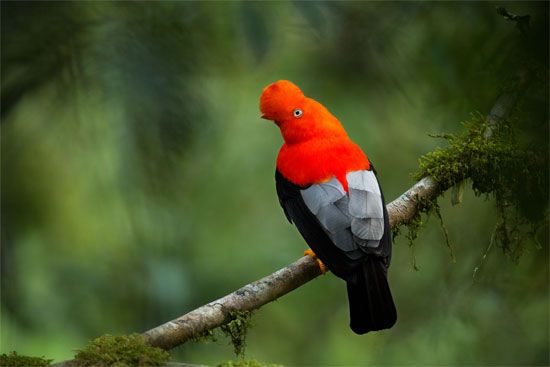
The cock-of-the-rock refers to either of two species of brilliantly colored birds native to tropical South America, typically classified within the family Cotingidae.12
These birds are most notable for the males’ distinctive, flattened circular crests that extend over their bills. They are well-known for their unique breeding behavior: males gather in communal display arenas called leks, where they perform elaborate posturing and stylized movements to attract females. Following mating, the plain-brown females nest independently, constructing their homes out of plant materials and mud against rock walls, often in caves—a nesting habit that gives the birds their name.123
The two primary species include:
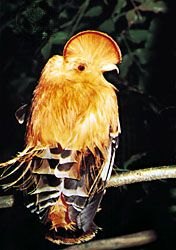
- Guianan cock-of-the-rock (Rupicola rupicola): An orange bird approximately 30 centimeters (12 inches) long.12
- Andean cock-of-the-rock (R. peruviana): A related species found in Andean forests.2
What is a lek and how does it function?
A lek is a communal area where two or more males of a species gather to perform courtship displays to attract females. This behavior, also known as arena behavior, is observed in various insects, birds, and mammals.4
How a Lek Functions
- Display and Signaling: Males congregate in a specific, often traditional, location to perform elaborate, ritualized displays. These signals may be visual or auditory and are designed to advertise the male’s readiness to mate.456
- Interaction: The level of interaction between males at a lek varies significantly, ranging from minimal contact to closely coordinated, cooperative dancing.4
- Female Selection: Females visit these arenas briefly to evaluate the males and select a mate. Once copulation occurs, the female leaves.45
- Lack of Pair Bonds: Lekking is characterized by the absence of lasting pair bonds. Males do not participate in parental care, and the relationship between the mating pair typically lasts only a few seconds.56
- Evolutionary Context: This system allows for the development of highly specialized and exaggerated displays in both movement and appearance, as males compete for the attention of visiting females.5
Why do male and female birds often look so different?
The differences in appearance between male and female birds, known as sexual dimorphism, are primarily driven by sexual selection. This evolutionary process favors traits that provide a reproductive advantage, either through competition between males or through female mate choice.89
Why Males Are Often More Colorful
In many species, males display bright plumage to increase their “sex appeal.” These striking colors serve as signals to females that the male is healthy and genetically robust. While such vibrancy can make a male more visible to predators—a disadvantage under natural selection—a male that survives despite this handicap demonstrates his fitness as a mate.8
The Role of Females
Conversely, females are often cryptically colored. This duller appearance provides essential camouflage, allowing them to remain concealed while nesting and protecting their eggs from predators. Because females are typically the ones responsible for the greater share of incubation and care, their survival is critical to the reproductive success of the species.910
Exceptions to the Rule
These roles are not universal. In species where sex roles are reversed, such as the phalarope, the female is the more brightly colored individual, as she is the one who courts males and defends territory, while the male handles incubation.86
What are some other examples of birds that perform elaborate courtship dances?
Many bird species engage in elaborate courtship rituals to attract mates, ranging from communal lek displays to intricate pair-bonding ceremonies. Beyond the well-known grouse, here are several notable examples:
- Cranes: These birds are famous for their “dances,” which involve leaping into the air, bowing, and tossing objects like sticks or grass. These displays help initiate and maintain the strong, lifelong pair bonds characteristic of the species.11
- Grebes: Known for complex ceremonies, grebes perform ritualized behaviors such as head shaking, diving, and “rushing” displays across the water. In some species, such as the western grebe, these displays are highly synchronized between partners.12
- Birds of Paradise: These birds are renowned for their incredibly bizarre and elaborate communal dances, which serve as a primary method for males to attract females.13
- Manakins: These tiny birds clear specific forest arenas to perform their courtship displays. Some of these display grounds have been used continuously for over 30 years.13
- Pelecaniforms: Many species, such as boobies and cormorants, perform specific advertising displays like “sky-pointing” or “wing-waving” to attract females to a chosen nest site.14
- Cock of the Rock: These birds are well-known for their dramatic dancing displays performed on the jungle floor.13
Sources
- Cock-of-the-rock — Encyclopædia Britannica
- cock of the rock — Merriam-Webster
- Passeriform - Territoriality and courtship — Encyclopædia Britannica
- Lek — Encyclopædia Britannica
- Reproductive behaviour - Courtship — Encyclopædia Britannica
- Reproductive behaviour - Birds — Encyclopædia Britannica
- lechwe — Encyclopædia Britannica
- Why are male animals more colorful? — Encyclopædia Britannica
- Sexual dimorphism — Encyclopædia Britannica
- coloration - Reproductive signals — Encyclopædia Britannica
- Galliform - Courtship and mating — Encyclopædia Britannica
- Gruiform - Courtship — Encyclopædia Britannica
- grebe — Encyclopædia Britannica
- Grouse — Encyclopædia Britannica
- pelecaniform - Courtship behaviour — Encyclopædia Britannica
Published on · 3 min read