Cladoselache
Cladoselache is a genus of extinct sharks that lived during the Upper Devonian period, approximately 385 to 359 million years ago. Known from fossils found…
What is Cladoselache?
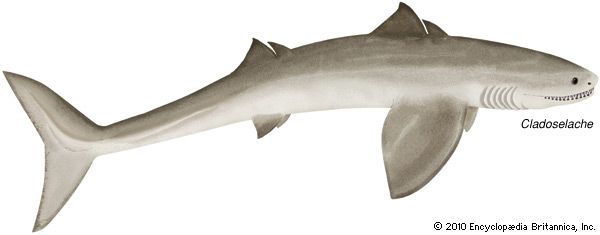
Cladoselache is a genus of extinct sharks that lived during the Upper Devonian period, approximately 385 to 359 million years ago. Known from fossils found in North America and Europe, it is considered one of the most primitive sharklike fishes.12
Unlike modern sharks, Cladoselache featured a mouth at the front of its skull rather than underneath it, and its pectoral and pelvic fins were broadly attached to its body. These characteristics suggest that while it may have been less maneuverable than later species, it was a high-speed predator. The animal possessed two dorsal fins along its midline, with strong spines located behind the head and at the base of the pectoral fins. Taxonomically, it serves as the type genus for the family Cladoselachidae and is associated with the subclass Pleuropterygii.123
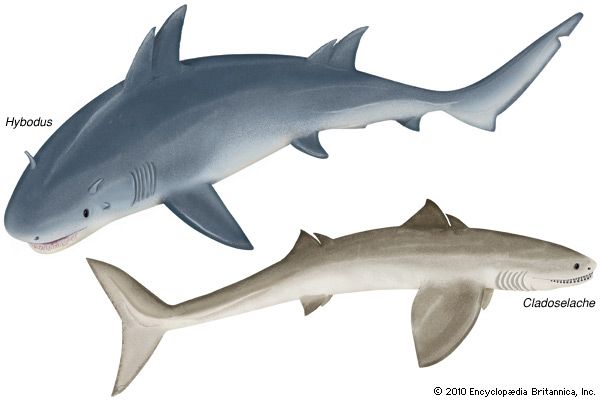
What are the main differences between ancient and modern sharks?
The evolution of sharks has resulted in significant morphological refinements, though many fundamental adaptations have remained consistent over millions of years. The primary differences between ancient and modern sharks involve their jaw structure, fin attachment, and overall maneuverability.1
Key Evolutionary Differences
- Jaw Structure: Ancient sharks, such as the Devonian-era Cladoselache, possessed a primitive jaw with double articulation that extended to the front of the skull. In contrast, modern sharks (order Selachii) evolved a hyostylic jaw, which articulates using the hyoid bone. This adaptation allows for greater jaw mobility, significantly enhancing their predatory efficiency.452
- Fin Attachment and Maneuverability: Early forms like Cladoselache had pectoral and pelvic fins that were broadly attached to the body, which likely limited their maneuverability compared to modern species. Modern sharks have evolved more efficient fin structures that allow for the powerful, streamlined swimming characteristic of today’s open-ocean predators.412
- Reproductive Mechanisms: Many ancient sharks lacked the specialized copulatory organs known as claspers, which are derived from pelvic fins and are used by modern sharks for internal fertilization.15
- Diversity and Radiation: While ancient sharks were prominent during the Carboniferous Period, the primary diversification of modern sharks, skates, and rays occurred much later, during the Jurassic and Cretaceous periods.12
Despite these changes, many traits—such as electroreception, chemoreception, and basic tooth morphology—have remained key to the survival of the lineage since their early origins.1
What was the Devonian Period like for marine life?
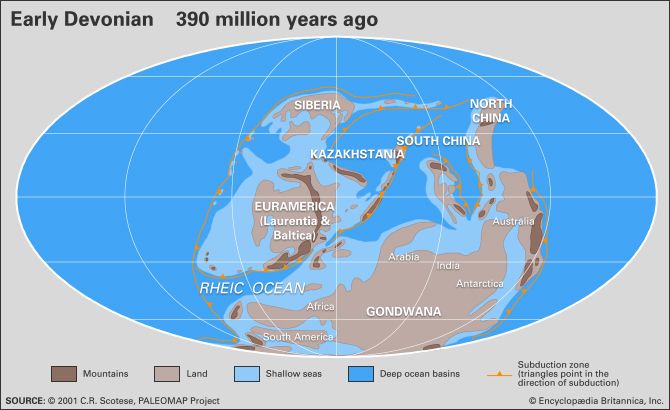
The Devonian Period (419.2 to 359 million years ago) is famously known as the “Age of Fishes” due to the remarkable diversification and abundance of primitive fishes in both marine and freshwater environments. During this time, an ocean covered approximately 85 percent of the globe, providing vast habitats for a wide array of life.89
Marine Invertebrates
The seas were populated by a diverse range of invertebrates, many of which continued from the Silurian Period. Shallow shelf environments featured abundant brachiopods, bivalves, and corals, while offshore areas hosted thriving reefs built by corals and stromatoporoids. Trilobites remained prominent, though they faced significant declines by the end of the period. Additionally, the Devonian saw the emergence of ammonites, which became important for tracking geological time.810
Environmental Stress and Extinction
Despite this diversity, marine life faced repeated crises. Episodes of low oxygen (anoxia) in the oceans, potentially linked to global climate shifts or nutrient influx from land plants, triggered major extinction events, such as the Taghanic, Kellwasser, and Hangenberg events. These episodes caused the loss of 70 to 80 percent of all animal species, particularly affecting marine groups like corals, brachiopods, and goniatites.911
How do scientists study fossils of cartilaginous fish?
Scientists study the fossil record of cartilaginous fish primarily by analyzing their teeth, which are highly diagnostic of specific species and often the most well-preserved remains of these animals. Because cartilaginous skeletons do not fossilize as readily as bony structures, researchers rely on these durable dental remains to reconstruct evolutionary lineages and identify different taxa.712
In addition to tooth analysis, paleontologists examine other preserved elements such as scales and, in rare instances, skeletal impressions or fossilized cartilaginous tissue. By comparing the morphology of these fossils—such as the shape of cusps, the structure of the tooth base, and the presence of specific features like claspers—scientists can trace the evolutionary history of Chondrichthyes from their origins in the Devonian Period to the diversification of modern sharks, skates, and rays. Researchers also employ comparative studies to investigate phenomena like convergent evolution, where similar tooth structures in different lineages may arise independently.12713
Sources
- Cladoselache — Encyclopædia Britannica
- Cladoselache — Merriam-Webster
- Cladoselachii — Merriam-Webster
- shark - Description and habits — Encyclopædia Britannica
- spiny shark — Encyclopædia Britannica
- fish - Chondrichthyes : sharks and rays — Encyclopædia Britannica
- chondrichthyan - Evolution — Encyclopædia Britannica
- A Journey Through Time Since the Precambrian - Devonian Period: 419.2 million to about 359 million years ago — Encyclopædia Britannica
- Devonian Period - Extinction events — Encyclopædia Britannica
- Devonian Period - Invertebrates — Encyclopædia Britannica
- Devonian Period - Devonian life — Encyclopædia Britannica
- Vertebrate - Evolution and paleontology — Encyclopædia Britannica
- megalodon - Paleontology — Encyclopædia Britannica
Published on · 3 min read