Clemmys
Clemmys is a genus of small, terrestrial or semi-aquatic turtles belonging to the family Emydidae. The genus consists of four species, all of which are…
What is Clemmys?
Clemmys is a genus of small, terrestrial or semi-aquatic turtles belonging to the family Emydidae. The genus consists of four species, all of which are native to North America.1
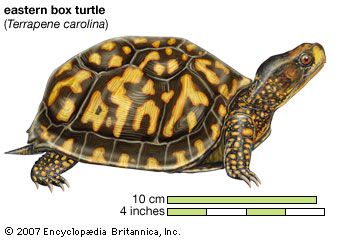
While earlier scientific classifications once grouped various European and Asian species under this name, those are now categorized within the genus Mauremys. Notable species within the Clemmys genus include:1
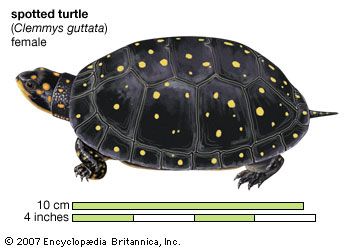
- Spotted turtle (Clemmys guttata): A small, slow-moving freshwater turtle recognized by its smooth, dark shell adorned with bright yellow or orange spots.2
- Wood turtle (Clemmys insculpta): A semi-aquatic species known for its rough, concentrically grooved shell and reddish neck and legs.3
- Bog turtle (Clemmys muhlenbergi): An officially recognized threatened species.1
These turtles generally lay fewer than a dozen eggs in early summer, which typically hatch by the autumn.1
What makes the bog turtle an endangered species?
The bog turtle (Glyptemys muhlenbergii, formerly Clemmys muhlenbergii) is a small, semi-aquatic species that faces significant threats to its survival in the wild. While the provided search results do not explicitly detail the specific legal or biological criteria for its “endangered” status, they highlight several factors that contribute to the vulnerability of such rare turtles:
- Isolation and Low Density: Unlike more common species that can reach high population densities, the bog turtle lives in extreme isolation. Each bog typically supports only a dozen or fewer adult individuals, making local populations highly susceptible to decline.4
- Habitat Specialization: Turtles are often restricted to specific, preferred habitats. Because the bog turtle relies on specialized bog environments, any loss or degradation of these wetlands directly threatens their ability to survive.4
- Vulnerability to Exploitation: Many turtle species are threatened by human activities, including the pet trade and commercial harvesting for food or medicine. Species that are found only in small geographic areas or that do not breed well in captivity are particularly at risk of extinction when targeted by these pressures.5
How do turtles adapt to living in both water and on land?
Turtles have evolved a variety of physiological and behavioral adaptations that allow them to thrive in both aquatic and terrestrial environments. These adaptations span their anatomy, locomotion, and sensory capabilities.
Physical and Respiratory Adaptations
The most distinct feature of a turtle is its shell, which provides defense against predators. Because the shell is rigid, turtles cannot use the standard rib-cage expansion seen in other reptiles to breathe. Instead, they have developed specialized muscles that change the volume of the body cavity to inflate their lungs. In aquatic species, the pressure of the water against their limbs can assist in the expiration process.7
Locomotion
Turtles adapt their movement based on their environment:
- Aquatic Turtles: Many freshwater species have webbed feet and use their limbs in an alternating sequence to swim. In contrast, sea turtles have evolved forelimbs into bladelike flippers, which they move in a figure-eight pattern to provide lift and thrust, similar to the flight of birds.58
- Bottom-Walkers: Some aquatic turtles, such as snapping turtles, are poor swimmers and primarily walk along the bottom of water bodies, using limb movements identical to those they use on land.5
- Terrestrial Turtles: Tortoises typically possess high, domed shells that make them difficult for predators to crush, while species like the pancake tortoise have flattened shells to hide in rocky crevices.9
Sensory and Feeding Adaptations
Turtles possess well-developed senses for both land and water. Their eyes are capable of adjusting for both aerial and aquatic vision. For feeding, turtles lack teeth, relying instead on sharp keratinous sheaths to cut vegetation or prey. Some aquatic species, such as the matamata, utilize a specialized gape-and-suck mechanism to pull prey into their mouths using water pressure.9
What are the main differences between the Emydidae family and other turtle families?
The family Emydidae represents a significant portion of turtle diversity, comprising more than 25 genera and 85 living species—roughly one-third of all living turtle species. While they share the order Testudines with all other turtles, they are distinguished by specific taxonomic and physical characteristics.12
Taxonomic Classification
Emydids belong to the suborder Cryptodira, which consists of “vertical-necked” turtles that retract their heads into their shells by bending their necks in an S-shape. This contrasts with the suborder Pleurodira, which includes side-necked and snake-necked turtles that fold their necks horizontally. Within the superfamily Testudinoidea, Emydidae is closely related to families like Testudinidae (true tortoises) and Geoemydidae (Asian river and box turtles).1314
Physical and Ecological Differences
- Shell Morphology: Most emydids are aquatic reptiles characterized by streamlined shells. This differs from the high, domed shells typical of terrestrial tortoises or the specialized, leathery shells of softshell turtles.121314
- Habitat: While most emydids are aquatic or semiaquatic—such as the painted turtle and pond turtle—the family also includes terrestrial forms like the North American box turtle.1214
- Distribution: Emydids are native to both the Old and New Worlds, primarily concentrated in the Northern Hemisphere, specifically Europe and the Americas.1213
Sources
- Clemmys — Encyclopædia Britannica
- spotted turtle — Encyclopædia Britannica
- wood turtle — Encyclopædia Britannica
- bog turtle — Merriam-Webster
- turtle - Habitats — Encyclopædia Britannica
- turtle — Encyclopædia Britannica
- turtle - Form and function — Encyclopædia Britannica
- Respiratory system - Reptiles — Encyclopædia Britannica
- Locomotion - Tetrapodal vertebrates — Encyclopædia Britannica
- Why are reptiles cold-blooded? — Encyclopædia Britannica
- reptile - Swimming — Encyclopædia Britannica
- Emydidae — Encyclopædia Britannica
- turtle - Classification — Encyclopædia Britannica
- list of turtles — Encyclopædia Britannica
Published on · 4 min read