Emydidae
Emydidae is a family of hard-shelled turtles native to the Northern Hemisphere, spanning both the Old and New Worlds. This family is highly diverse…
What is Emydidae?
Emydidae is a family of hard-shelled turtles native to the Northern Hemisphere, spanning both the Old and New Worlds. This family is highly diverse, comprising more than 25 genera and 85 living species, which accounts for roughly one-third of all known turtle species.1
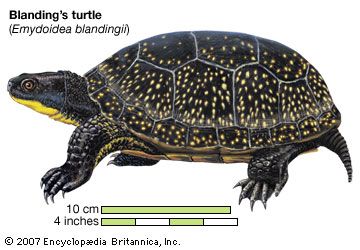
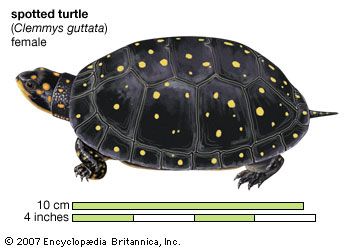
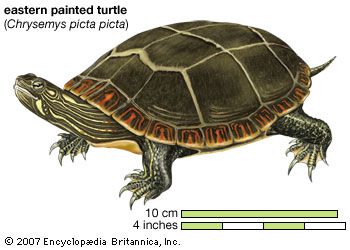
Most members of this family are aquatic reptiles characterized by streamlined shells, though some forms, such as the North and Central American box turtles, are terrestrial. Well-known species within the family include the painted turtle, spotted turtle, Blanding’s turtle, chicken turtle, pond turtle, and the diamondback terrapin.12
Taxonomically, Emydidae is classified within the superfamily Testudinoidea. While it is a distinct family, some authorities have historically categorized it as a subfamily (Emydinae) of Testudinidae, the family primarily reserved for land tortoises.213
How do box turtles differ from other members of the Emydidae family?
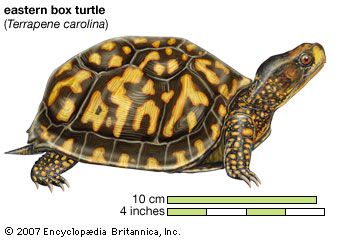
While most members of the Emydidae family are aquatic reptiles with streamlined shells, North American box turtles (Terrapene) are distinct because they are primarily terrestrial.15
The defining physical difference of the box turtle is its specialized shell structure, which allows for unique defensive behavior. Unlike the bony bridge found in most other turtles, box turtles possess a plastron (bottom shell) connected to the carapace (upper shell) by ligaments5. This, combined with a transverse hinge on the plastron, enables the turtle to draw its head and limbs completely inside and close the shell tightly, effectively sealing itself like a box. This high, domed shell and the ability to close it securely make them difficult for predators to consume.5
While other emydids are adapted for life in the water, the Terrapene genus has evolved to thrive in temperate terrestrial environments, with the notable exception of the semiaquatic Coahuilan box turtle.15
What are the main physical differences between turtles and tortoises?
While all tortoises are technically turtles—as both belong to the order Testudines—they possess distinct anatomical and behavioral traits that set them apart from other turtles.6
Key Differences
- Habitat: Tortoises are exclusively land-dwelling creatures, whereas other turtles are often aquatic or semiaquatic, spending significant time in water.6
- Limb Anatomy: Tortoises are characterized by elephantine, columnar hind limbs and non-webbed feet. In contrast, many aquatic turtles have flipperlike limbs or webbed feet adapted for swimming.6
- Diet: Tortoises are generally vegetarians, while most other turtles are omnivorous.6
- Shell Shape: Most tortoises have high, domed shells, which serve as a defense mechanism against predators. While some land-dwelling turtles (like box turtles) also have domed shells, aquatic turtles typically possess more streamlined shells to facilitate movement through water.7
It is important to note that these distinctions apply to the family Testudinidae. Other land-dwelling species, such as box turtles, are not classified as true tortoises despite their terrestrial nature.6
How do aquatic turtles adapt to living in freshwater environments?
Aquatic turtles have evolved a variety of physiological and behavioral adaptations to thrive in freshwater environments. These adaptations primarily focus on locomotion, feeding, and sensory perception.
Locomotion and Morphology
Many freshwater turtles are adapted for swimming through the development of elongated, strongly webbed feet, which provide propulsion. While some species are proficient swimmers, others—such as snapping turtles, mud turtles, and musk turtles—are primarily bottom-walkers. These bottom-dwelling species often possess less streamlined, ridged carapaces that may assist in camouflage within their habitat.78
Feeding Mechanisms
Freshwater turtles utilize specialized feeding strategies to capture prey. Some species, such as the matamata, employ a gape-and-suck mechanism; by rapidly enlarging their mouth and throat cavity, they create a vacuum that draws in both water and prey. Because turtles lack teeth, they use sharp, keratinous sheaths on their jaws to cut vegetation or crush mollusks.8
Sensory and Respiratory Adaptations
Aquatic turtles possess eyes capable of adjusting quickly for both aerial and aquatic vision. Their ears are also specialized for receiving low-frequency sounds, which are effectively transmitted through water. Furthermore, while they rely on lungs for respiration, aquatic turtles can hold their breath for extended periods during dives, and the pressure of water on their limbs can assist in the expiration process.8910
Sources
- Emydidae — Encyclopædia Britannica
- Emydidae — Merriam-Webster
- turtle - Classification — Encyclopædia Britannica
- turtle - Habitats — Encyclopædia Britannica
- box turtle — Encyclopædia Britannica
- What’s the Difference Between a Turtle and a Tortoise? — Encyclopædia Britannica
- turtle - Form and function — Encyclopædia Britannica
- Biosphere - Salinity — Encyclopædia Britannica
- Respiratory system - Reptiles — Encyclopædia Britannica
- Locomotion - Tetrapodal vertebrates — Encyclopædia Britannica
- chondrichthyan - Salt and water balance — Encyclopædia Britannica
- sound reception - Turtles — Encyclopædia Britannica
- bivalve - Locomotion — Encyclopædia Britannica
- turtle - Feeding behaviour — Encyclopædia Britannica
Published on · 3 min read