Climatius
Climatius is a genus of extinct, primitive jawed vertebrates that lived during the Devonian period, approximately 408 to 360 million years ago. Fossils of…
What is Climatius?
Climatius is a genus of extinct, primitive jawed vertebrates that lived during the Devonian period, approximately 408 to 360 million years ago. Fossils of these creatures have been discovered in Europe and North America.1
As a representative of the acanthodians—often referred to as “spiny sharks”—Climatius is related to the true bony fishes of the class Osteichthyes. These fish were characterized by diamond-shaped scales and fins supported by strong, bony spines at their leading edges. Specifically, Climatius possessed two dorsal fins and numerous paired ventral fins, each featuring a supporting spine. They are classified within the family Diplacanthidae.12
What are the main differences between acanthodians and placoderms?
Acanthodians and placoderms were both groups of early jawed vertebrates that flourished during the Devonian period, yet they possessed distinct physical characteristics and evolutionary traits.
Key Differences
Feature
Acanthodians
Placoderms
Armor
Generally lacked head armor; covered in small, diamond-shaped scales.
Characterized by heavy, bony plates covering the head and trunk.
Size
Mostly small, typically under 75 cm (30 inches) in length.
Varied; many were small, but some, like
Dunkleosteus
, reached up to 10 meters (33 feet).
Appearance
Known as “spiny sharks” due to their prominent fin spines.
Known as “plate-skin” fishes due to their dermal armor.
Skeleton
Possessed a partially ossified internal skeleton.
Bones were dermal in origin, distinct from the internal skeletons of modern bony fish.
Jaws
Features resemble both sharks and bony fishes.
Specialized jaws with toothlike structures, often too rigid to be ancestral to modern fish.
While both groups eventually declined after the Devonian, they represent different strategies in early vertebrate evolution. Acanthodians were active swimmers that relied heavily on vision, whereas many early placoderms were bottom-dwellers that utilized their heavy armor for protection.56
How did the development of jaws change early fish evolution?
The development of jaws was a transformative milestone in vertebrate evolution, marking the transition from the primitive, jawless agnathans to the more diverse and efficient gnathostomes.9710
Prior to the emergence of jaws, early vertebrates were primarily filter feeders or scavengers that relied on sucking or nibbling actions to consume tiny organisms. The evolution of jaws—movable structures consisting of an upper maxilla and a lower mandible—fundamentally changed this dynamic by enabling biting, chewing, and the active handling of food.976
This innovation provided several evolutionary advantages:
- Dietary Expansion: Jaws allowed vertebrates to transition from passive feeding to active predation, enabling them to consume a wider variety of prey.97
- Increased Efficiency: The ability to grasp and process food more effectively likely contributed to the success of groups like placoderms, acanthodians, and early bony fishes, which eventually replaced many jawless forms.9117
- Ecological Diversification: By occupying new niches as predators, jawed vertebrates were able to adapt to diverse aquatic environments, setting the stage for the eventual rise of higher vertebrates, including amphibians.97
What was the environment like during the Devonian period?
The Devonian Period (approximately 419.2 to 359 million years ago) was a time of significant geological and biological transformation, often referred to as the “Age of Fishes.”
Geography and Climate
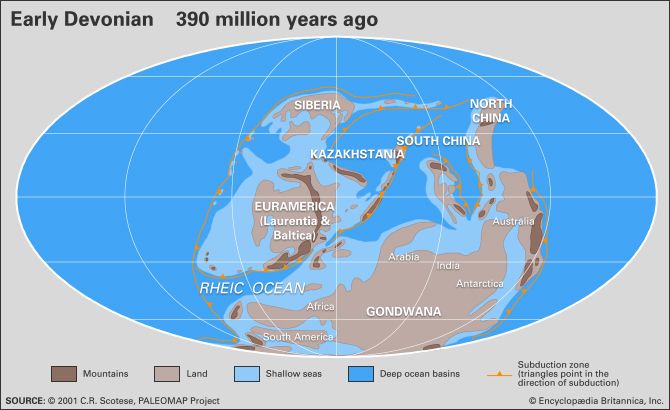
During this era, the Earth’s landmasses were largely organized into two major units: the northern supercontinent of Laurussia (or Euramerica) and the massive southern continent of Gondwana. Approximately 85 percent of the globe was covered by oceans. The climate was generally warm and equitable, with little evidence of polar ice caps. However, the period experienced frequent fluctuations in sea level, and evidence suggests that the Devonian year was longer, consisting of about 400 days.121314
Environmental Dynamics
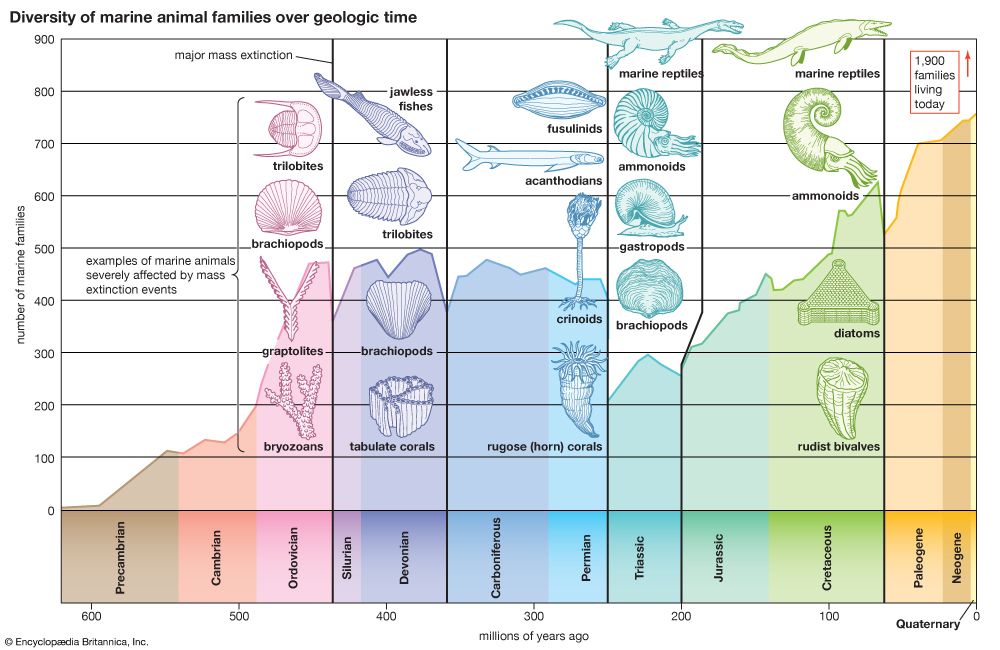
The period was marked by significant environmental stress in marine ecosystems. Episodes of reduced oxygen (anoxia) in the oceans led to widespread deposition of black shale and triggered major extinction events, such as the Kellwasser Event. These extinctions may have been driven by global cooling, volcanic activity, or nutrient influxes from the colonization of land by vascular plants.121514
Sources
- Climatius — Encyclopædia Britannica
- acanthodian — Merriam-Webster
- fish - Placodermi: plate-skin fishes — Encyclopædia Britannica
- climatius — Merriam-Webster
- placoderm — Encyclopædia Britannica
- Devonian Period - Vertebrates — Encyclopædia Britannica
- fish - Acanthodii: early jawed fishes — Encyclopædia Britannica
- Placodermi — Merriam-Webster
- fish - Agnatha: early jawless fishes — Encyclopædia Britannica
- jaw — Encyclopædia Britannica
- gnathostome — Merriam-Webster
- A Journey Through Time Since the Precambrian - Devonian Period: 419.2 million to about 359 million years ago — Encyclopædia Britannica
- Devonian Period - Extinction events — Encyclopædia Britannica
- Devonian Period - Paleoclimate — Encyclopædia Britannica
- Devonian Period - Significant geologic events — Encyclopædia Britannica
- Devonian Period - Devonian life — Encyclopædia Britannica
Published on · 3 min read