Devonian Extinctions
The Devonian Period (419.2 to 359 million years ago) was marked by a series of mass extinction events that eliminated 70 to 80 percent of all animal species.…
What are the main extinction events that occurred during the Devonian period?
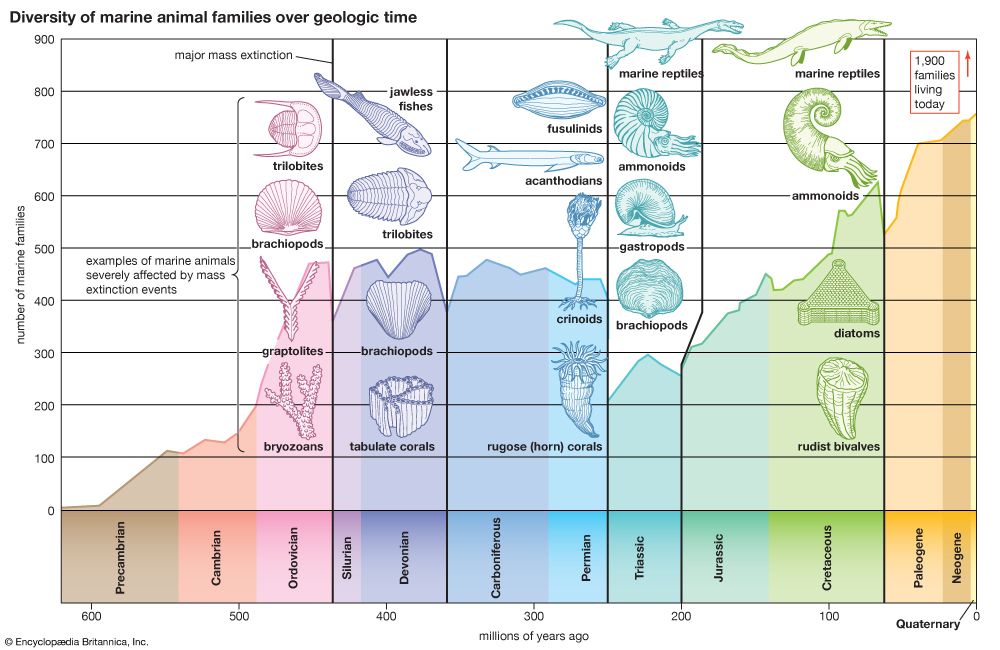
The Devonian Period (419.2 to 359 million years ago) was marked by a series of mass extinction events that eliminated 70 to 80 percent of all animal species. These events were often linked to widespread anoxic conditions in marine environments, likely caused by environmental stresses such as rapid climate change or nutrient runoff.12
Key extinction episodes include:
- Lower Zlichov Event: Occurred at the start of the Emsian Stage; it saw the extinction of graptoloids and the emergence of coiled goniatites.12
- Taghanic Event: A significant period of decline for goniatites, corals, and brachiopods.12
- Kellwasser Event: Occurring at the Frasnian-Famennian boundary, this event caused the loss of many conodont species, most colonial corals, several trilobite groups, and specific brachiopods.12
- Hangenberg Event: Occurred at the end of the Famennian Stage, resulting in the extinction of phacopid trilobites and clymeniid cephalopods.12
Scientists continue to debate whether these extinctions were driven by bolide impacts, global cooling, or greenhouse effects.12
How did the Devonian extinctions affect life on land versus in the oceans?
The Devonian extinctions were primarily characterized by their devastating impact on marine communities, which suffered the loss of 70 to 80 percent of all animal species. These events were closely tied to widespread anoxic or hypoxic conditions in the oceans, where a lack of dissolved oxygen in bottom waters led to the collapse of diverse marine groups, including corals, brachiopods, trilobites, and various conodont and goniatite species.123
In contrast, the effect on terrestrial life is less explicitly defined as a mass extinction in the provided records. While the period saw the colonization of land by plants and the emergence of the first four-legged amphibians, the primary environmental stressors—such as nutrient runoff from land—actually suggest a complex interaction between the two realms. Specifically, the increased influx of nutrients from the colonization of landmasses by rooted plants may have contributed to the marine anoxia that fueled the oceanic extinctions. While some primitive plant groups, such as the Psylotophytopsida, did not survive the Late Devonian, the period is generally noted for the diversification and establishment of diverse vascular flora rather than a widespread terrestrial die-off.3124
What was the Devonian period, and when did it occur in Earth’s history?
The Devonian Period was a significant interval in Earth’s history that occurred from approximately 419.2 million to 359 million years ago. Often referred to as the “Age of Fishes,” the period was defined by the remarkable diversification and abundance of primitive fishes in both marine and freshwater environments.36
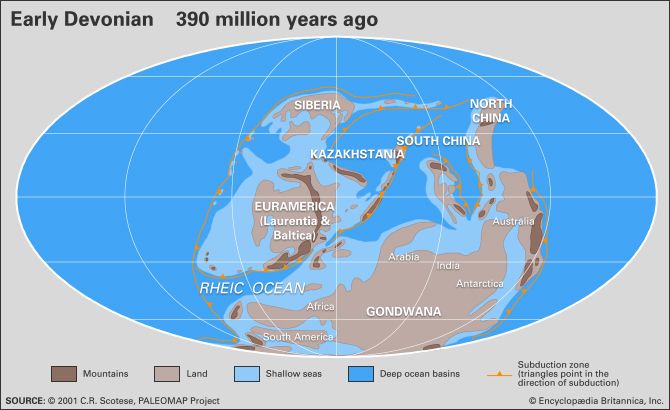
During this time, the world’s geography was dominated by the supercontinent Laurussia (or Euramerica), while oceans covered roughly 85 percent of the globe. The climate was generally warm and equitable, with little evidence of polar ice caps.3
Key biological milestones of the Devonian include:
- Marine Life: The seas were home to diverse invertebrates, including the first ammonites, though the period also saw massive marine extinctions due to fluctuating oxygen levels.36
- Terrestrial Colonization: The period witnessed the rise of vascular plants and the emergence of the first forests. By the late Devonian, the first four-legged amphibians appeared, marking the successful transition of vertebrates onto land.36
What were the primary causes of the Devonian extinctions?
It is not possible to definitively attribute the Devonian extinctions to a single cause. Scientists believe these events likely resulted from a combination of several environmental stresses occurring over millions of years.21
Primary factors under investigation include:
- Marine Anoxia: Widespread hypoxic or anoxic conditions in the oceans, evidenced by layers of black shale, are strongly linked to these extinctions. High global temperatures may have slowed ocean mixing, preventing the reoxygenation of bottom waters and suffocating marine life.21
- Nutrient Runoff: The colonization of land by rooted plants may have increased the influx of nutrients into continental seas, potentially triggering algal blooms that further depleted oxygen levels.21
- Climatic Shifts: Evidence suggests that rapid global warming or abrupt cooling—the latter associated with the development of glaciers and falling sea levels—contributed to faunal turnover.21
- Bolide Impacts: While some researchers have linked extinction pulses to meteorite or comet impacts, such as the Siljan structure in Sweden, the connection between these impacts and specific extinction events remains a subject of debate.21
Sources
- Devonian Period - Extinction events — Encyclopædia Britannica
- Devonian extinctions — Encyclopædia Britannica
- A Journey Through Time Since the Precambrian - Devonian Period: 419.2 million to about 359 million years ago — Encyclopædia Britannica
- Devonian Period - Plants — Encyclopædia Britannica
- Ordovician Period - Earliest land plants — Encyclopædia Britannica
- Devonian Period - Devonian life — Encyclopædia Britannica
- Devonian Period - Significant geologic events — Encyclopædia Britannica
Published on · 3 min read