Rhipidistia
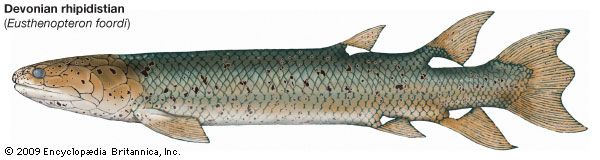
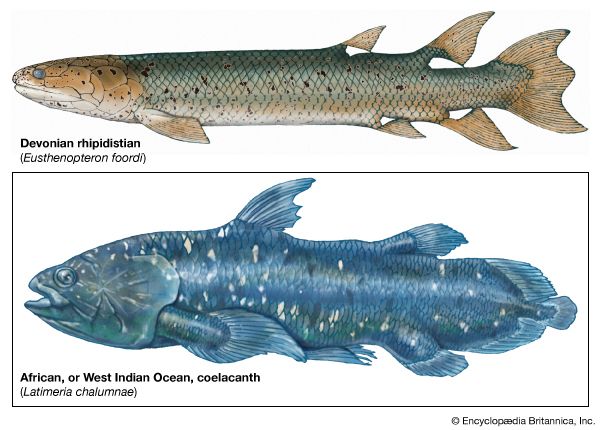
Rhipidistia is an extinct group of lobe-finned fishes belonging to the order Crossopterygii. These fish were prevalent during the Devonian Period and…
What is Rhipidistia?
Rhipidistia is an extinct group of lobe-finned fishes belonging to the order Crossopterygii. These fish were prevalent during the Devonian Period and persisted until their extinction in the Early Permian.1
Rhipidistians are scientifically significant because they are considered the ancestors of amphibians and all other terrestrial vertebrates. This evolutionary link is supported by specific anatomical features, such as:
- Skull structure: Patterns of skull bones that resemble those of early land-living vertebrates.1
- Dental anatomy: The presence of infolded, or labyrinthodont, tooth enamel.1
- Fin morphology: Elements within their paired fins that correspond to the limb bones of tetrapods.1
Genera such as Osteolepis serve as key examples of these close evolutionary relationships. Unlike many other fish, these creatures possessed characteristics that bridged the gap between aquatic and land-dwelling life forms.12
How did lobe-finned fish evolve into land-dwelling tetrapods?
The transition from lobe-finned fishes (Sarcopterygii) to land-dwelling tetrapods is one of the most significant events in vertebrate evolution, occurring during the Devonian Period roughly 397 million years ago.45
Evolutionary Adaptations
The shift from aquatic to terrestrial life involved profound anatomical and physiological changes:
- Limb Development: The paired fins of sarcopterygian fishes contained internal skeletal elements homologous to the bones found in tetrapod limbs. These fins initially served as supportive struts in shallow or seasonal waters, eventually evolving into limbs capable of weight-bearing and propulsion on land.678
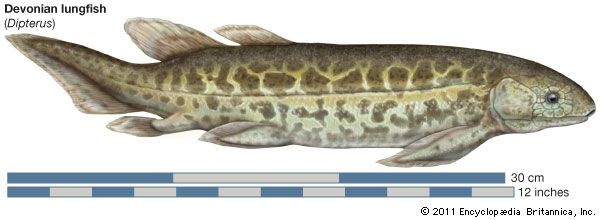
- Respiratory Systems: Many lobe-finned fishes, such as lungfish, possessed both gills for aquatic respiration and lungs for air-breathing. This dual system allowed them to survive in oxygen-poor or temporary water environments, a prerequisite for the eventual move to land.68
- Skeletal Changes: As vertebrates moved onto land, the axial musculature—which provided primary propulsion in fish—became less critical than the appendicular musculature of the limbs. The pelvic girdle, which was not attached to the vertebral column in fish, became fused to the spine via the sacrum in land vertebrates to better support body weight.87
- Sensory and Cranial Anatomy: Early tetrapods developed features like the stapes (ear bone) and an oval window in the skull, which were essential for hearing in a terrestrial environment.4
While the exact ancestral group remains a subject of scientific study, creatures like Ventastega curonica exhibit a mix of fish-like and tetrapod-like traits, marking a critical point in this evolutionary transition.4
What are the main differences between lobe-finned and ray-finned fish?
Lobe-finned and ray-finned fishes are the two primary groups that make up the superclass of bony fish (Osteichthyes). While both groups share a skeleton composed primarily of true bone, they differ significantly in their anatomy and evolutionary history.
Key Differences
- Fin Structure: The most distinct difference lies in their fins. Lobe-finned fishes (Sarcopterygii) possess fleshy, lobed fins supported by an internal skeletal structure of bone and muscle that is homologous to the limbs of land vertebrates. In contrast, ray-finned fishes (Actinopterygii) have fins supported by thin, bony rays radiating from the body, lacking the complex internal bony structure found in lobe-finned species.21112
- Evolutionary Significance: Lobe-finned fishes are of particular scientific interest because they are the ancestors of tetrapods—all land-dwelling vertebrates, including amphibians, reptiles, birds, and mammals. Ray-finned fishes represent a different evolutionary path and comprise the vast majority of all living fish species.5711
- Respiration: Unlike many ray-finned fishes that rely exclusively on gills, some lobe-finned fishes, such as lungfish, possess lungs that allow them to breathe air, an adaptation that helped them survive in shallow or seasonal water environments.21113
While lobe-finned fishes were once a diverse group, they have been largely replaced by the more numerous and diverse ray-finned fishes in modern aquatic ecosystems.11
What is the significance of the Devonian Period for animal evolution?
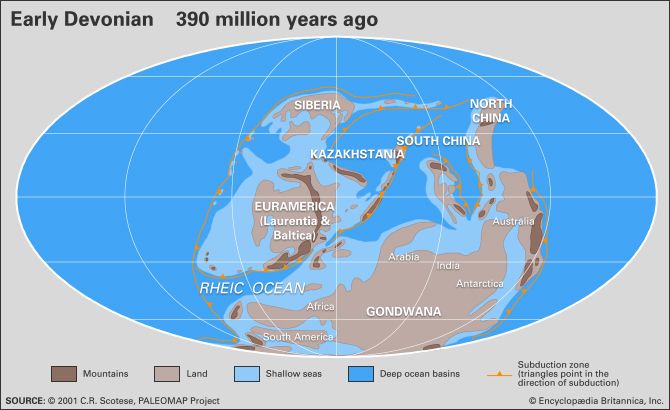
The Devonian Period (approximately 419.2 to 359 million years ago) is famously known as the “Age of Fishes” due to the remarkable diversification and abundance of fish species in both marine and freshwater environments. This era was a pivotal turning point for animal evolution, marked by several key developments:1415
- Rise of Vertebrates: The period saw the emergence of jawed fishes (gnathostomes), including heavily armored placoderms, as well as the first appearances of lungfish, coelacanths, and rhipidistians.16
- Colonization of Land: Near the middle of the period, tetrapods—the first four-legged land-dwelling vertebrates—evolved from rhipidistian fish, marking the transition of vertebrates from water to land.1516
- Extinction and Diversification: The Devonian was also defined by significant extinction events, such as the Taghanic, Kellwasser, and Hangenberg events. These episodes, often linked to low-oxygen conditions or climatic shifts, caused massive losses in marine biodiversity but were followed by periods of rapid evolutionary radiation as surviving species filled new ecological niches.171418
Sources
- Rhipidistia — Encyclopædia Britannica
- lobe-finned — Merriam-Webster
- Rhipidistia — Merriam-Webster
- lungfish - Evolution — Encyclopædia Britannica
- tetrapod — Encyclopædia Britannica
- crossopterygian — Encyclopædia Britannica
- muscle - Origins of the tetrapod limbs — Encyclopædia Britannica
- skeleton - General features — Encyclopædia Britannica
- reptile - Historical development — Encyclopædia Britannica
- Animal - Rise of vertebrates — Encyclopædia Britannica
- bony fish — Encyclopædia Britannica
- fish - Body plan — Encyclopædia Britannica
- fish - Sarcopterygii: fleshy-finned fishes — Encyclopædia Britannica
- A Journey Through Time Since the Precambrian - Devonian Period: 419.2 million to about 359 million years ago — Encyclopædia Britannica
- Devonian Period - Devonian life — Encyclopædia Britannica
- Devonian Period - Extinction events — Encyclopædia Britannica
- Devonian Period - Vertebrates — Encyclopædia Britannica
- Devonian Period - Significant geologic events — Encyclopædia Britannica
Published on · 4 min read