Cobalt Milkweed Beetle
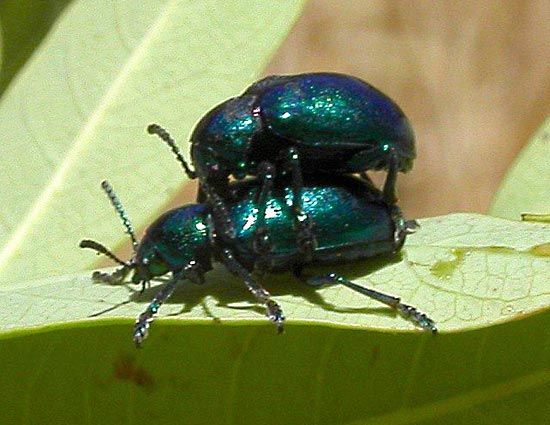
The cobalt milkweed beetle (Chrysochus cobaltinus) is a species of leaf beetle native to the far western United States.
What is cobalt milkweed beetle?
The cobalt milkweed beetle (Chrysochus cobaltinus) is a species of leaf beetle native to the far western United States.1
Characterized by its striking dark cobalt blue coloration, this insect is a member of the family Chrysomelidae and the order Coleoptera. It primarily feeds on milkweed and dogbane plants. The species is closely related to the dogbane beetle (Chrysochus auratus), though it is slightly shorter in length.1
Taxonomically, it is classified as follows:
- Kingdom: Animalia1
- Phylum: Arthropoda1
- Class: Insecta1
How does the cobalt milkweed beetle differ from the dogbane beetle?
The cobalt milkweed beetle (Chrysochus cobaltinus) and the dogbane beetle (Chrysochus auratus) are closely related members of the genus Chrysochus within the family Chrysomelidae, but they differ in several key ways:
- Geographic Range: The cobalt milkweed beetle is found throughout the far western United States, whereas the dogbane beetle is native to eastern North America.12
- Appearance: The cobalt milkweed beetle is characterized by a dark cobalt blue color. In contrast, the dogbane beetle is known for its iridescent blue-green appearance, which often features a metallic copper, golden, or crimson shine.12
- Size: The cobalt milkweed beetle is noted to be slightly shorter in length than its relative, the dogbane beetle, which typically measures between 8 and 11 mm.12
Both species share similar dietary habits, as they feed on milkweed and dogbane plants.12
Why do these beetles specifically feed on milkweed plants?
The cobalt milkweed beetle (Chrysochus cobaltinus) feeds on milkweed and dogbane plants primarily because these plants belong to the family Apocynaceae, which is characterized by the presence of toxic secondary metabolites, specifically cardenolides (cardiac glycosides) and various alkaloids.415
While these substances are highly toxic to many vertebrates—often causing vomiting or heart failure—specialized insects have evolved the ability to consume these plants without ill effects. By feeding on these plants, such insects can sequester these toxins within their own bodies, which often serves as a chemical defense mechanism against their own predators. This evolutionary adaptation allows the beetles to utilize a food source that is effectively protected from many other potential herbivores.45
What are the physical characteristics of the leaf beetle family?
The leaf beetle family (Chrysomelidae) comprises approximately 35,000 species that exhibit a diverse range of physical forms. While they vary from simple egg-shaped bodies to slender, flat, or wedge-shaped structures, they generally share several common characteristics:67
- Size and Shape: Most leaf beetles are small, typically measuring less than 12 mm (0.5 inch) in length. They are generally oval or rounded in shape.68
- Head and Antennae: These beetles possess small heads with short antennae, which are usually about half the length of their bodies. Their mouthparts are typically inconspicuous.68
- Surface and Coloration: Many species are smooth, shining, and brightly colored. Some specialized groups, such as the tortoise beetles, feature wide elytra (wing covers), while leaf-mining species may exhibit numerous spines or tubercles.87
- General Beetle Features: As members of the order Coleoptera, they possess a segmented body consisting of a head, thorax, and abdomen, and they typically have hardened front wings known as elytra that serve as protective covers.910
Sources
- cobalt milkweed beetle — Encyclopædia Britannica
- List of insects - beetles and weevils (order Coleoptera) — Encyclopædia Britannica
- dogbane beetle — Encyclopædia Britannica
- mimicry - The chemical basis for repulsion — Encyclopædia Britannica
- Gentianales - Apocynaceae — Encyclopædia Britannica
- leaf beetle — Encyclopædia Britannica
- Coleoptera - Distinguishing taxonomic features — Encyclopædia Britannica
- Coleoptera - Size range and diversity of structure — Encyclopædia Britannica
- homopteran - Head — Encyclopædia Britannica
- Coleoptera - Adult features — Encyclopædia Britannica
- shining leaf chafer — Encyclopædia Britannica
- Chrysomelidae — Merriam-Webster
- cucumber beetle — Encyclopædia Britannica
Published on · 2 min read