Corn Earworm
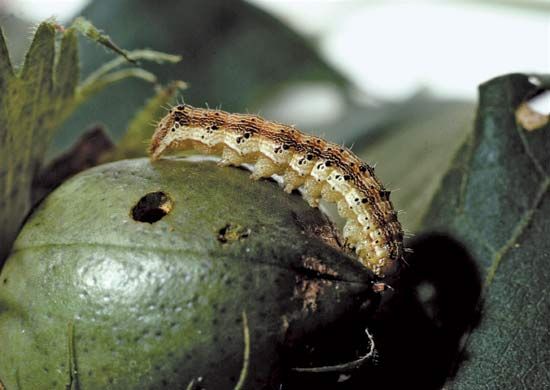
The corn earworm is the larva of the moth Helicoverpa zea (also classified as Heliothis zea), a member of the family Noctuidae.
What is Corn earworm?
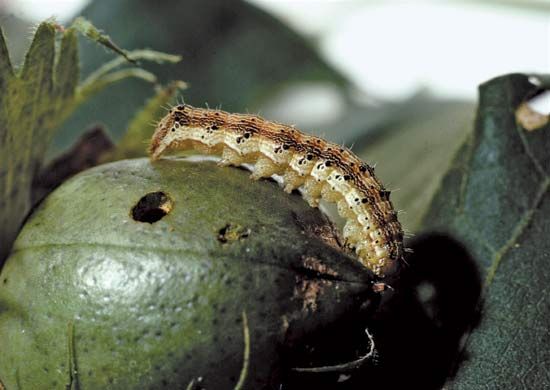
The corn earworm is the larva of the moth Helicoverpa zea (also classified as Heliothis zea), a member of the family Noctuidae.12
These smooth, fleshy caterpillars, which can appear green or brown, are recognized as serious agricultural pests. They are particularly destructive to corn (maize), where they feed on the kernels at the tips of the ears, but they also cause significant damage to other crops, including tomatoes, cotton, and tobacco.12
The adult moths are pale brown with a wingspan of approximately 3.5 cm (about 1 1/3 inches), and they typically produce four or five generations annually. Before pupating in the soil, the larvae can cause widespread economic loss, leading farmers to employ various cultural and mechanical controls to manage infestations.13
What are the different stages of the corn earworm life cycle?
The life cycle of the corn earworm (Helicoverpa zea) follows the standard developmental stages of a moth, which include the egg, larva, pupa, and adult phases.12
- Egg: Adult moths lay eggs on the host plants, such as corn, tomatoes, or cotton.12
- Larva: Upon hatching, the larvae—often referred to as corn earworms—emerge as smooth, fleshy caterpillars that can be green or brown in color. This is the primary feeding stage, during which they cause significant agricultural damage by consuming plant parts, particularly the kernels at the tips of corn ears.12
- Pupa: Once the larvae have completed their growth, they descend to the soil to pupate, transitioning into their next developmental form.1
- Adult: The final stage is the adult moth, which has a wingspan of approximately 3.5 cm (about 1 1/3 inches) and a pale brown appearance. These moths are responsible for the next generation, with four or five generations typically produced annually.1
How do farmers use crop rotation to manage pests?
Farmers use crop rotation—the practice of growing different crops in a specific sequence on the same land—as a key cultural method to manage pests, including insects, nematodes, and diseases.
By alternating crops that are unacceptable or resistant to specific pests, farmers disrupt the life cycles of organisms that would otherwise thrive in a monoculture system. This strategy renders the environment unfavorable for pests that rely on a single host plant to survive and reproduce from one season to the next.456
Effective rotation planning involves selecting sequences that balance soil health and pest suppression. For example, incorporating legumes or sod-forming crops can improve soil structure and nutrient levels, which in turn helps plants better resist or tolerate pest intrusion. While rotation is a powerful tool, it is often used alongside other practices—such as deep plowing, sanitation, and the use of resistant plant varieties—to maintain productivity and minimize reliance on chemical pesticides.34576
What are some other common insects that damage corn crops?
In addition to the corn earworm, several other insects are known to cause significant damage to corn crops:
- European corn borer (Ostrinia nubilalis): A major pest in North America, the larvae of this moth bore into the stems, crowns, and fruits of corn plants, causing structural damage and reducing yields.111
- Southwestern corn borer (Diatraea grandiosella): Another type of pyralid moth whose larvae cause serious damage by boring into corn stalks.11
- Cutworms: These are the larvae of certain owlet moths. Some species feed on corn at night, severing stems and roots near the ground level, while others live underground and feed directly on the roots.12
While these insects are primary concerns, farmers often employ integrated pest management strategies—such as the use of resistant crop varieties, biological controls, and cultural practices like crop rotation—to mitigate the damage caused by these pests.133
Sources
- Corn earworm — Encyclopædia Britannica
- corn earworm — Merriam-Webster
- Agricultural technology - Mechanical and cultural controls — Encyclopædia Britannica
- Crop rotation — Encyclopædia Britannica
- Agricultural technology - Crop rotation — Encyclopædia Britannica
- horticulture - Pest control — Encyclopædia Britannica
- Agricultural technology - Disadvantages of monoculture — Encyclopædia Britannica
- Agricultural technology - Weed control — Encyclopædia Britannica
- Agricultural technology - Control of plant diseases and nematodes — Encyclopædia Britannica
- Bollworm — Encyclopædia Britannica
- cotton - Pests and diseases — Encyclopædia Britannica
- European corn borer — Merriam-Webster
- cutworm — Encyclopædia Britannica
- Agricultural technology - Biological controls — Encyclopædia Britannica
- corn borer — Merriam-Webster
- Corn smut — Encyclopædia Britannica
Published on · 3 min read