Copper Butterfly
Copper butterflies belong to the subfamily Lycaeninae within the gossamer-winged butterfly family (Lycaenidae). While they share the family's general…
How do copper butterflies differ from other butterfly families?
Copper butterflies belong to the subfamily Lycaeninae within the gossamer-winged butterfly family (Lycaenidae). While they share the family’s general characteristics—such as being delicate, agile fliers with reduced forelegs in males—they are primarily distinguished by their specific coloration.12
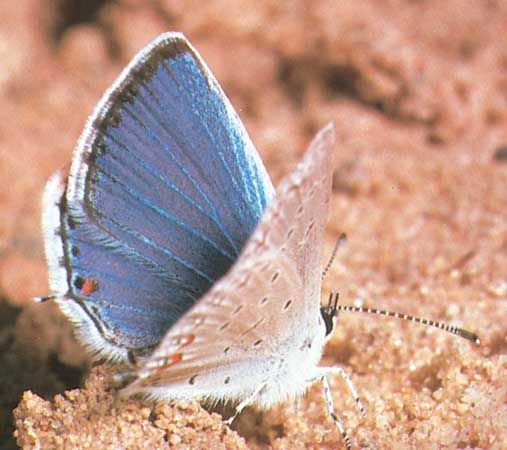
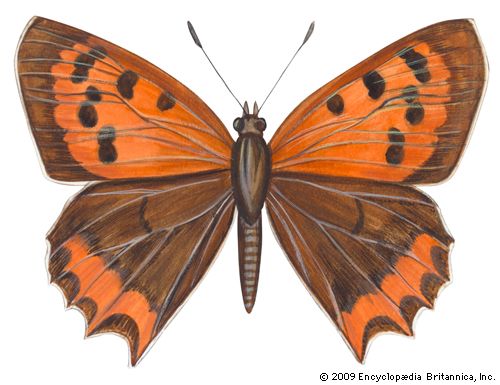
Unlike other members of the Lycaenidae family, such as the blue butterfly (subfamily Polyommatinae) which typically displays iridescent blue wings, copper butterflies are characterized by coloration ranging from orange-red to brown, often featuring a distinct copper tinge and dark markings.13
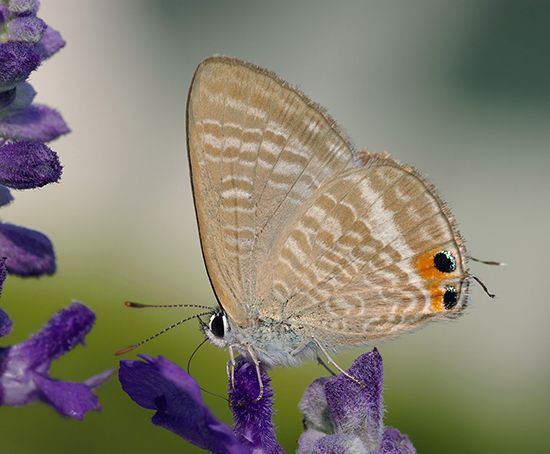
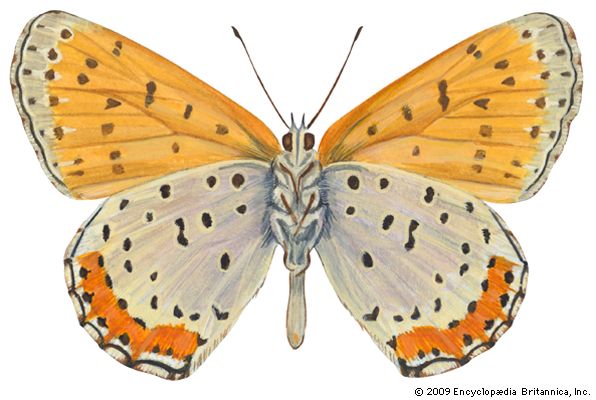
While some gossamer-winged butterflies, including certain blues and hairstreaks, have evolved complex relationships with ants—sometimes secreting honeydew or even living within ant nests—coppers are most readily identified by their unique wing hues. Additionally, specific species like the bronze copper butterfly are further distinguished from other coppers by the gray-white undersides of their hind wings, which feature an orange margin and black spots.132
How do male and female copper butterflies differ in appearance?
In the gossamer-winged butterfly family (Lycaenidae), sexual dimorphism is common, though the specific differences between male and female copper butterflies often relate to their anatomy rather than just color.
A primary anatomical distinction is found in the forelegs: in males, the forelegs are reduced, whereas in females, they are fully developed. While males of many gossamer-winged species are known for having brightly colored and iridescent upper-wing surfaces, the general coloration for both sexes of copper butterflies typically ranges from orange-red to brown, often featuring a copper tinge and dark markings.13
Regarding the bronze copper butterfly, both males and females share the same distinctive underwing pattern—gray-white hind wings with an orange margin and black spots—which helps distinguish them from other copper species.1
Which species of copper butterflies are most common, and where can they be found?
Two of the most common species of copper butterflies are the American copper and the bronze copper butterfly. Their distribution and characteristics are as follows:
- American copper (Lycaena phleas): This is the most common species found throughout North America. It is widely distributed across central and eastern regions of the continent, specifically north of the Gulf Coast. These butterflies are delicate, rapid fliers with a wingspan of approximately 18 to 38 mm (0.75 to 1.5 inches), and their larvae typically feed on plants such as clover, dock, or sorrel.15
- Bronze copper butterfly (L. hyllus): This species is found across southern Canada and throughout the majority of the United States. They are slightly larger than the American copper, with a wingspan typically ranging from 3.2 to 4.8 cm (1.3 to 1.9 inches). They are easily identified by the gray-white undersides of their hind wings, which feature an orange margin and distinct black spots.1
What are the typical feeding habits and preferred food plants of copper butterflies?
The feeding habits of copper butterflies vary significantly between their larval and adult stages, and even among different species within the gossamer-winged butterfly family.
Larval Feeding Habits
The diet of copper butterfly larvae is diverse and can be categorized as follows:
- Plant-based diets: Many species, such as the American copper, rely on specific host plants. Common food sources include clover, dock, and sorrel. More broadly, the family Lycaenidae feeds on a variety of trees, shrubs, and annual legumes.13
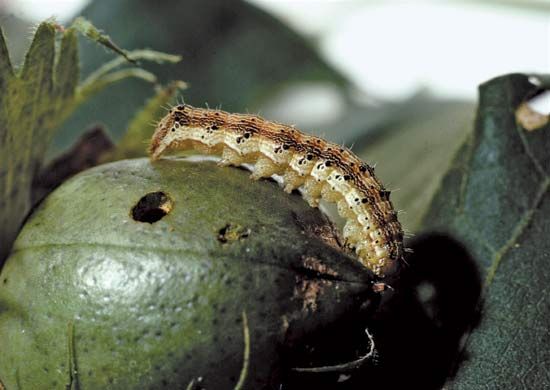
- Carnivorous diets: Interestingly, the larvae of some species are carnivorous. These larvae may require a diet consisting of aphids or even ant larvae to survive.3
- Ant associations: In some cases, larvae have developed a symbiotic relationship with ants. While the larvae may consume ant larvae, they also possess special milk glands that secrete substances consumed by adult ants, which in turn may provide protection to the butterfly larvae.3
Sources
- copper butterfly — Encyclopædia Britannica
- blue butterfly — Encyclopædia Britannica
- gossamer-winged butterfly — Encyclopædia Britannica
- homopteran - Reproduction and growth — Encyclopædia Britannica
- American copper — Merriam-Webster
Published on · 3 min read