Coconut
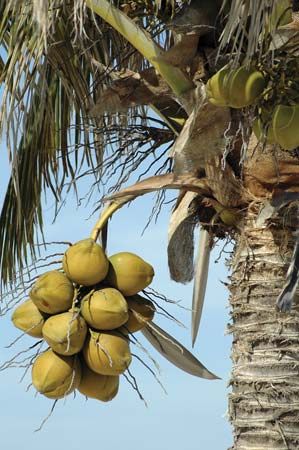
The coconut fruit consists of several distinct parts, each with significant utility:
What are the main parts of a coconut and their uses?
The coconut fruit consists of several distinct parts, each with significant utility:
- Husk: The thick, fibrous outer layer yields coir, a durable fiber resistant to salt water. It is used to manufacture ropes, mats, baskets, brushes, and brooms, and serves as a growing medium in hydroponic gardening1.12
- Shell: This hard layer protects the inner seed.32
- Meat (Endosperm): The edible kernel can be eaten fresh or dried into copra. Copra is processed to extract coconut oil, which is used in food products, soaps, detergents, and cosmetics. The meat can also be grated and mixed with water to create coconut milk, a common cooking ingredient.342
- Liquid: Found within the nut, this is known as coconut water and is consumed as a beverage.352
Beyond the fruit itself, the coconut palm provides materials for construction, thatching, and food, such as the edible young bud known as palm cabbage young bud known as palm cabbage.5
How is coconut used in different cuisines around the world?
The coconut is a foundational ingredient in cuisines across the Pacific and Southeast Asia, where it is used as a vegetable, cooking fat, flavoring, and beverage. Its versatility allows it to serve as a primary component in diverse culinary traditions:1
- Indonesia: Coconut is central to the national diet, used in everything from main courses and relishes to the popular beverage tjendol. It is a key ingredient in gado-gado, a salad of cooked and raw vegetables served with a rich sauce made of peanuts, coconut, and spices.1
- Malaysia and Sumatra: Coconut milk is frequently used in slow-cooked dishes like rendang, a beef stew that absorbs the liquid, mirroring the technique of dry curries found in India.1
- Thailand: The cuisine utilizes coconut in complex, liquid-based stews known as kaeng, which are related to Indian-style curries but feature a vast, unique repertoire of flavor combinations.1
- Pacific Islands: Coconut cream, obtained from compressed fresh meat, serves as a principal sauce and flavoring agent throughout the region.6
Beyond these regions, coconut oil is widely used in global food production, particularly in baking and confectionery, due to its high smoke point and resistance to rancidity.3
What are some common coconut-derived products and their applications?
The coconut palm provides a wide array of products, each with distinct industrial and culinary applications:
- Coir: Obtained from the fibrous husk, this durable, salt-water-resistant fiber is used to manufacture ropes, mats, baskets, brushes, and brooms. In horticulture, it serves as an environmentally friendly alternative to peat moss, helping to aerate soil and retain moisture in hydroponic systems.213
- Copra and Coconut Oil: The dried meat of the coconut, known as copra, is processed to extract coconut oil. This oil is used in the production of soaps, detergents, shampoos, glycerin, and synthetic rubber. In food production, its high smoke point and resistance to rancidity make it ideal for frying, baking, and use in margarines and shortenings.15
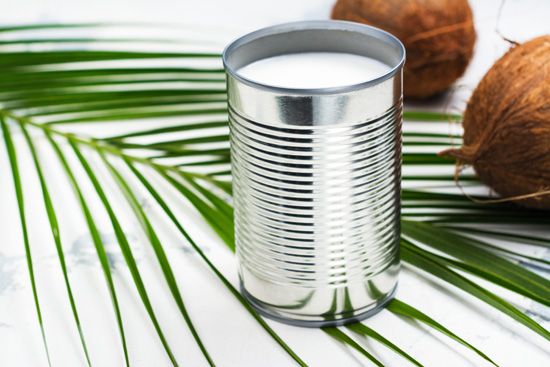
- Culinary Products: Fresh meat can be grated and mixed with water to create coconut milk, a common cooking ingredient and dairy substitute. The liquid from green nuts, coconut water, is consumed as a beverage1.13
- Other Derivatives: The sap from flower stalks is used to produce toddy, a source of sugar and alcohol. Additionally, the tree provides palm cabbage for food, while leaves and trunks are used for thatching and construction.3
How do coconuts disperse and spread to new areas?
The coconut palm disperses and spreads to new areas primarily through two methods: ocean currents and human intervention.5
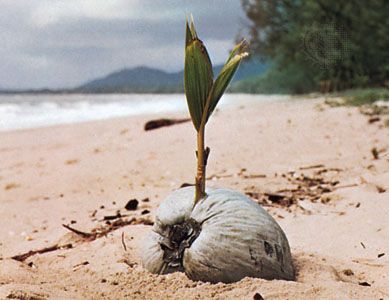
As a form of hydrochory (dispersal by water), the coconut fruit is uniquely adapted for travel across the sea. Its structure, specifically the thick, fibrous mesocarp of the drupe, provides the necessary buoyancy to float over long distances. Once a coconut washes ashore, this same fibrous mesocarp assists in the germination process by collecting rainwater, while the endosperm—the coconut’s “milk”—provides essential nourishment for the seedling to establish itself in environments that may lack abundant fresh water.910
In addition to natural water dispersal, humans have played a significant role in spreading coconut palms throughout the tropics, transporting the fruits as a vital agricultural crop.5
Sources
- Coconut — Encyclopædia Britannica
- Coir — Encyclopædia Britannica
- coconut oil — Encyclopædia Britannica
- coconut water — Merriam-Webster
- Coconut palm — Encyclopædia Britannica
- gastronomy - The Pacific and Southeast Asia — Encyclopædia Britannica
- coconut oil — Merriam-Webster
- coconut cream — Merriam-Webster
- Seed dispersal - Hydrochory: dispersal by water — Encyclopædia Britannica
- Seed - Dispersal by water — Encyclopædia Britannica
Published on · 3 min read