Coelophysis
Coelophysis was a small, carnivorous dinosaur that lived during the Late Triassic Period, approximately 228 million to 200 million years ago, in what is now…
What is Coelophysis?
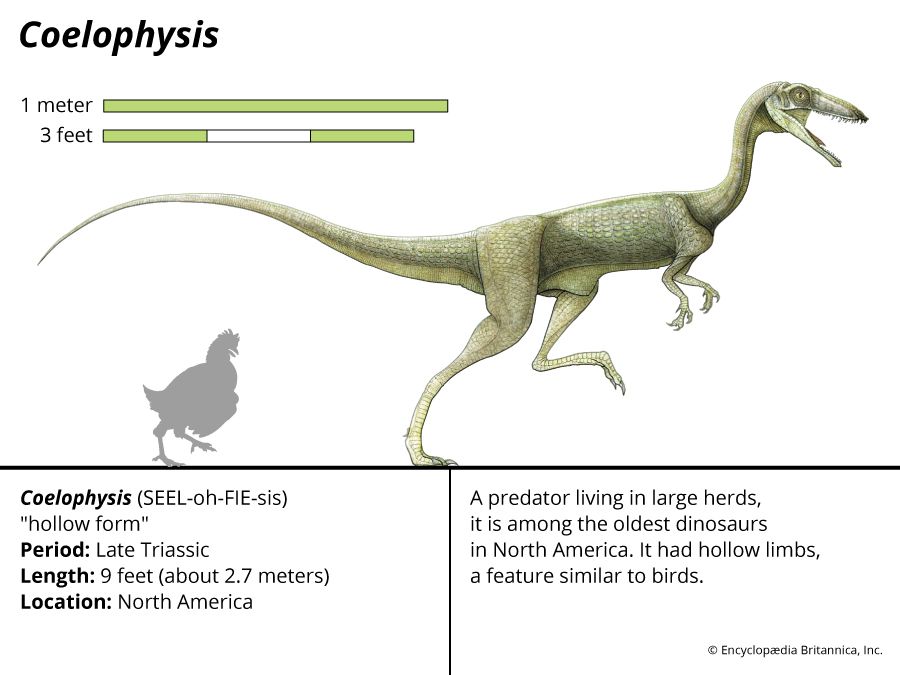
Coelophysis was a small, carnivorous dinosaur that lived during the Late Triassic Period, approximately 228 million to 200 million years ago, in what is now North America1.
As a primitive theropod, Coelophysis was an agile, lightly built predator. It typically grew to about 2 meters (6.6 feet) in length and weighed between 18 and 23 kg (40–50 pounds). Physically, it was characterized by a long, slender neck, tail, and hind legs, paired with a long, narrow head equipped with many sharp teeth. It is believed to have preyed upon small reptiles and early mammal relatives/animal/reptile) and early mammal relatives.1
This genus is significant as a representative of the basal stock from which more derived theropods evolved. Much of our knowledge about the animal comes from a massive death assemblage of hundreds of skeletons discovered at Ghost Ranch, near Abiquiu, New Mexico, which was first excavated in 1947.1
What are theropod dinosaurs?
Theropods are a diverse subgroup of saurischian (“lizard-hipped”) dinosaurs that include all known carnivorous dinosaurs as well as birds. Ranging in size from the crow-sized Microraptor to massive predators like Tyrannosaurus rex, theropods were obligate bipeds, meaning they relied on their hind legs for support and locomotion.34
Key characteristics of theropods include:
- Anatomy: They typically possessed sharp, recurved teeth, large claws on their fingers, and hollow bones in their hind legs.34
- Stance: Their feet were digitigrade (supported by the toes) and often resembled those of birds, which inherited their foot structure from this lineage.4
- Forelimbs: While hind limbs were adapted for running or weight-bearing, forelimbs were modified for grasping and tearing prey, though they varied widely in size and function across different species.34
Three major groups are generally recognized: Ceratosaurs, carnosaurs, and coelurosaurs. Theropod remains have been found on every continent, dating from the Middle Triassic to the end of the Cretaceous Period.324
Why is the Ghost Ranch site in New Mexico significant for paleontologists?
The Ghost Ranch site near Abiquiu, New Mexico, is of immense significance to paleontologists primarily because it contains a massive death assemblage of hundreds of Coelophysis skeletons.
First excavated in 1947, this site provides a unique and extensive record of these small, carnivorous theropod dinosaurs from the Late Triassic Period. Because Coelophysis represents the basal stock from which more derived theropods evolved, the abundance of well-preserved specimens at Ghost Ranch offers researchers invaluable insights into the anatomy, behavior, and evolutionary history of early predatory dinosaurs.1
How do scientists distinguish between carnosaurs and coelurosaurs?
Scientists distinguish between carnosaurs and coelurosaurs primarily through their evolutionary relationships and specific anatomical features rather than just their physical size.52
Evolutionary Definitions
- Carnosaurs (Carnosauria): This group includes Allosaurus and all theropod dinosaurs more closely related to it than to birds.52
- Coelurosaurs (Coelurosauria): This group is defined as birds and all theropods more closely related to birds than to carnosaurs.52
Key Anatomical Distinctions
While historical classifications often grouped large predators as carnosaurs, modern paleontology uses distinct skeletal traits to separate the two:2
- Pelvic Structure: In coelurosaurs, the pelvis is modified such that the ischium is reduced to two-thirds or less the size of the pubis.2
- Skull and Teeth: Carnosaurs typically possess high skulls with dagger-shaped, laterally compressed, and serrated teeth. In contrast, groups like tyrannosaurs—now classified as giant coelurosaurs—are distinguished by exceptionally large, high skulls and teeth with more rounded cross-sections.52
- Other Features: Coelurosaurs often exhibit larger eyes and have no more than 15 tail vertebrae with transverse projections.2
Because phylogenetic analyses continue to evolve as new fossils are discovered, the classification of these groups remains a subject of ongoing scientific reappraisal.26
Sources
- Coelophysis — Encyclopædia Britannica
- dinosaur - Tetanurae — Encyclopædia Britannica
- theropod — Encyclopædia Britannica
- dinosaur - Theropoda — Encyclopædia Britannica
- carnosaur — Encyclopædia Britannica
- dinosaur - Classification — Encyclopædia Britannica
Published on · 3 min read