Colorado Potato Beetle
To control infestations of the Colorado potato beetle, several methods have been developed, ranging from historical chemical applications to modern…
What methods are used to control Colorado potato beetle infestations?
To control infestations of the Colorado potato beetle, several methods have been developed, ranging from historical chemical applications to modern biological and genetic strategies.
- Chemical Insecticides: Historically, massive outbreaks in the 1860s prompted the first large-scale agricultural use of toxic chemicals like Paris green and lead arsenate. Later, synthetic compounds such as DDT were widely used, though these often caused ecological imbalances and led to the development of resistant pest strains.1
- Biological Control: This approach focuses on using natural enemies or biological agents to manage populations. It includes introducing specific predators or parasites from the pest’s native range and utilizing insect diseases.12
- Bacillus thuringiensis (Bt): Specific strains of the bacterium Bacillus thuringiensis (such as tenebrionis and san diego) are effective against leaf beetles like the Colorado potato beetle. Bt can be applied as a spray or introduced into crops through genetic engineering to allow plants to produce the toxin internally. Unlike broad-spectrum chemicals, Bt is generally considered more environmentally benign and target-specific.3
How did the Colorado potato beetle spread from its native habitat to other parts of the world?
The Colorado potato beetle is native to western North America, where it originally fed on the buffalo bur, a wild plant in the potato family found in the Rocky Mountain region1.
The beetle’s expansion began when cultivated potatoes were introduced into its native range. The insect adapted to this new, abundant food source, which allowed it to escape the natural controlling factors of its original semidesert habitat. As potato cultivation expanded, the beetle followed, spreading rapidly across regions where the crop was grown. By the 1850s, it had become a major agricultural pest, and by 1874, it had established itself as a significant threat wherever potatoes were cultivated in the United States. This rapid spread was facilitated by the creation of large-scale agricultural monocultures, which provided the beetles with virtually unlimited food resources while removing many of the environmental checks that previously limited their population growth.135
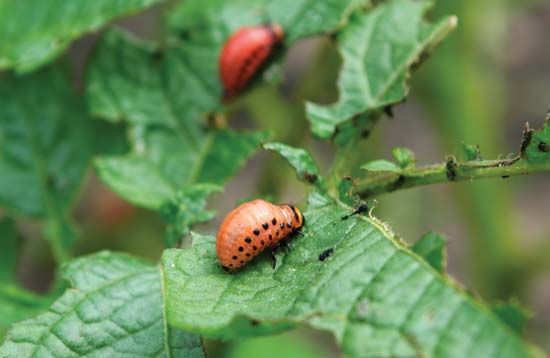
What is the Colorado potato beetle and where does it originate from?
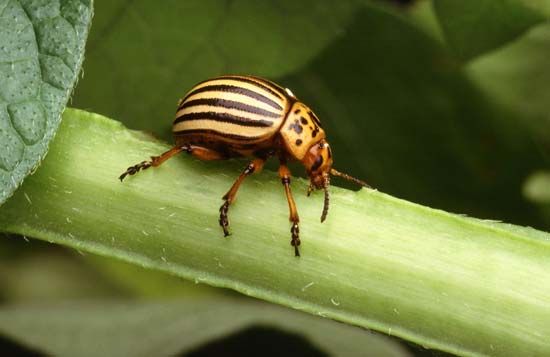
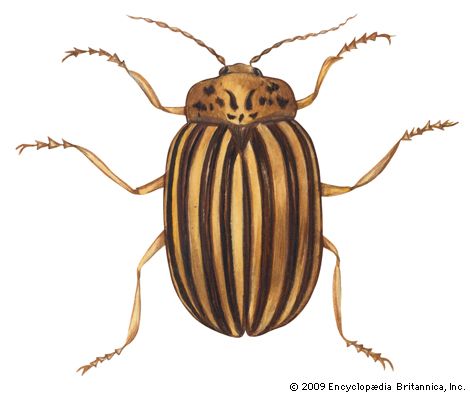
The Colorado potato beetle (Leptinotarsa decemlineata) is a species of leaf beetle recognized as a major agricultural pest of potato plants. Physically, the beetle is hemispherical, measures approximately 10 mm (0.4 inch) in length, and features an orange-red or yellow body with distinct black stripes on its wing covers.1
The species is native to western North America. Originally, it fed on the buffalo bur, a wild plant belonging to the potato family that is abundant in the Rocky Mountain region. The beetle transitioned to cultivated potatoes after they were introduced into its native habitat. By 1874, it had established itself as a significant pest wherever potatoes were grown.1
What natural predators does the Colorado potato beetle have?
The provided search results do not explicitly list the specific natural predators of the Colorado potato beetle.
While the literature notes that insect populations are generally limited by factors such as predators, parasites, and diseases, the Colorado potato beetle is specifically highlighted as an example of a pest that escaped its original controlling factors when it adapted to cultivated potatoes in North America. Because it moved into new agricultural environments without its full range of natural enemies, it became a highly destructive pest.
Current management strategies often rely on integrated pest management, which includes the use of the soil-dwelling bacterium Bacillus thuringiensis (Bt). Specific strains of Bt, such as san diego and tenebrionis, are effective against the Colorado potato beetle by blocking its digestive system, and these methods are favored because they do not harm the natural enemies of insects.
Sources
- Colorado potato beetle — Encyclopædia Britannica
- insect - Control of insect damage — Encyclopædia Britannica
- insect - Ecological factors — Encyclopædia Britannica
- Bacillus thuringiensis — Encyclopædia Britannica
- potato beetle — Encyclopædia Britannica
- Colorado potato beetle — Merriam-Webster
Published on · 3 min read