Asian Longhorned Beetle
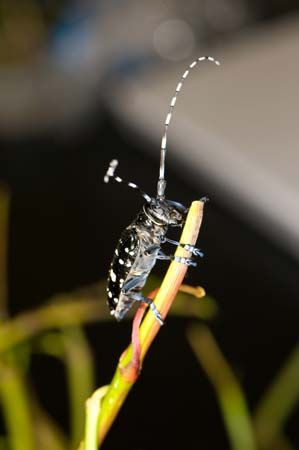
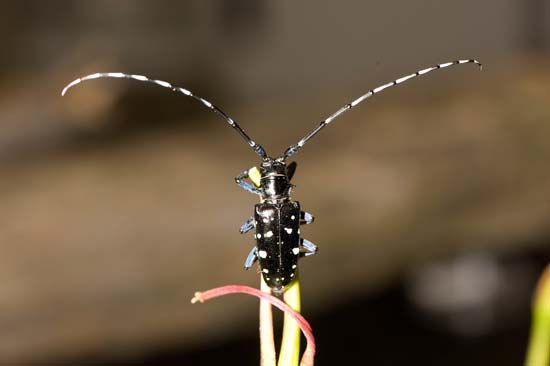
The Asian longhorned beetle (Anoplophora glabripennis) is an invasive species that lacks natural enemies in regions like the United States, where it has been…
Are there any natural predators of the Asian longhorned beetle?
The Asian longhorned beetle (Anoplophora glabripennis) is an invasive species that lacks natural enemies in regions like the United States, where it has been introduced. In its native range, the beetle is kept at low densities, but in areas where it has become an invasive pest, it faces few, if any, effective natural predators to curb its population growth.12
Researchers are currently investigating potential natural enemies, including fungi, nematodes, and various insect predators and parasitoids, as part of biological control efforts. While long-horned beetle larvae in general are known to be parasitized by certain wasps that lay eggs on or in them, the suitability and safety of introducing these or other natural enemies to manage the Asian longhorned beetle are still being studied to avoid the risks associated with introducing foreign species.23
How long can Asian longhorned beetles live, and how many eggs can a female lay?
Adult female Asian longhorned beetles have a life span of approximately 66 days. During this period, a single female can lay between 50 and 125 individual eggs, though the exact number depends on factors such as the geographic strain of the beetle, the availability of suitable host trees, and exposure to environmental pathogens.16
What role do international trade and wooden packing materials play in the spread of Asian longhorned beetles?
International trade has been the primary driver behind the global spread of the Asian longhorned beetle. The insect is most frequently transported to new regions, including North America, Europe, and Japan, through solid-wood packing materials such as shipping pallets and packing crates.16
These materials often contain developing larvae or pupae hidden deep within the wood, allowing the beetles to survive long-distance transit undetected. Once these shipments arrive at ports of entry, the beetles can emerge and infest local hardwood trees, such as maples, elms, and willows. While rare, the beetle has also been discovered in shipments of live plants.13
Because these infestations are difficult to detect in their early stages, the movement of contaminated wood products poses a significant threat to urban tree canopies and timber industries. To mitigate this risk, authorities have implemented strict regulations on the transport of wood and urge the public to avoid moving firewood or other potentially infested items.13
How does the Asian longhorned beetle damage trees, and what are the signs of infestation?
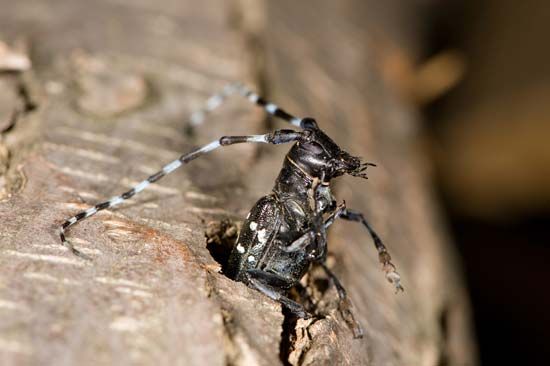
The Asian longhorned beetle (Anoplophora glabripennis) causes severe damage to hardwood trees primarily through the feeding habits of its larvae. After hatching, the larvae tunnel from the bark into the cambium, sapwood, and heartwood of the tree. This extensive tunneling disrupts the tree’s vascular flow, which weakens the host and can eventually lead to its death. In cases of repeated infestation, the structural integrity of the tree is compromised, often causing limbs or trunks to break during high winds or heavy snow.3
Signs of an infestation include:
- Egg-laying sites: Adult females chew pits into the bark of the upper trunk or main branches to deposit eggs, creating visible, dark, circular wounds approximately 1.3 cm (0.5 inch) in diameter.13
- Exit holes: When fully developed, the adult beetle chews its way out of the tree, leaving behind a distinct, round exit hole that is roughly 10–15 mm (0.4–0.6 inch) in diameter.3
- Sawdustlike waste: As larvae feed and tunnel, they produce and push out sawdustlike waste (frass) through the tunnel openings.3
Sources
- Asian longhorned beetle — Encyclopædia Britannica
- Asian long-horned beetle — Merriam-Webster
- long-horned beetle — Encyclopædia Britannica
- Coleoptera - Beetles as prey — Encyclopædia Britannica
- parasitoid — Encyclopædia Britannica
- Asian longhorned beetle: Top Questions — Encyclopædia Britannica
Published on · 3 min read