Competition
Competition is a fundamental driver of natural selection and evolution, acting as a powerful force that shapes the organization of biological communities.…
What role does competition play in the process of natural selection and evolution?
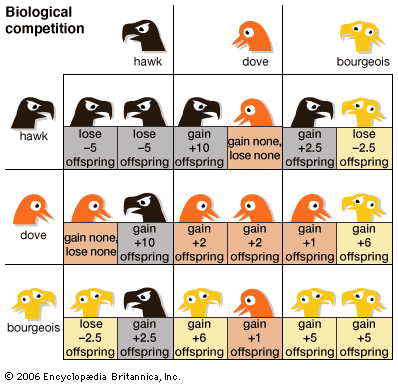
Competition is a fundamental driver of natural selection and evolution, acting as a powerful force that shapes the organization of biological communities. While often associated with the concept of “survival of the fittest”—the process by which organisms best adapted to their environment are most successful at surviving and reproducing—competition itself is an interaction where no species benefits.123
Over evolutionary time, competition forces species to adapt in several ways. When faced with a stronger competitor, a species may go extinct locally, evolve increased competitive ability, or diverge in its resource use to fill different niches. This divergence, known as character displacement, occurs when natural selection favors individuals that compete less with other species, leading to observable physical changes, such as the varied bill shapes seen in Darwin’s finches. Ultimately, these interactions determine which species coexist and how they distribute themselves across various environments.1
How does competition differ from other types of biotic interactions like predation or symbiosis?
In ecological communities, interactions between species are categorized by their effects on the participants. While many relationships involve at least one beneficiary, competition is unique because it is an interaction where no species benefits.453
Distinguishing Competition from Other Interactions
Biotic interactions are often defined by whether they are positive, negative, or neutral for the species involved:5
- Competition: Occurs when organisms utilize the same limited resources, such as food or space. Because the resources are insufficient to meet the needs of all, the interaction is detrimental to all involved, often leading to local extinction, resource divergence, or the evolution of increased competitive ability.367
- Predation and Parasitism: These are antagonistic relationships where one species benefits at the direct expense of another (the prey or host). Unlike competition, where the “loss” is a byproduct of shared resource scarcity, these interactions involve a direct, often lethal or debilitating, transfer of energy or resources from one organism to another.53
- Symbiosis: This term encompasses a broad range of living arrangements between different species, including mutualism (where both benefit), commensalism (where one benefits and the other is unaffected), and parasitism (where one benefits at the other’s expense).4
While competition is inherently negative for all parties, it remains a primary driver of community structure and evolutionary change, forcing species to adapt to minimize direct conflict.37
What is the definition of competition as a biotic interaction in ecology?
In ecology, competition is defined as the utilization of the same resources by organisms of the same or different species living within a community when those resources are insufficient to meet the needs of all individuals.7
This interaction is unique among biotic relationships because no species involved benefits from the encounter. Competition can occur through two primary mechanisms:1
- Exploitation competition: Species compete by capturing resources, such as water or nutrients, more rapidly than their competitors.10
- Interference competition: Species physically interfere with one another, often through aggressive behavior, to exclude others from specific habitats or resources.10
When resources are scarce, competition acts as a powerful force in shaping community structure. It can lead to local extinction, the evolution of increased competitive ability, or character displacement, where species evolve physical or behavioral differences to minimize overlap in resource use.16
What are some examples of competition between different species in nature?
Interspecific competition occurs when different species vie for the same limited resources, such as food, space, or nesting sites. Because these interactions are detrimental to all involved, species often evolve distinct behaviors or physical traits to minimize direct conflict.671
Examples of competition in nature include:
- Nesting Sites: Hole-nesting birds often compete for the same limited number of tree holes, which are essential for raising offspring.6
- Resource Extraction: Some plant species engage in exploitation competition by extracting water and nutrients from the soil at a faster rate than their neighbors, effectively limiting the resources available to others.6
- Evolutionary Divergence (Darwin’s Finches): Competition has driven the evolution of different bill sizes and shapes among Darwin’s finches in the Galapagos. This character displacement allows species to utilize different food sources, thereby reducing direct competition.3
- Desert Rodents: Studies of seed-feeding rodents in North American deserts have shown that these species have evolved differences in body size and foraging characteristics to minimize overlap in resource use.3
- Pollination: Various plant species may compete for the attention of the same pollinators or seed dispersers within a community.6
Sources
- community ecology - The effects of competition — Encyclopædia Britannica
- survival of the fittest — Merriam-Webster
- community ecology - Competition — Encyclopædia Britannica
- symbiosis — Encyclopædia Britannica
- community ecology - Interspecific interactions and the organization of communities — Encyclopædia Britannica
- community ecology - Types of competition — Encyclopædia Britannica
- competition — Encyclopædia Britannica
- symbiotic — Merriam-Webster
- Reproduction - Natural selection and reproduction — Encyclopædia Britannica
- community ecology - Guilds and interaction webs — Encyclopædia Britannica
Published on · 3 min read