Community Ecology
Ecologists employ a diverse array of methods and technologies to study and monitor ecological communities, balancing the complexity of living systems with…
What methods and technologies are used to study and monitor ecological communities?
Ecologists employ a diverse array of methods and technologies to study and monitor ecological communities, balancing the complexity of living systems with the need for quantitative data. Because environmental variables are difficult to control in the field, researchers often utilize a combination of laboratory experiments, statistical modeling, and advanced remote sensing.12
Key Research Methods and Tools
- Controlled Environments: Researchers use environmental chambers to maintain organisms under precise conditions of light, temperature, and humidity to isolate specific variables. Laboratory microcosms—small-scale aquatic or soil ecosystems—allow for the study of nutrient cycling and ecosystem development under controlled conditions.1
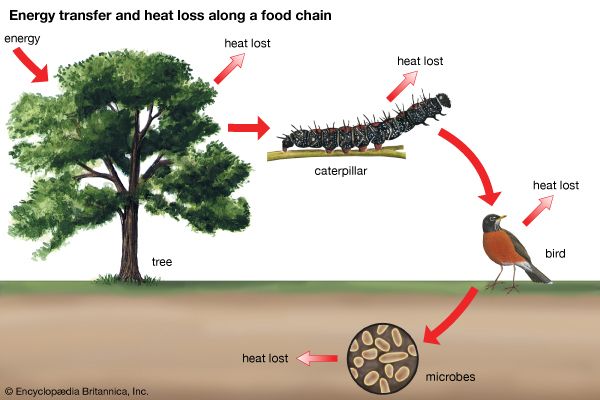
- Tracking and Tracing: Biotelemetry and electronic tracking equipment enable the remote monitoring of free-ranging organisms. Additionally, radioisotopes are essential for tracing energy and nutrient pathways through food chains.1
- Community Analysis: Plant ecologists often use standardized sampling areas to count species, determining factors such as ground cover, species dominance, and community structure.2
- Data Analysis: The integration of biostatistics and computer modeling is critical for managing the vast amounts of data generated by modern electronic sensors, allowing for the simulation of ecosystem functions.12
Remote Sensing
Remote sensing provides a broad perspective by measuring electromagnetic radiation from aircraft or satellites. Techniques include:3
- Multispectral Imaging: Using different spectral bands to identify specific vegetation types, soil conditions, and changes over time, such as seasonal growth or storm damage.3
- Thermal Infrared: Detects surface temperature variations, which can reveal phenomena like groundwater movement.3
- Radar: Technologies like side-looking airborne radar (SLAR) can penetrate clouds to map surface roughness and land slope.3
How do invasive species alter community composition and ecosystem processes?
Invasive species significantly alter ecological communities by disrupting established food webs and modifying ecosystem processes. Because they often lack natural predators in their new environments, these nonnative organisms can gain a competitive advantage, leading to the displacement or localized extinction of native species.45
Alterations to Community Composition
Invasive species reshape communities through several mechanisms:
- Direct Competition: Invaders often outcompete native species for essential resources such as food, living space, and sunlight, frequently forming dense monocultures that crowd out native vegetation.45
- Predation: Invasive predators can be highly efficient, causing rapid declines in native prey populations. In some cases, this triggers a trophic cascade, where the removal or addition of a predator causes reciprocal changes in the populations of other species throughout the food chain.465
- Disease Transmission: Invasive plants and animals often act as vectors for pathogens and parasites, introducing diseases to native populations that lack natural resistance.45
Impact on Ecosystem Processes
Beyond changing species composition, invaders can fundamentally alter how an ecosystem functions:
- Nutrient Cycling: By changing the biomass and metabolic rates of primary producers, invasive species can shift the rates of nutrient recycling and the availability of essential elements like nitrogen and phosphorus.6
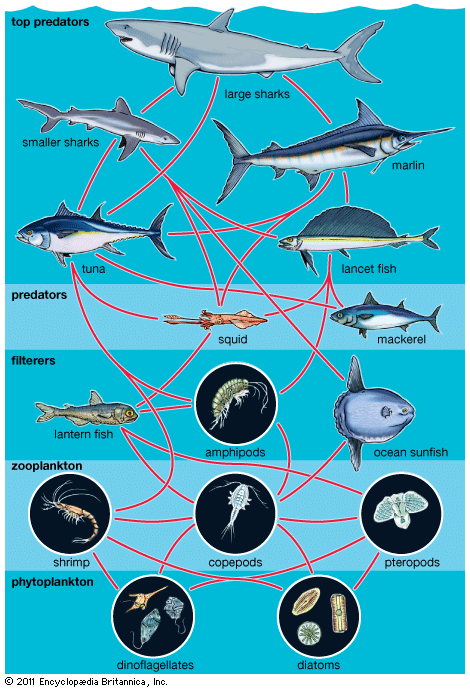
- Physical Environment: Some invaders modify the physical structure of their habitat. For example, invasive plants can stabilize or degrade soil, while filter-feeding mollusks like the zebra mussel can significantly increase water clarity by removing large amounts of algae, thereby altering the entire aquatic food web.65
- Atmospheric Exchange: By influencing primary production and respiration, invasive species can affect the exchange of carbon dioxide and oxygen between an ecosystem and the atmosphere.6
What role do keystone species play in shaping ecological communities?
A keystone species is an organism that exerts a disproportionately large influence on its biological community relative to its abundance9. The term, coined by zoologist Robert T. Paine in 1969, draws an analogy to the wedge-shaped stone at the top of an arch; just as the arch relies on that single stone for structural integrity, the entire community depends on the keystone species to maintain its organization and biodiversityystone species to maintain its organization and biodiversity.9
Keystone species typically shape their environments through two primary roles:
- Population Control: Many are apex predators that prevent a single species from dominating the community. For example, the starfish Pisaster ochraceus consumes mussels, keeping their populations in check so that other species can inhabit the rocky intertidal zone. Similarly, wolves regulate prey populations like deer and elk, which prevents overgrazing and alters the behavior of other animals.10911
- Resource Provision: Some species act as critical food sources. In tropical forests, figs serve as a keystone resource because they bear fruit year-round, sustaining many birds and mammals during seasons when other food is scarce.109
Because their presence is vital to community structure, the loss of a keystone species can trigger a cascade of secondary extinctions. Notably, a species may function as a keystone in one environment but not in another, depending on the specific ecological interactions present.12109
What are trophic cascades, and how do they impact entire ecosystems?
A trophic cascade is an ecological phenomenon where the addition or removal of top predators triggers reciprocal changes in the populations of species throughout a food chain. Coined by zoologist Robert Paine, this process demonstrates that ecosystem structure is not governed solely by physical or chemical factors, but also by top-down biological control.5
Impacts on Ecosystems
When top carnivores are removed or added, the effects ripple through multiple levels of the food web:
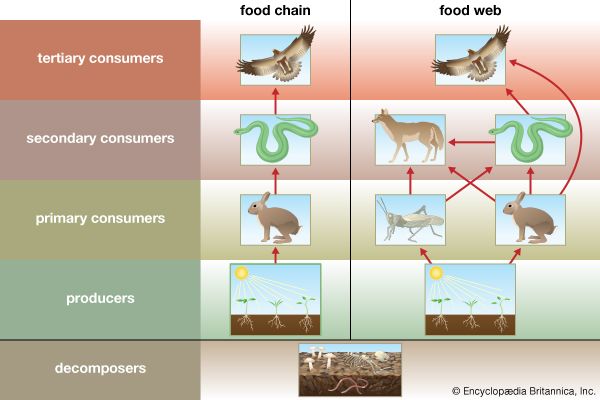
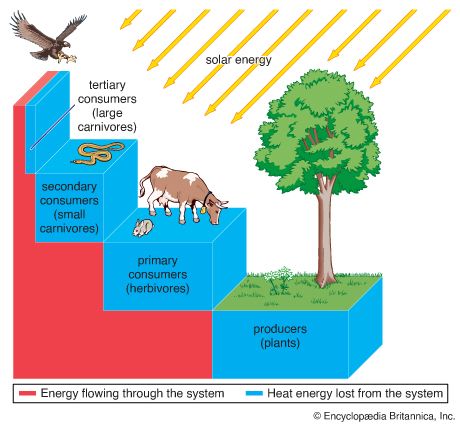
- Population Dynamics: In a three-level food chain, an increase in carnivores typically decreases herbivore populations, which in turn allows primary producers like plants or phytoplankton to flourish. Conversely, the loss of predators can lead to mesopredator release, where medium-sized predators increase in number, further suppressing their own prey species.5
- Ecosystem Processes: Trophic cascades influence nutrient cycling, biomass production, and even the exchange of carbon dioxide and oxygen between the ecosystem and the atmosphere. In aquatic environments, for example, these cascades can dictate water clarity and the prevalence of harmful algae blooms.5
Because these cascades are vital for maintaining the quality of air, water, and soil, the conservation of top predators is essential for preserving the functional integrity of natural habitats.5
Sources
- ecology - Methods in ecology — Encyclopædia Britannica
- Earth exploration - Remote sensing — Encyclopædia Britannica
- botany - Ecological aspects — Encyclopædia Britannica
- invasive species — Encyclopædia Britannica
- trophic cascade — Encyclopædia Britannica
- invasive species - A global problem — Encyclopædia Britannica
- conservation - Removing invasive species — Encyclopædia Britannica
- invasive species - Solutions — Encyclopædia Britannica
- keystone species — Encyclopædia Britannica
- community ecology - Keystone species — Encyclopædia Britannica
- conservation - Secondary extinctions — Encyclopædia Britannica
- apex predator — Encyclopædia Britannica
Published on · 5 min read