Indian Grass
Indian grass (Sorghastrum nutans) is a tall, perennial grass belonging to the family Poaceae. It is a key component of the North American tallgrass prairie…
What is Indian grass?
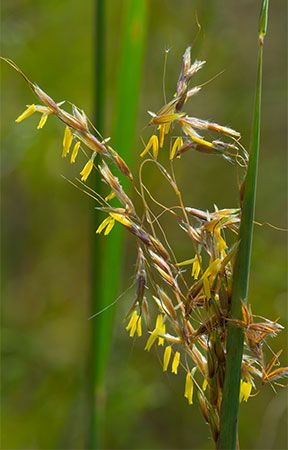
Indian grass (Sorghastrum nutans) is a tall, perennial grass belonging to the family Poaceae1. It is a key component of the North American tallgrass prairie, often found alongside big and little bluestem.12
Characterized as a sod-forming plant, it features fibrous roots that can reach depths of up to 1.8 meters (6 feet). Its blue-green leaves turn a distinct yellow-orange in the autumn, and it produces narrow, branched flower clusters. The yellow spikelets are fringed with white hairs, giving the plant a unique silver-and-gold appearance.1
Beyond its ecological role, Indian grass is valued as a forage plant for livestock and is sometimes cultivated as an ornamental border grass. It is well-adapted to fire and thrives in a variety of soils.1
What other plants are commonly found in the North American tallgrass prairie?
In addition to Indian grass, the North American tallgrass prairie is home to a diverse array of plant species. The vegetation is primarily composed of perennial grasses, alongside numerous flowering plants from the pea and composite families.4
Key grass species commonly found in these ecosystems include:
- Big bluestem (Andropogon gerardii): Often called the characteristic species of the tallgrass prairie, it can grow over 2 meters tall.45
- Little bluestem (Schizachyrium scoparium): A shorter bunchgrass typically found in drier prairie areas.56
- Prairie cordgrass (Spartina pectinata): Also known as slough grass, this sod-forming grass is common in wet lowlands.4
- Prairie dropseed (Sporobolus heterolepis): A bunchgrass frequently found on drier upland sites.4
- Needlegrass (or porcupine grass, Stipa): Another bunchgrass species characteristic of upland prairie environments.4
While grasses dominate the landscape, a wide variety of herbaceous plants also thrive alongside them. Although native prairie has been largely replaced by intense cultivation, these species remain emblematic of the original tallgrass ecosystem.64
Why are controlled fires important for the health of prairie ecosystems?
Controlled fires, or prescribed fires, are essential for maintaining the health and biodiversity of prairie ecosystems. Because many prairie species are fire-adapted, they depend on periodic burning to persist and reproduce.78
These fires provide several critical ecological benefits:
- Restoring Historical Conditions: Historically, natural fires prevented trees and woody plants from encroaching on grasslands. Decades of fire suppression allowed fuels to accumulate and altered vegetation communities; prescribed burning restores these areas to their natural state.789
- Reducing Competition and Pests: Fire reduces competition among plants and helps decrease the prevalence of diseases and pests that can degrade the quality of the ecosystem.78
- Nutrient Cycling: Burning clears away dead vegetation and fertilizes the soil with ash, which promotes new growth.8
- Managing Productivity: For land managers, periodic burning increases the productivity and quality of forage plants for wildlife and livestock, such as bison and cattle.7
By mimicking natural fire regimes, land managers can effectively promote the conservation and preservation of these unique landscapes.78
How did the tallgrass prairie influence the lives of the Plains Indians?
The tallgrass prairie was a defining feature of the Great Plains, profoundly shaping the lives and cultures of the Indigenous peoples who inhabited the region.
Environmental Management
Plains Indians actively managed the tallgrass prairie through the use of fire. These repeated burnings served several strategic purposes: they cleared away trees to thicken the grass, which provided better pasture for bison; they helped stampede herds during mass hunts; and they made travel across the landscape easier by removing dense vegetation.4
Settlement and Subsistence
Before the widespread adoption of the horse, many groups lived in earth-lodge villages along river valleys, where the fertile soil supported the cultivation of corn, beans, squash, sunflowers, and tobacco. These communities balanced village-based agriculture with seasonal hunting expeditions.10
The Impact of the Horse
The introduction of horses in the 18th century revolutionized life on the prairie. Increased mobility allowed many groups to transition into a nomadic lifestyle centered on hunting bison. This shift was so significant that it fundamentally altered the social and economic structure of Plains cultures, leading to the development of a distinctive equestrian society that reached its peak around 1800.101112
Sources
- Indian grass — Encyclopædia Britannica
- Indian grass — Merriam-Webster
- North America - Temperate grasslands — Encyclopædia Britannica
- Prairie — Encyclopædia Britannica
- bluestem — Encyclopædia Britannica
- Grassland - Biota — Encyclopædia Britannica
- prescribed fire — Encyclopædia Britannica
- Brush fire — Encyclopædia Britannica
- Savanna: Top Questions — Encyclopædia Britannica
- Native American - The Plains — Encyclopædia Britannica
- Indigenous peoples of the Great Plains: Top Questions — Encyclopædia Britannica
- Primitive culture - The Plains Indians — Encyclopædia Britannica
Published on · 3 min read