Coquina Clam
The coquina clam refers to any bivalve mollusk belonging to the genus Donax. These marine invertebrates are found on sandy beaches worldwide, where they are…
What is coquina clam?
The coquina clam refers to any bivalve mollusk belonging to the genus Donax. These marine invertebrates are found on sandy beaches worldwide, where they are known for being highly active; they frequently migrate up and down the shore with the tide and can rapidly reburrow between waves.1
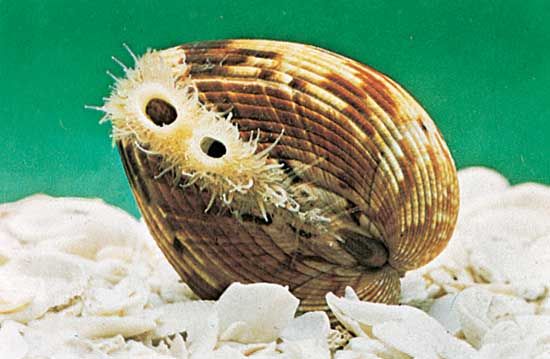
Typically measuring between 10 and 25 mm in length, these clams possess wedge-shaped shells that display a wide range of colors, including white, yellow, pink, blue, and mauve. They feed on detritus and suspended plant material using short siphons. Because they are edible, coquina clams are commonly used in the preparation of broths and chowders.12
The term “coquina” is also a geologic classification of Spanish origin, referring to a type of limestone composed primarily of shell fragments. Deposits of this limestone containing abundant Donax variabilis shells are notably found in Florida.1
How do coquina clams use their foot to move in the sand?
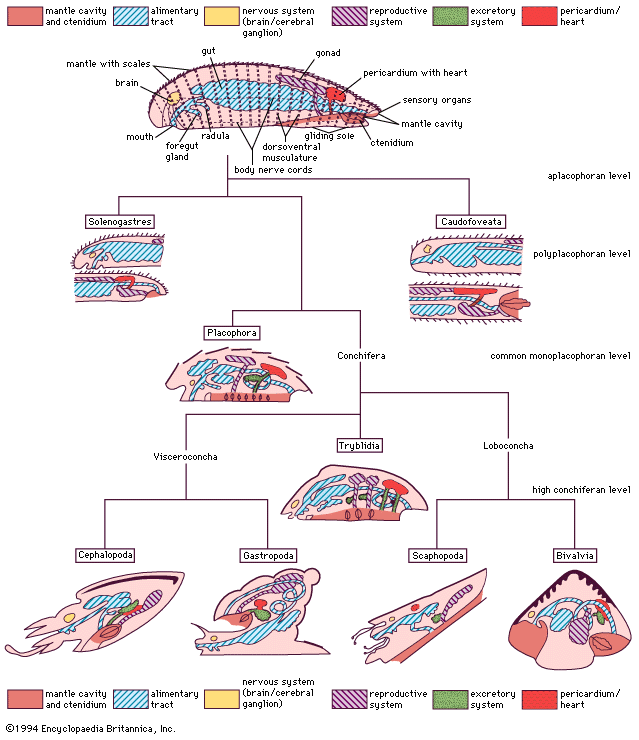
Coquina clams, like other bivalves, utilize a specialized, bladelike foot to burrow into sandy environments. Because they lack a flat creeping sole, their foot is specifically adapted for digging through the sediment.4
The burrowing process involves a coordinated interaction between the clam’s musculature and its hydrostatic skeleton:
- Extension: The foot is extended anteriorly from between the shell valves by pumping blood into it.4
- Anchoring: Once extended, the tip of the foot dilates to take a firm grip on the surrounding substrate.4
- Retraction: The pedal retractor muscles then contract, pulling the shell downward into the sand.4
- Fluidization: This movement is assisted by the sharp closure of the shell valves, which forces water out of the mantle cavity and into the burrow. This process fluidizes the sediment, significantly reducing resistance and making the movement more efficient.4
This mechanism is highly effective, allowing coquina clams to reburrow rapidly between waves as they migrate with the tide.41
What are some other types of bivalves found on sandy beaches?
Several other types of bivalves are commonly found in sandy or muddy coastal environments, each adapted to specific modes of life within the sediment:
- Razor clams: Members of the family Solenidae, these bivalves are characterized by narrow, elongated, razor-like shells. They possess a large, active foot that allows them to move rapidly within their burrows and retreat quickly when disturbed. Some species can even swim short distances by jetting water through their siphons.
- Cockles: Belonging to the family Cardiidae, these clams are found worldwide in sandy or muddy areas. They typically live shallowly buried, usually no more than three centimeters deep. Many species feature shells with radiating ribs, and they range significantly in size, from one centimeter to the 15-centimeter-wide smooth giant cockle.
- Surf clams: Also known as sea clams, these are typically large, edible bivalves belonging to the family Mactridae. A well-known example is the Atlantic surf clam (Spisula solidissima), which is common along the Atlantic coast.
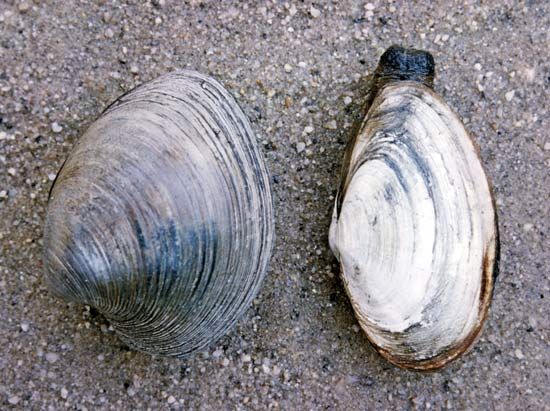
- Quahogs: These are thick-shelled, rounded clams belonging to the family Veneridae. They are common in the intertidal zone and are highly valued as food, often referred to as hard-shell, cherrystone, or littleneck clams depending on their size.
- Soft-shell clams: Also called longneck clams or steamers, these bivalves bury themselves in mud or sand at depths of 10 to 30 centimeters. They are widely recognized for their oval, dirty-white shells.
How do seashells get their different colors and patterns?
The vibrant colors and intricate patterns found on seashells are primarily the result of specialized cells located along the edge of the mollusk’s mantle. As the mollusk grows, these cells secrete a variety of pigments that are deposited onto the shell’s surface.3
While the shell itself is largely composed of calcium carbonate secreted by the mantle to provide protection and structural support, the addition of these pigments creates the diverse designs observed in nature. In some species, these colors serve a clear function, such as camouflage to help the animal blend into its environment and avoid predators. However, for many other species, the biological significance of these complex patterns remains unclear.312
In some invertebrates, these pigments include porphyrins, which are nitrogenous compounds that can sometimes exhibit fluorescence when exposed to light. Because the shell grows incrementally at its outer margin, the patterns are essentially a record of the pigment secretion activity of the mantle edge over time.13312
Sources
- coquina clam — Encyclopædia Britannica
- clam — Encyclopædia Britannica
- seashell — Encyclopædia Britannica
- bivalve - Locomotion — Encyclopædia Britannica
- mollusk - Locomotion — Encyclopædia Britannica
- razor clam — Encyclopædia Britannica
- cockle — Encyclopædia Britannica
- bivalve - Size range and diversity of structure — Encyclopædia Britannica
- surf clam — Merriam-Webster
- sea clam — Merriam-Webster
- bivalve - Distribution and abundance — Encyclopædia Britannica
- Integument - Mollusks — Encyclopædia Britannica
- mantle — Encyclopædia Britannica
- coloration - Porphyrins — Encyclopædia Britannica
Published on · 3 min read