Clam
Clams are primarily filter feeders that obtain nutrients by straining suspended particles from the water. They typically draw water in and expel it through…
How do clams feed and what is their typical diet?
Clams are primarily filter feeders that obtain nutrients by straining suspended particles from the water. They typically draw water in and expel it through two tubes known as siphons. Inside the mantle cavity, millions of tiny hairlike structures called cilia on the gills create a water current, while other cilia trap food particles and transport them, entangled in mucus, to the mouth.123
Their typical diet consists of:
- Plant detritus, bacteria, and algae: These are the primary food sources for the vast majority of bivalves, found either on the sediment surface or suspended in the water column.3
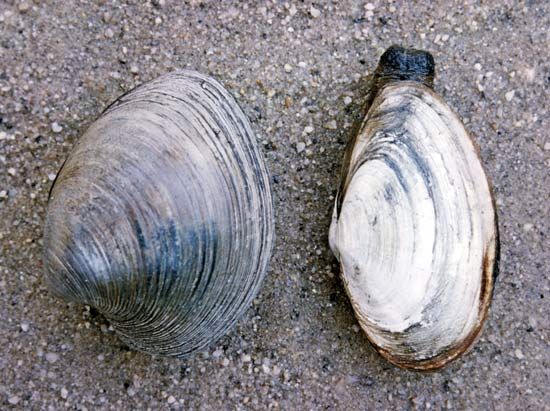
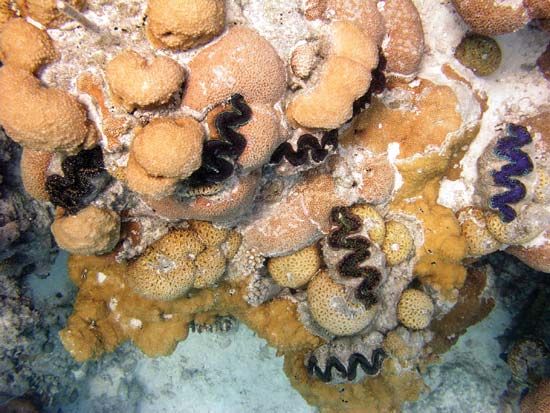
- Symbiotic relationships: Some species, such as giant clams, host symbiotic zooxanthellae (algae) within their tissues to gain nutrition. Others, found near hydrothermal vents, rely on sulfur-oxidizing bacteria.32
- Prey: Certain deepwater species have evolved to capture small crustaceans, worms, and larvae by creating pressure changes that suck prey into the mantle cavity.3
What are the different habitats where clams can be found?
Clams are highly adaptable bivalves found in a wide variety of aquatic environments across the globe. Their habitats are primarily defined by their need to burrow or anchor themselves, with species distributed throughout both marine and freshwater systems.25
Primary Habitats
- Sedimentary Bottoms: Most clams are specialized for life on or within sandy or muddy bottoms. They use a powerful, muscular foot to burrow into these substrates, ranging from just beneath the surface to depths of nearly a meter, which provides them with protection from predators and wave action.267
- Intertidal and Shallow Waters: Many common species, such as the quahog, inhabit the intertidal zone and shallow coastal waters, where they remain buried while extending their siphons to feed and breathe.26
- Deep-Sea Environments: While most clams prefer shallow areas, some species are remarkably resilient. For example, the Abra profundorum clam has been discovered at depths exceeding 4,800 meters in the Pacific Ocean.2
- Specialized Environments: Certain clams have adapted to extreme conditions, such as sulfide-rich sediments and hydrothermal vents, where they rely on symbiotic bacteria for nutrition rather than traditional filter feeding. Additionally, some specialized species are capable of boring into harder substrates like wood or rock.257
How do clams use their siphons, and what are they used for?
Clams use their siphons—often referred to as a “neck”—as specialized tubes that extend from their mantle tissue to the surface of the substrate in which they are buried. These structures are essential for the animal’s survival, as they allow the clam to remain safely hidden from predators while maintaining a connection to the water column above.32
The siphons serve two primary functions:
- Respiration: Clams use their siphons to draw in and expel water, which facilitates the exchange of gases necessary for breathing.38
- Feeding: The siphons act as conduits for filter feeding. By drawing water into the mantle cavity, the clam allows its gills to strain out food particles, such as algae, bacteria, and plant detritus, which are then transported to the mouth.63
In some specialized deepwater species, the siphons have evolved even further. For example, certain Anomalodesmata use their siphons to create pressure changes that suck prey into the mantle cavity, or they may evert the inhalant siphon like a hood to capture small crustaceans and worms.6
What are some of the largest and smallest species of clams?
Clam species exhibit a vast range in size, from microscopic organisms to massive marine giants.
- Largest Species: The giant clam (Tridacna gigas) is the largest known bivalve. Found on coral reefs in the Indian and Pacific oceans, these impressive animals can reach lengths of more than 137 centimeters (54 inches) and weigh over 264 kilograms (582 pounds).962
- Smallest Species: At the other end of the spectrum, some of the smallest clams, such as those in the genus Condylocardia, measure as little as 0.1 millimeters (0.004 inches) in length.2
This extreme diversity in size reflects the wide variety of ecological niches that clams occupy, from the deep-sea floor to shallow intertidal zones.62
Sources
- Filter feeding — Encyclopædia Britannica
- clam — Encyclopædia Britannica
- bivalve - Food and feeding — Encyclopædia Britannica
- gaper clam — Encyclopædia Britannica
- What’s the difference between clams, mussels, and oysters? — Encyclopædia Britannica
- bivalve - Size range and diversity of structure — Encyclopædia Britannica
- mollusk - Habitats, feeding habits, and associations — Encyclopædia Britannica
- Respiratory system - Gills of invertebrates — Encyclopædia Britannica
- giant clam — Merriam-Webster
Published on · 3 min read