Cordylidae
Cordylidae is a family of small to medium-sized lizards native to sub-Saharan Africa and Madagascar. Often referred to as spiny-tailed or girdle-tailed…
What is Cordylidae?
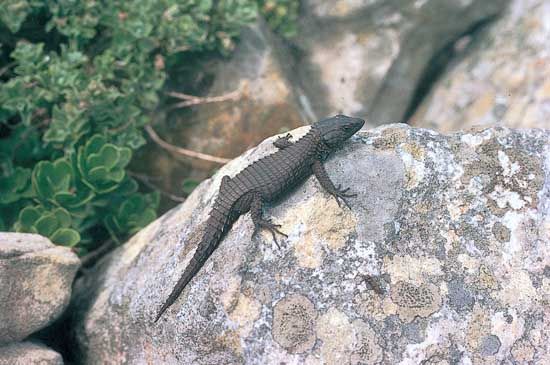
Cordylidae is a family of small to medium-sized lizards native to sub-Saharan Africa and Madagascar. Often referred to as spiny-tailed or girdle-tailed lizards, these reptiles are characterized by their heavy armor, consisting of spiny or platelike scales underlain by bony plates.12
Key features of the family include:
- Physical Characteristics: They range from 6 to 30 cm (2.4 to 11.8 inches) in length. Most species are dorsoventrally flattened, an adaptation that allows them to seek refuge in narrow rock crevices. One genus, Chamaesaura, is nearly limbless and snakelike.12
- Habitat and Diet: Most species are terrestrial and inhabit arid or semiarid environments, typically living among rocks. They are generally insectivorous, feeding on a variety of arthropods, though larger species may also consume small vertebrates.12
- Classification: The family is divided into two subfamilies: the girdle-tailed lizards, which are mostly viviparous (giving birth to live young), and the plated lizards, which are oviparous (egg-laying).1
How do Cordylidae lizards use rock crevices to protect themselves?
Members of the Cordylidae family utilize rock crevices as a primary defensive strategy to evade predators. Because many of these lizards are dorsoventrally flattened, they are physically adapted to squeeze into narrow gaps within rock piles to seek refuge.1
Once inside a crevice, these lizards employ specific behaviors to make their extraction difficult for predators:
- Body Inflation: Similar to other rock-dwelling lizards, they can puff up their bodies while inside a crevice, effectively wedging themselves in place and making it nearly impossible for a predator to pull them out.3
- Tail Exposure: Many spiny-tailed lizards position themselves so that only their heavily armored, spiny tails are exposed to the outside, presenting a formidable barrier to any attacker.3
- Defensive Posturing: In some species, such as the armadillo lizard (Cordylus cataphractus), the lizard may grab its own tail in its mouth. This action forms a protective ring of sharp, spiny scales that prevents predators from finding a starting point to begin swallowing the lizard.34
What is the difference between viviparous and oviparous reproduction in these lizards?
The primary difference between oviparous and viviparous reproduction in lizards lies in where the embryo develops and how it receives nutrients.9
- Oviparity (Egg-laying): In oviparous species, the female deposits eggs outside her body. These eggs contain a supply of yolk that provides all the energy and nutrients the embryo requires to complete its development until it hatches.910
- Viviparity (Live-bearing): In viviparous species, the female retains the developing young within her oviduct until they are born alive. The level of maternal support varies significantly:10
- Simple Viviparity: In some cases, the only difference from egg-laying is that a shell never forms. The embryo still relies entirely on the yolk for energy, with the mother providing only shelter and oxygen.910
- Complex Viviparity: In more advanced species, the mother provides additional support through a placenta. This structure allows for the transfer of nutrients from the mother to the offspring during development, with some species relying on the mother for nearly all their nutritional needs.910
Within the Cordylidae family, these reproductive strategies are divided by subfamily: the girdle-tailed lizards are primarily viviparous, while the plated lizards are oviparous.1
Why are some Cordylidae species flattened in body shape?
The flattened body shape found in many Cordylidae species is a specialized physical adaptation that allows these lizards to exploit narrow rock crevices for protection. By possessing a dorsoventrally compressed (flattened) body, these lizards can effectively squeeze into tight gaps within rock piles or boulder formations, which serve as essential refuges from predators.
This morphological trait is directly linked to their survival strategy in rocky environments. Once inside these narrow spaces, the flattened shape enables the lizard to wedge itself securely, making it difficult for a predator to extract them. This physical structure is often complemented by other defensive behaviors, such as inflating the body to increase friction against the rock walls or positioning armored scales to block the entrance.
Sources
- Cordylidae — Encyclopædia Britannica
- lizard - Annotated classification — Encyclopædia Britannica
- reptile - Body form and posturing — Encyclopædia Britannica
- lizard - Defensive strategies — Encyclopædia Britannica
- girdle-tailed lizard — Encyclopædia Britannica
- girdle-tailed lizard — Merriam-Webster
- reptile - Clinging and climbing — Encyclopædia Britannica
- scale — Encyclopædia Britannica
- Animal reproductive system - Provisions for the developing embryo — Encyclopædia Britannica
- lizard - Embryonic development and sex determination — Encyclopædia Britannica
- lizard - Parental care — Encyclopædia Britannica
Published on · 3 min read