Corfu
Corfu is an island located in the Ionian Sea, situated just off the coast of Epirus in western Greece.
What is the geographical location and size of Corfu island?
Corfu is an island located in the Ionian Sea, situated just off the coast of Epirus in western Greece.1
Regarding its physical dimensions, the island spans approximately 36 miles (58 km) in length, with a maximum breadth of about 17 miles (27 km). It covers a total area of 229 square miles (593 square km). The island is characterized by a limestone structure, featuring mountainous terrain in the north—including the peak of Pantokrator Mountain—and lower elevations in the south.1
What are some of the most famous landmarks and attractions on Corfu?
Corfu features several notable landmarks and attractions, many of which are concentrated in its historic capital city. Key sites include:
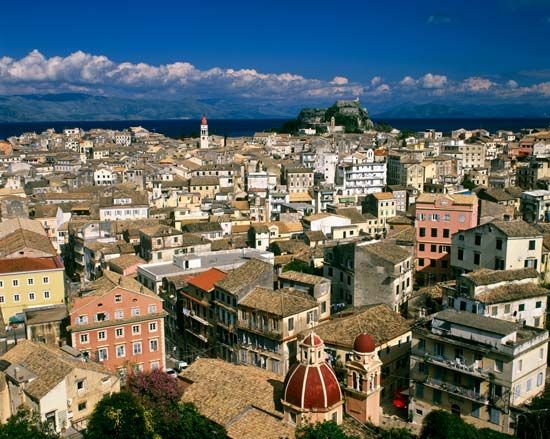
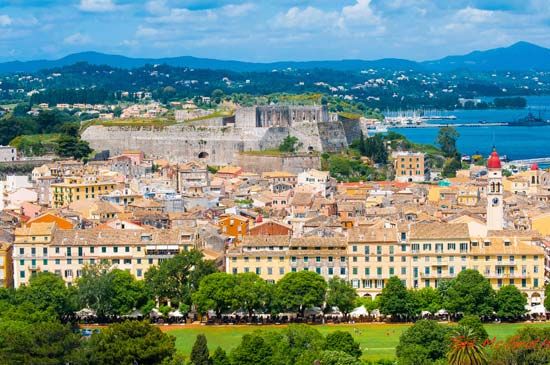
- Old Town of Corfu: A UNESCO World Heritage site known for its labyrinthine network of hilly, narrow streets and distinct architectural character.12
- The Old Citadel: A twin-peaked fortress featuring fortifications originally constructed by the Venetians in 1550. It was once separated from the city by a channel, effectively serving as an islet.1
- The Royal Palace: Built in 1816, this structure served as the residence for British governors during the period of the British protectorate. It survived the destruction of World War II and now functions as a museum.1
- Achilleion Palace: Constructed between 1890 and 1891 for Empress Elizabeth of Austria, this site was later converted into a casino in 1962.1
- Pantokrator Mountain: Located in the island’s mountainous north, this peak reaches an elevation of 2,972 feet (906 metres) and offers a prominent natural landmark.1
How did Corfu play a role in World War II?
The premise that the “Corfu incident” was a part of World War II is inaccurate; the Corfu incident occurred in 1923, well before the outbreak of the war.31
During World War II, Corfu experienced significant military activity and occupation. The city was subjected to bombing by Italian forces, and the island was subsequently occupied by Italian and German troops between 1941 and 1944. The fighting that took place in 1943 resulted in the destruction of many of the island’s buildings and landmarks, though some structures, such as the Royal Palace, managed to survive the conflict. Corfu was ultimately restored to Greece in 1944.1
How does Corfu’s climate differ from mainland Greece?
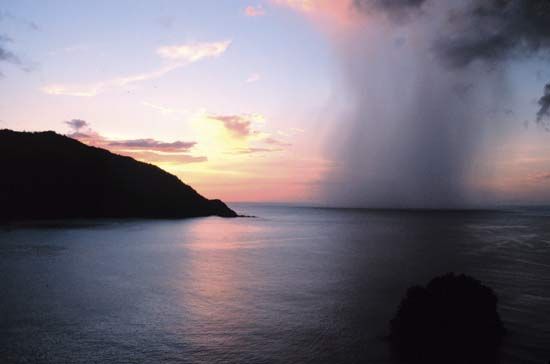
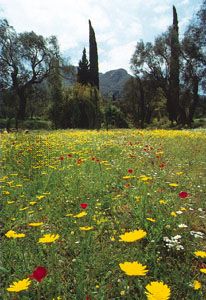
Corfu’s climate is defined by the Mediterranean climate typical of the region, but it is significantly wetter than much of mainland Greece due to its location on the Ionian coast.
Western climatic influences bring substantial precipitation to the Ionian islands and the mountains behind them. While many parts of Greece experience relatively low annual rainfall—such as Athens, which receives about 16 inches (400 mm) annually—Corfu is notably more humid, with an average annual precipitation of approximately 52 inches (1,320 mm).4
Regarding temperatures, Corfu maintains a milder winter profile compared to northern mainland regions. While cities like Thessaloníki may see January temperatures in the low 40s F (about 6 °C), Corfu’s January temperatures average in the low 50s F (10 °C), similar to those found in Athens and Crete. During the summer, the island shares the hot, dry conditions common across the country, though coastal areas benefit from sea breezes that moderate the afternoon heat.4
Sources
- Corfu — Encyclopædia Britannica
- list of World Heritage sites - Greece — Encyclopædia Britannica
- Corfu incident — Encyclopædia Britannica
- Greece - Climate of Greece — Encyclopædia Britannica
Published on · 3 min read