Crete
Crete’s landscape and climate are fundamental to its economy, shaping both its agricultural output and its appeal as a tourist destination.
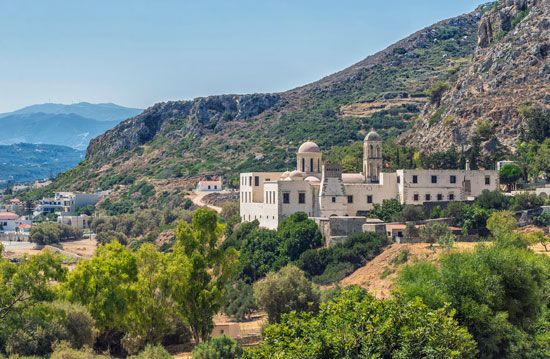
How does Crete’s climate and landscape contribute to its agriculture and tourism?
Crete’s landscape and climate are fundamental to its economy, shaping both its agricultural output and its appeal as a tourist destination.
Agriculture
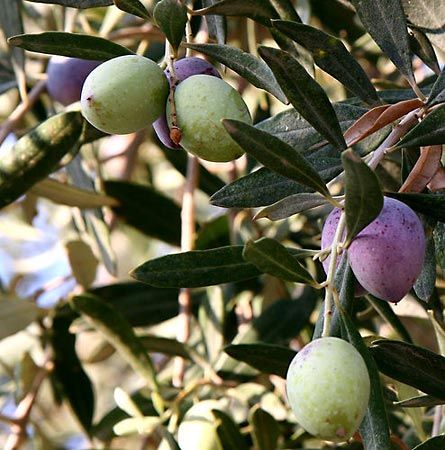
Crete’s rugged, mountainous terrain limits cultivation to about one-third of its total area. While most farming is small-scale, the Mesara Plain serves as a vital, well-watered exception where efficient, mechanized farming is possible. The island’s temperate-to-subtropical climate supports a diverse range of products, including olives, grapes, vegetables, and fruits. Notably, Cretan olive oil production accounts for more than one-third of Greece’s national crop. Additionally, farmers utilize plastic hothouses to capitalize on the climate for winter produce, while the mountainous regions support the stock breeding of sheep and goats, essential for local yogurt production.12
Tourism
Tourism has become the island’s economic mainstay, largely driven by its Mediterranean climate. Visitors are drawn to the island’s sunshine, coastal amenities, and natural harbors along the northern coast. While the dramatic mountains and gorges, such as the Samariá Gorge, offer opportunities for trekking, much of the tourism industry is centered on package tours and cruise ships that favor the island’s beaches and temperate weather.12
How has Crete’s history been shaped by ancient civilizations, particularly the Minoans?
The history of Crete is deeply rooted in the Minoan civilization, a Bronze Age culture that emerged around 3000 BCE and established the first high civilization in the Aegean area. Centered at Knossos, the Minoans built sophisticated palace complexes that served as political, economic, and ceremonial hubs.678910
The Minoan Influence
The Minoans were a maritime power whose trade networks connected them to Egypt, the Levant, and mainland Greece. Their legacy is defined by:8
- Architecture: The construction of palaces featuring advanced plumbing, light wells, and paved roads, which influenced later architectural styles.7910
- Art and Religion: Vibrant frescoes depicting religious and secular life, including motifs like the bull and the snake goddess, which suggest a culture with prominent female religious figures.7810
- Writing: The development of early scripts, including Linear A, which laid the groundwork for later administrative practices.89
Transition and Legacy
By 1500 BCE, the Mycenaeans from the Greek mainland began exerting influence, eventually assuming control of Knossos. They introduced Linear B, a script adapted from Minoan systems and considered a prototype of the Greek language. Following the decline of the palace culture around 1400 BCE, Crete remained a significant cultural touchstone, fascinating later Greeks as a source of myths and legends, such as the story of the Minotaur and the labyrinthine palace of King Minos.698
How has Crete’s relationship with mainland Greece evolved over time, including periods of autonomy or independence?
Crete’s relationship with mainland Greece has evolved significantly over millennia, shifting from cultural influence to political integration.
During the Bronze Age, the Minoan civilization served as the foundational culture for the Aegean. By 1500 BCE, mainland Mycenaeans exerted increasing influence, eventually assuming control of the island after 1450 BCE. This period established a deep connection that persisted through the Iron Age and the classical era, where Crete was viewed by mainlanders as a source of foundational myths and laws.611
Following centuries of foreign rule—including periods under Rome, Byzantium, Venice, and the Ottoman Empire—Cretans maintained their Greek language and Orthodox identity. In the 19th century, persistent uprisings against Ottoman rule reflected a strong desire for union with the Greek kingdom. After the Turks were expelled in 1898, Crete functioned as an autonomous state until it formally achieved union with Greece in 1913.612
What role did Crete play during World War II and the Greek Resistance?
During World War II, Crete served as a site of immense strategic importance due to its command of shipping lanes to the Middle East and the Black Sea.13
The Battle of Crete
Following the fall of mainland Greece in April 1941, Allied forces evacuated to the island. From May 20 to June 1, 1941, Nazi Germany launched the Battle of Crete, the first major airborne assault in the history of warfare. German forces utilized elite parachute and glider troops to seize airfields, ultimately forcing a British and Commonwealth evacuation. While the Allies suffered heavy losses—including thousands of casualties and the sinking of several Royal Navy ships—the high German casualty count led Adolf Hitler to curtail future large-scale airborne operations.1314
Occupation and Resistance
Following the battle, Crete remained under German military occupation for the duration of the war. Throughout occupied Europe, resistance movements emerged to oppose Nazi rule through sabotage, intelligence gathering, and guerrilla warfare. These clandestine groups often received support from the British Special Operations Executive, which provided arms and supplies to aid in subversive activities against Axis forces.1415
Sources
- Crete - Economy — Encyclopædia Britannica
- Crete - Land — Encyclopædia Britannica
- Crete - Cultural life — Encyclopædia Britannica
- Greece - Climate of Greece — Encyclopædia Britannica
- Greece - The islands of Greece — Encyclopædia Britannica
- Crete - History — Encyclopædia Britannica
- Minoan — Encyclopædia Britannica
- Minoan civilization — Encyclopædia Britannica
- Knossos — Encyclopædia Britannica
- Western architecture - Minoan Crete — Encyclopædia Britannica
- Greece - Extension of Greek borders — Encyclopædia Britannica
- Aegean civilizations — Encyclopædia Britannica
- Battle of Crete — Encyclopædia Britannica
- World War II - Central Europe and the Balkans , 1940–41 — Encyclopædia Britannica
- resistance — Encyclopædia Britannica
Published on · 4 min read