Period
The term "period" is multifaceted, with meanings that vary significantly depending on the context:
What is period?
The term “period” is multifaceted, with meanings that vary significantly depending on the context:
- Physics: In physics, a period (symbolized as T) is the interval of time required for a periodic motion to repeat a full cycle. It is the reciprocal of frequency, expressed as T=1/fT = 1/f.12
- Language and Punctuation: A period (also called a full stop or full point) is a punctuation mark used to indicate the end of a grammatically complete declarative sentence or to mark an abbreviation.34
- Time and Chronology: It refers to a portion of time determined by recurring phenomena, such as a menstrual period, or a specific chronological division, such as a stage of culture or a geologic time unit.35
- General Usage: It can denote the completion of a cycle, a specific division of an academic day, or a segment of playing time in a game.3
How is frequency related to the period of a wave?
In physics, the frequency (ff) and the period (TT) of a wave are inversely related. The period represents the time interval required for a periodic motion to complete one full cycle, while the frequency denotes the number of cycles that occur per unit of time.27
The mathematical relationship between these two properties is defined as:
f=1Tf = \frac{1}{T}
This inverse relationship implies that as the frequency of a wave increases, its period decreases, and conversely, as the frequency decreases, the period increases. For instance, a sound wave with a high frequency of 20 kilohertz has a very short period of 0.00005 seconds, whereas a lower frequency of 20 hertz corresponds to a longer period of 0.05 seconds.26
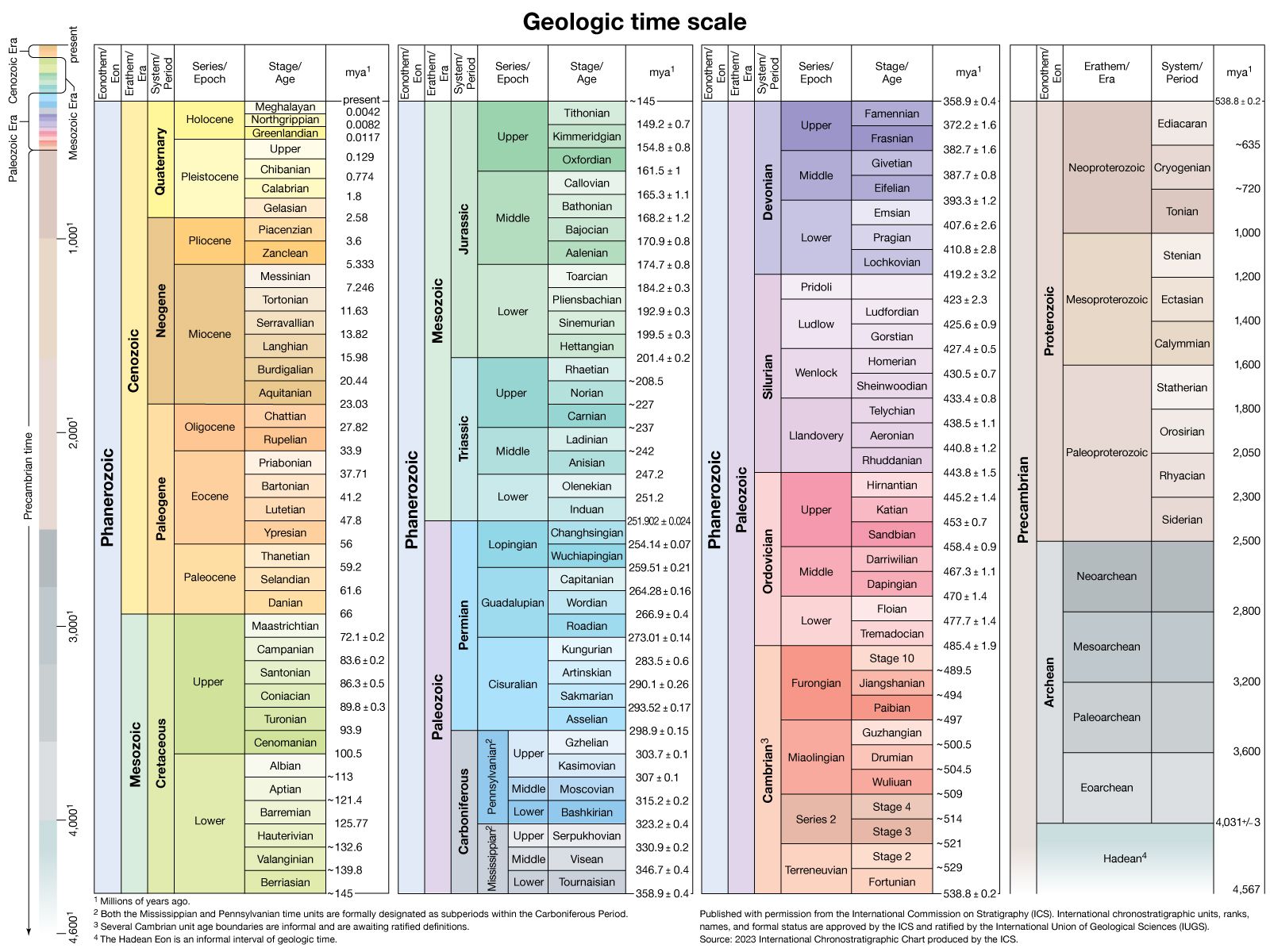
What is the difference between an era, an epoch, and a period in geology?
In geology, the geologic time scale functions as a calendar for Earth’s history, organizing time into a hierarchical structure of named units. These units are delineated primarily by the emergence and disappearance of widespread species in the fossil record and are correlated through stratigraphy.
The relationship between these units, in descending order of duration, is as follows:
- Era: An era is a very long span of geologic time, representing the second-longest division after eons. An era is composed of one or more geologic periods. Examples include the Paleozoic, Mesozoic, and Cenozoic eras.89
- Period: A period is a subdivision of an era. It represents a specific interval of time during which distinct rock systems were formed, such as the Jurassic or Cretaceous periods.89
- Epoch: An epoch is a smaller subdivision of a period. Epochs provide finer-scaled discrimination of geologic time, such as the Eocene, Miocene, or Pleistocene epochs.910
How did the use of the period as a punctuation mark evolve over time?
The evolution of the period as a punctuation mark is rooted in the transition from ancient rhetorical systems to modern syntactic structures.
Ancient Origins
In classical Greek and Latin, punctuation was initially nonexistent, with texts written in continuous script. By the 3rd century BCE, Aristophanes of Byzantium proposed a three-point system where a point placed at different heights—top, middle, or bottom—indicated pauses of varying lengths. The highest point marked the longest pause, known as a periodos, which is the etymological ancestor of the modern period.12
Medieval Development
During the Middle Ages, punctuation evolved to assist in reading aloud. Scribes used various marks, including the punctus elevatus, to indicate both pauses and vocal inflections. By the 12th century, these systems were highly refined for liturgical use. However, as silent reading became more common, the focus shifted away from these inflectional cues.12
Modern Standardization
The modern system emerged during the Renaissance. In 1566, the younger Aldus Manutius expounded a system that established the period (or full stop) as a primary mark for clarifying syntax rather than just elocution. By the 17th century, the use of the period to mark the end of a grammatically complete sentence became standard practice in English.1213
Sources
- period — Merriam-Webster
- period — Encyclopædia Britannica
- punctuation - Punctuation in English since 1600 — Encyclopædia Britannica
- menstrual period — Merriam-Webster
- period — Merriam-Webster
- periodic motion — Encyclopædia Britannica
- sound - Wavelength , period , and frequency — Encyclopædia Britannica
- era — Encyclopædia Britannica
- geologic time — Encyclopædia Britannica
- era — Merriam-Webster
- geochronology - Completion of the Phanerozoic time scale — Encyclopædia Britannica
- punctuation - Punctuation in Greek and Latin to 1600 — Encyclopædia Britannica
- full stop — Merriam-Webster
Published on · 3 min read