Precipitation
Cloud seeding is a weather modification technique that involves introducing substances into clouds to act as condensation nuclei or ice nuclei to induce or…
How do cloud seeding techniques attempt to modify precipitation?
Cloud seeding is a weather modification technique that involves introducing substances into clouds to act as condensation nuclei or ice nuclei to induce or alter precipitation.1
The process varies based on the cloud’s temperature:
- Supercooled Clouds: These clouds contain water droplets at temperatures below freezing. They are typically seeded with silver iodide or dry ice. These agents provide nuclei that cause water vapor to deposit into ice crystals, which grow and eventually fall as rain or snow.213
- Warm Clouds: In clouds with temperatures above freezing, substances like sodium chloride or calcium chloride are used. These particles encourage the formation of larger droplets that grow through coalescence and fall as rain.21
Seeding agents are dispersed using aircraft, ground-based generators, rockets, or artillery. While some studies suggest seeding can increase precipitation by up to 20 percent under optimal conditions, the practice remains a subject of scientific debate regarding its overall effectiveness and predictability.2134
How do El Niño and La Niña phenomena affect global precipitation patterns?
El Niño and La Niña are opposing phases of the El Niño-Southern Oscillation (ENSO), a climate pattern that significantly alters global precipitation through atmospheric “teleconnections.”56
El Niño (Warm Phase)
During El Niño, weakened trade winds allow warm surface water to shift eastward across the Pacific. This leads to:57
- Increased Rainfall: Western South America (notably Ecuador and Peru) experiences heavy rains and flooding, while parts of the U.S. Southwest and California often see wetter, stormier winters.67
- Drought: Indonesia, Australia, and parts of northeastern South America typically face severe drought.57
- Monsoon Disruption: Severe events can cause monsoon failure, leading to intense drought in India and East Africa.6
La Niña (Cool Phase)
La Niña strengthens trade winds, pushing warm water toward Asia and Australia. This results in:58
- Increased Rainfall: Indonesia, northern Australia, and parts of the middle latitudes of North America often experience higher precipitation.5
- Drought: Drier conditions may occur in parts of South America and other regions.5
These shifts displace storm tracks and pressure systems globally, causing unpredictable weather far from the tropical Pacific.6
What are the different types of precipitation, and how do they form?
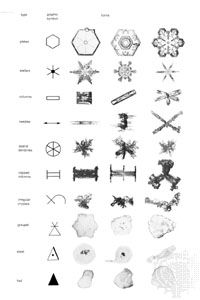
Precipitation consists of liquid or solid water particles that fall from clouds and reach the ground, including rain, drizzle, snow, hail, and sleet. These particles form through two primary mechanisms:9
Warm-Cloud Processes
In warmer clouds, precipitation develops through the collision and coalescence of droplets. Small condensation nuclei collect water to form droplets. Larger droplets fall faster, colliding and fusing with smaller ones in their path until they are heavy enough to fall as rain or drizzle.910
Cold-Cloud Processes
In clouds reaching temperatures below 0 °C, the Bergeron-Findeisen mechanism occurs. Supercooled water droplets and ice nuclei coexist; because ice crystals grow more rapidly than water droplets, they consume the surrounding moisture.1011
- Snow: Ice crystals grow by deposition, aggregation (clumping), or riming (freezing of supercooled droplets onto the crystal).11
- Hail: Formed in strong updrafts within thunderstorms, graupel is repeatedly wetted and refrozen, creating layered ice balls.1112
- Sleet and Freezing Rain: If snow melts while falling through warm air, it may refreeze into ice pellets (sleet) in the air or freeze upon contact with the ground (freezing rain).11
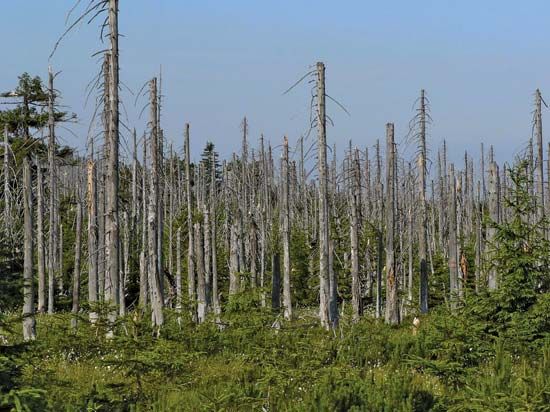
What is acid rain, and how does it form?
Acid rain, more scientifically termed acid deposition, refers to the various ways acidity moves from the atmosphere to Earth’s surface. While the term is often associated with rain, it also encompasses other forms of wet deposition—such as snow, sleet, hail, and fog—as well as the dry deposition of acidic particles and gases that can affect landscapes even in the absence of precipitation.14
Formation
Acid deposition is primarily caused by the emission of sulfur dioxide (SO₂) and nitrogen oxides (NOₓ) into the atmosphere, largely through the combustion of fossil fuels like coal, oil, and natural gas.1514
Once these pollutants are airborne, they undergo chemical reactions with water, oxygen, and other chemicals to form sulfuric acid (H₂SO₄) and nitric acid (HNO₃). These acids lower the pH of precipitation; while normal rainwater is slightly acidic (around 5.7) due to dissolved carbon dioxide, acid rain is defined as precipitation with a pH of less than 5.2.151614
Sources
- weather modification - Cloud seeding — Encyclopædia Britannica
- Cloud seeding — Encyclopædia Britannica
- weather modification - General considerations — Encyclopædia Britannica
- weather modification - Precipitation modification — Encyclopædia Britannica
- What Is the Difference Between El Niño and La Niña? — Encyclopædia Britannica
- La Niña — Encyclopædia Britannica
- Climate change - Interannual variation — Encyclopædia Britannica
- El Niño — Encyclopædia Britannica
- Precipitation — Encyclopædia Britannica
- How Is Artificial Snow Made? — Encyclopædia Britannica
- Climate - Mechanisms of precipitation release — Encyclopædia Britannica
- Atmosphere - Precipitation of ice — Encyclopædia Britannica
- Hail — Encyclopædia Britannica
- What causes acid rain? — Encyclopædia Britannica
- hydrosphere - Acid rain — Encyclopædia Britannica
- Acid rain - Chemistry of acid deposition — Encyclopædia Britannica
Published on · 4 min read