Cotoneaster
Cotoneaster is a versatile genus of shrubs and small trees widely cultivated for their attractive growth habits and ornamental value in temperate landscapes.
How is cotoneaster typically used in landscaping and gardening?
Cotoneaster is a versatile genus of shrubs and small trees widely cultivated for their attractive growth habits and ornamental value in temperate landscapes.1
Their use in gardening typically depends on their size and growth form:
- Ground Cover: Low-growing species, such as the creeping cotoneaster (C. adpressus), are particularly useful for covering ground due to their compact height of less than 30 cm. Other low-growing varieties like rockspray, bearberry, and cranberry cotoneaster are also popular choices for landscape design.1
- Shrubs and Hedging: Species that reach heights of 1–4 metres, such as the spreading, Peking, many-flowered, and European cotoneasters, are often used as ornamental shrubs.1
- Specimen Plants: In warmer climates, larger species like the tree cotoneaster can reach heights of up to 6 metres, serving as taller focal points in a garden.1
While these plants are valued for their showy fruit and flowers, it is important to note that some members, such as the bright bead cotoneaster, are considered invasive species in certain regions.1
Are there any edible or medicinal uses for cotoneaster?
What is a cotoneaster plant and what are its main characteristics?
The cotoneaster is a genus comprising at least 50 species of shrubs and small trees belonging to the rose family (Rosaceae). Native to temperate Eurasia, these plants are closely related to hawthorns and firethorns.1
Key characteristics include:
- Foliage: They can be deciduous or evergreen, featuring alternate, smooth-edged leaves.1
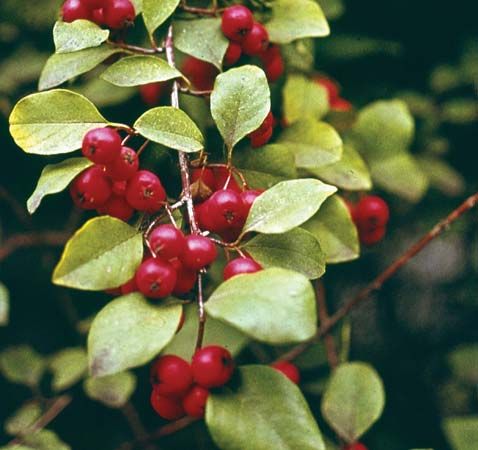
- Flowers: The plants produce small, five-petaled flowers in shades of white to pink, typically arranged in clusters.1
- Fruit: They bear showy, pome-type fruit that ranges from red to black, measuring approximately 8 mm in diameter and containing two to five stones.1
- Growth Habit: They vary significantly in size, ranging from low-growing ground covers under 30 cm tall to larger shrubs and trees reaching up to 6 metres in warmer climates.1
While widely appreciated for their ornamental value, some varieties, such as the bright bead cotoneaster, are classified as invasive species in certain regions.1
What are the different species of cotoneaster and how do they vary?
The genus Cotoneaster includes at least 50 species that vary significantly in their growth habits, ranging from low-lying ground covers to small trees. These species are primarily categorized by their height and structural form.1
Low-Growing Species
These plants typically reach heights of less than 1 metre (3.3 feet) and are often utilized in landscaping for their compact size.1
- Creeping cotoneaster (C. adpressus): A very low-growing variety that stays under 30 cm (1 foot) tall, making it an effective ground cover.1
- Rockspray or rock cotoneaster (C. horizontalis): A low-growing species valued for its ornamental habit.1
- Bearberry cotoneaster (C. dammeri): Another low-growing member of the genus.1
- Cranberry cotoneaster (C. apiculatus): A compact species suitable for smaller landscape spaces.1
Shrub-Forming Species
These species generally grow between 1 and 4 metres (3.3–13.1 feet) tall.1
- Spreading cotoneaster (C. divaricatus): A Chinese shrub characterized by its spreading branches, pink flowers, and red ellipsoid fruit.12
- Peking cotoneaster (C. acutifolius), many-flowered cotoneaster (C. multiflorus), and common or European cotoneaster (C. integerrimus): These are standard shrub-sized varieties.1
Tree-Forming Species
In warmer climates, certain species can reach heights of 4.5–6 metres (15–20 feet).1
- Purpleberry cotoneaster (C. affinis), Cooper’s cotoneaster (C. cooperi), and tree cotoneaster (C. frigidus): These represent the larger, tree-like members of the genus.1
Additionally, some species, such as the bright bead cotoneaster (C. glaucophyllus), are recognized as invasive species in various regions.1
Sources
- cotoneaster — Encyclopædia Britannica
- spreading cotoneaster — Merriam-Webster
Published on · 3 min read