Creeping Water Bug
A creeping water bug is any flat-backed, oval-shaped insect belonging to the family Naucoridae (order Heteroptera). There are approximately 150 species in…
What is creeping water bug?
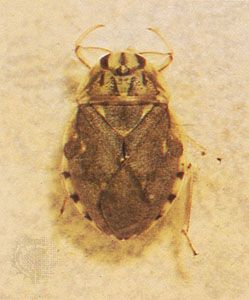
A creeping water bug is any flat-backed, oval-shaped insect belonging to the family Naucoridae (order Heteroptera). There are approximately 150 species in this family, which are also commonly referred to as water creepers or naucorids.1234
These small, dark insects typically measure between 5 and 16 millimeters (0.2 to 0.6 inches) in length. They are primarily found in tropical regions, where they inhabit quiet, grassy, or reedy waters. As predators, they feed on small aquatic organisms.1
Most creeping water bugs are adapted for an aquatic lifestyle by breathing from air stored under their wings while submerged. While most members of the family rely on these air stores, some species in the subfamily Aphelocheiridae can remain underwater indefinitely by extracting oxygen directly from the surrounding water. They are distinct from other aquatic insects, such as the giant water bug, which belongs to a different family (Belostomatidae) and is generally much larger.152
How do aquatic insects breathe while submerged underwater?
Aquatic insects have evolved diverse strategies to extract oxygen while submerged, as their primary respiratory organs—the trachea—are fundamentally designed for air-breathing.
Atmospheric Air Reliance
Many aquatic insects must periodically return to the surface to replenish their oxygen supply:
- Air Bubbles: Insects like the water beetle carry a bubble of air trapped against their bodies. As they consume oxygen, the bubble acts as a physical gill, allowing dissolved oxygen from the water to diffuse into the bubble to replace what was used.78
- Siphons: Some, such as mosquito larvae, use a respiratory siphon that breaks the surface film to intake air directly.89
Permanent Submergence
Other insects have developed adaptations to remain underwater indefinitely:
- Plastron Respiration: Certain insects, including some creeping water bugs, possess a plastron—a thin, permanent layer of air held against the body by dense, water-repellent hairs. This structure allows for continuous gas exchange with the surrounding water.729
- Tracheal Gills: Many immature insects, such as mayfly and caddisfly larvae, utilize thin-walled external gills that contain tracheal networks, enabling them to extract oxygen directly from the water.78
- Internal Stores: Some species, like Buenoa, utilize hemoglobin-filled cells to store oxygen internally.7
What are some other examples of predatory insects that live in water?
Beyond the creeping water bug, there are several other predatory insects that thrive in aquatic environments:
- Predaceous diving beetles: Members of the family Dytiscidae, these carnivorous beetles range from 1.5 mm to over 35 mm in length. Both the adults and their larvae—often called “water tigers”—are voracious predators that feed on insects, tadpoles, and even small fish.
- Giant water bugs: Belonging to the family Belostomatidae, these are among the largest aquatic insects. They are ambush predators that hang suspended in the water, using their front legs to grasp prey such as insects, snails, salamanders, and small fish.
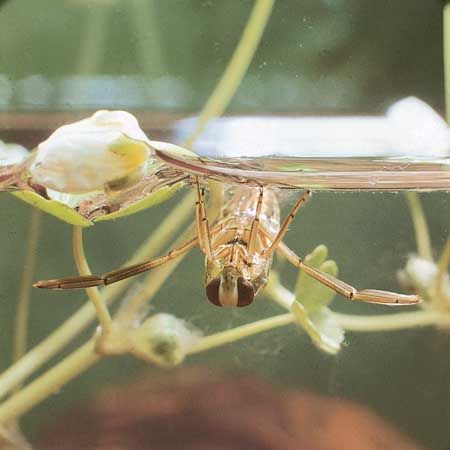
- Backswimmers: These insects (family Notonectidae) are named for their habit of swimming on their backs. They are active predators that use their long, oarlike legs to pursue prey, including insects, tadpoles, and small fish, which they consume by sucking out body fluids.
- Dragonfly larvae: Also known as naiads, these aquatic nymphs are highly effective predators. They possess a unique, extendable mouthpart called a “mask” equipped with fanglike pincers, which they use to seize prey such as mosquito larvae, worms, crustaceans, and tadpoles.
How do backswimmers differ from creeping water bugs?
Backswimmers (family Notonectidae) and creeping water bugs (family Naucoridae) are both members of the suborder Heteroptera, but they differ significantly in their physical characteristics and behaviors:
- Swimming and Posture: Backswimmers are named for their unique habit of swimming on their backs, which are shaped like the keel of a boat. They use long, oarlike legs for propulsion and are often seen floating at the water’s surface with their legs extended. In contrast, creeping water bugs are generally not characterized by this inverted swimming style.
- Respiration: While both groups rely on air stores, their capabilities differ. Backswimmers must surface periodically to replenish air stored in chambers under their wings or trapped by dense hairs. While most creeping water bugs also use air stores, some members of the related family Aphelocheiridae can remain submerged indefinitely by extracting oxygen directly from the water.
- Body Shape: Backswimmers typically have an elongated body and an oval-shaped head, usually measuring less than 15 mm. They also exhibit countershading, a form of camouflage where their light-colored backs blend with the sky when viewed from below, and their darker undersides blend with the bottom of the water when viewed from above.
Sources
- creeping water bug — Encyclopædia Britannica
- heteropteran - Habitats — Encyclopædia Britannica
- Naucoridae — Merriam-Webster
- water creeper — Merriam-Webster
- naucorid — Merriam-Webster
- giant water bug — Encyclopædia Britannica
- Respiratory system - Trachea — Encyclopædia Britannica
- insect - Aquatic insects — Encyclopædia Britannica
- heteropteran - Respiratory system — Encyclopædia Britannica
- predaceous diving beetle — Encyclopædia Britannica
- nymph — Encyclopædia Britannica
- backswimmer — Encyclopædia Britannica
- dragonfly — Encyclopædia Britannica
- mosquito: Top Questions — Encyclopædia Britannica
- List of insects - hemipterans (order Hemiptera) — Encyclopædia Britannica
Published on · 3 min read