Dragonfly
While both dragonflies and damselflies belong to the order Odonata, they possess distinct physical and behavioral differences:
What are the main differences between dragonflies and damselflies?
While both dragonflies and damselflies belong to the order Odonata, they possess distinct physical and behavioral differences:
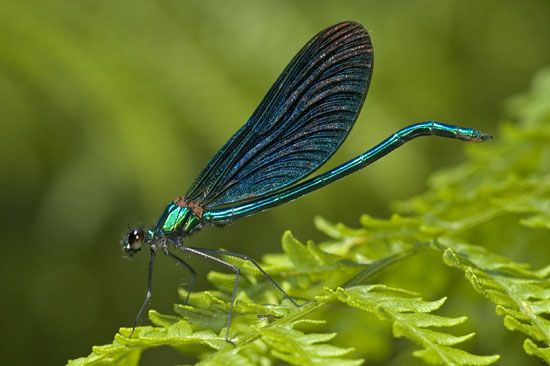
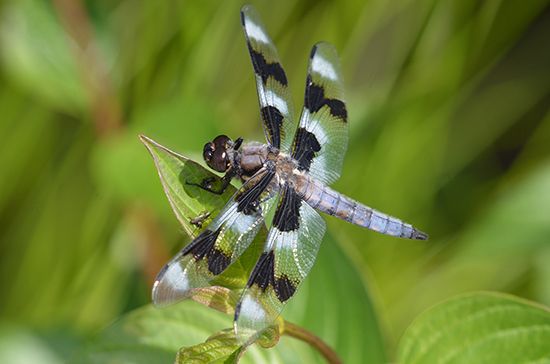
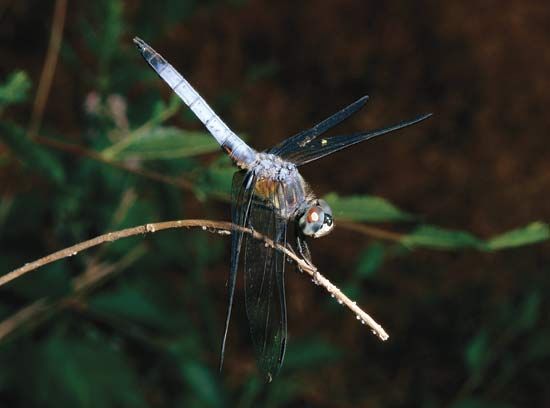
- Resting Position: When at rest, damselflies typically hold their wings vertically together above their bodies, whereas dragonflies hold their wings spread horizontally.12
- Eyes: Dragonfly eyes are large and often touch or are very close together, providing a nearly 360-degree field of vision. In contrast, damselfly eyes are always widely separated.123
- Body Shape: Dragonflies have a more robust, powerful build. Damselflies are generally smaller, more delicate, and possess thinner, needlelike abdomens.12
- Wing Structure: Dragonfly wing pairs are shaped differently from one another. Damselfly wings are almost identical in size and shape.12
- Larval Development: Damselfly larvae breathe using three external, leaflike gills at the tip of the abdomen, while dragonfly larvae possess internal gills.12
- Flight: Dragonflies are generally stronger, more agile fliers compared to the weaker, more graceful flight of damselflies.12
Are there any cultural or symbolic meanings associated with dragonflies in different parts of the world?
The provided search results do not contain information regarding the cultural or symbolic meanings of dragonflies in different parts of the world. While the text notes that some names, such as “snake doctor” or “devil’s darning needle,” are rooted in regional superstitions, it does not provide a broader overview of global cultural symbolism.
Sorry, the Britannica knowledge base does not contain this information.
What role do dragonflies play in their ecosystems?
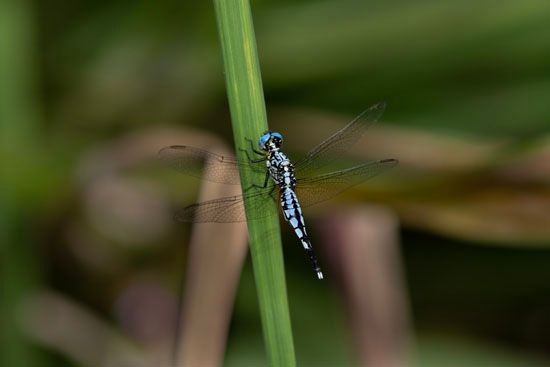
Dragonflies play a vital role in their ecosystems as both predators and prey throughout their life cycle. As members of the order Odonata, they function as significant macroinvertebrates that help maintain the balance of freshwater habitats.
Aerial and Aquatic Predation
Dragonflies are highly effective predators in two distinct environments:
- Adults: As agile aerial hunters, they consume large quantities of flying insects, including mosquitoes and flies. Their speed and hunting efficiency allow them to capture prey that can be up to 60 percent of their own body weight.3
- Larvae: During their aquatic stage, dragonfly larvae (or nymphs) are voracious predators. Using a specialized anatomical structure called a “mask,” they seize various aquatic organisms, including worms, crustaceans, tadpoles, and small fish.35
Role in the Food Web
Dragonflies serve as a critical link in the food chain. While they are predators, they are also a primary food source for a variety of animals, including birds, amphibians, reptiles, and fish. Their presence and abundance contribute significantly to the biomass of freshwater ecosystems.675
What is the life cycle of a dragonfly, from egg to adult?
The life cycle of a dragonfly is a process of incomplete metamorphosis, occurring in three primary stages: egg, aquatic nymph (or naiad), and adult.
Egg Stage
The cycle begins when a female lays eggs in or near water. Depending on the species, she may deposit them within plant tissue, attach them to leaves, or drop them directly onto the water’s surface.8
Nymph (Naiad) Stage
Upon hatching, the dragonfly enters the nymphal stage. Unlike many other insects, dragonflies do not have a pupal stage. Instead, they develop through a series of stages called instars, molting 8 to 17 times as they grow.9
- Aquatic Life: These nymphs are aquatic and possess gills for underwater respiration.7
- Development: They are voracious predators, feeding on small crustaceans, snails, and even small fish. This stage can last anywhere from three weeks to eight years, depending on the species and climate.9
Adult Stage
When the nymph reaches maturity, it climbs out of the water onto vegetation to undergo its final molt, a process known as emergence7. The newly emerged adult is initially soft and pale, eventually hardening into its flight-ready form. Adults then undergo a maturation period before becoming reproductively active and beginning the cycle anew.8
Sources
- damselfly — Encyclopædia Britannica
- List of insects - dragonflies and damselflies (order Odonata ) — Encyclopædia Britannica
- dragonfly — Encyclopædia Britannica
- Odonata - Basic structure — Encyclopædia Britannica
- macroinvertebrate — Encyclopædia Britannica
- What Purposes Do Mosquitoes Serve in Ecosystems? — Encyclopædia Britannica
- Odonata - The larval stage — Encyclopædia Britannica
- Odonata - The adult stage — Encyclopædia Britannica
- nymph — Encyclopædia Britannica
Published on · 3 min read