Caddisfly
The diet of a caddisfly changes significantly as it transitions from its immature stage to adulthood.
What do adult caddisflies eat, and how does this differ from their larval diet?
The diet of a caddisfly changes significantly as it transitions from its immature stage to adulthood.
Larval Diet
In their aquatic larval stage, most caddisflies are herbivores or detritivores, consuming aquatic plants, algae, diatoms, or decaying plant debris. However, this diet varies by species: some are predatory, feeding on other aquatic insects, crustaceans, and mollusks, while others are omnivorous.1
Adult Diet
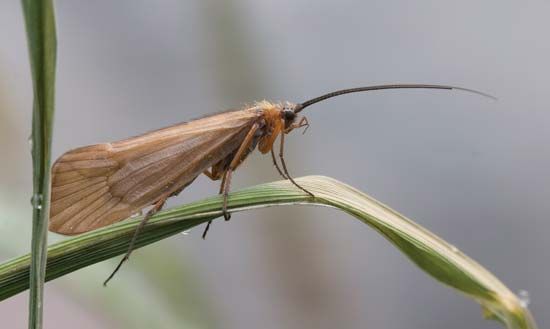
Adult caddisflies have a much more restricted diet. Because most species are physically incapable of consuming solid food, they survive by imbibing nectar from flowers.1
This shift from the diverse, solid-based diet of the larva to a liquid-based adult diet is a key aspect of their life cycle. While larvae are essential for processing organic matter within food webs, the nectar-feeding adults play a different ecological role, with at least one species even acting as a pollinator for Alpine flowers.1
How do caddisfly larvae construct their protective cases, and what materials do they use?
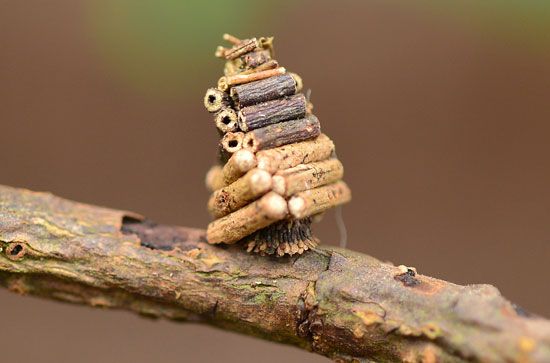
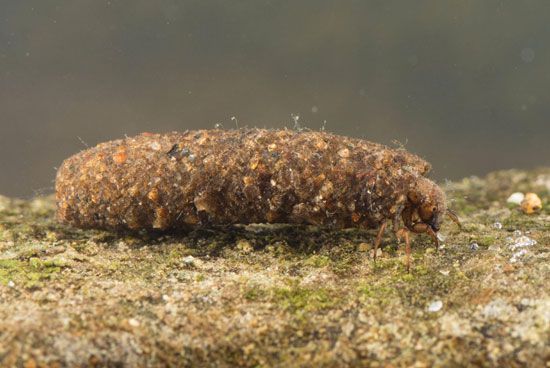
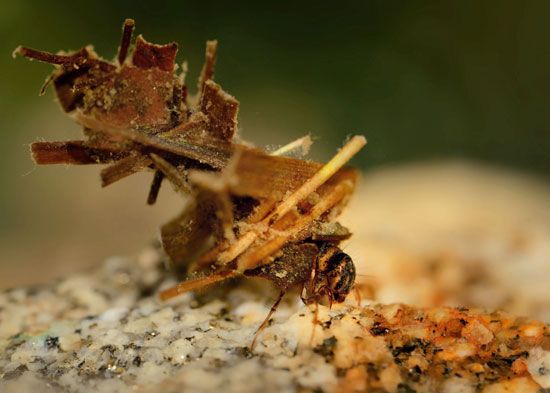
Caddisfly larvae construct their protective cases using silk produced by glands located on their lower lip, or labium.3
Many herbivorous species utilize this silk to spin tubular cases that are open at both ends, which they enlarge as they grow. To provide additional protection and structural rigidity, the larvae incorporate various materials into the silk, most commonly sand grains or vegetable debris.3
While inside these cases, the larvae pull the structure along with their abdomen, with their head and thorax protruding from the opening. The cases also serve a respiratory function; by performing undulating movements, the larvae circulate water through the tube to ensure a steady supply of oxygen. Before pupating, the larva typically attaches its case to a solid object and seals the ends, leaving only small holes to maintain water circulation.3
What is the economic importance of caddisflies, both positive and negative?
Caddisflies (order Trichoptera) provide significant ecological and economic value, primarily through their roles in freshwater ecosystems and their utility in human recreation.
Positive Economic and Ecological Importance
- Recreational Angling: Because caddisflies are a primary food source for fish, particularly trout, they are essential to the sport of fly-fishing. Their life stages are frequently used as models for artificial lures.251
- Environmental Monitoring: As nonmigratory macroinvertebrates, caddisflies serve as vital indicators of environmental health. Because different species exhibit varying sensitivities to pollution, their presence or absence helps scientists assess water quality during infrastructure and conservation projects.51
- Ecosystem Services: Larvae are critical to food webs, as they process organic matter by consuming algae and decaying plant debris, effectively recycling nutrients within aquatic communities.21
Negative Impacts
The provided search results do not identify significant negative economic impacts caused by caddisflies. Unlike some other macroinvertebrates that transmit disease or cause irritation, caddisflies are generally considered beneficial components of their habitats.5
What are some common predators of caddisflies in both their larval and adult stages?
Caddisflies serve as a vital food source for a wide variety of predators throughout their life cycle. Their vulnerability to predation changes significantly as they transition from aquatic larvae to winged adults.
Larval Predators
During their immature, aquatic stages, caddisflies are primarily consumed by:
- Freshwater fish: Species such as trout and eels are significant predators of both larvae and swimming pupae.12
- Parasites: Certain hymenopterans parasitize the larvae. Specifically, a parasitic wasp may enter the water to lay its eggs inside a caddisfly’s protective case; the resulting parasitic larva then consumes the caddisfly host.1
Adult Predators
Once they emerge as adults, caddisflies face a broader range of terrestrial and aerial predators, including:
Sources
- caddisfly - Ecology — Encyclopædia Britannica
- caddisfly — Encyclopædia Britannica
- caddisfly - Life cycle — Encyclopædia Britannica
- caddisfly - Distinguishing taxonomic features — Encyclopædia Britannica
- macroinvertebrate — Encyclopædia Britannica
Published on · 3 min read