Firefly
The dietary habits of fireflies (family Lampyridae) vary significantly between their developmental stages:
What do fireflies eat in their larval and adult stages?
The dietary habits of fireflies (family Lampyridae) vary significantly between their developmental stages:
- Larval Stage: Firefly larvae are predatory and live on the ground. They feed primarily on snails and slugs by injecting a fluid into their prey and then withdrawing the partially digested matter through hollow mouthparts.1
- Adult Stage: The feeding habits of adult fireflies are diverse. Many species feed on pollen and nectar. However, some adult fireflies do not eat at all. Additionally, in a few specific species, females are predatory and will feed on the males of other firefly species.1
What are the main predators of fireflies?
While fireflies possess a bitter taste that serves as a chemical defense against many predators, they are not immune to predation. The primary predators identified include:
- Frogs: Certain species of frogs are known to consume large numbers of fireflies. In some instances, these frogs ingest so many that they themselves exhibit a glow.1
- Other Fireflies: A form of aggressive mimicry exists within the family Lampyridae. Specifically, females of the genus Photuris are known to prey upon males of the genus Photinus. By mimicking the flash patterns of female Photinus, the Photuris female lures the male in to be captured and eaten.14
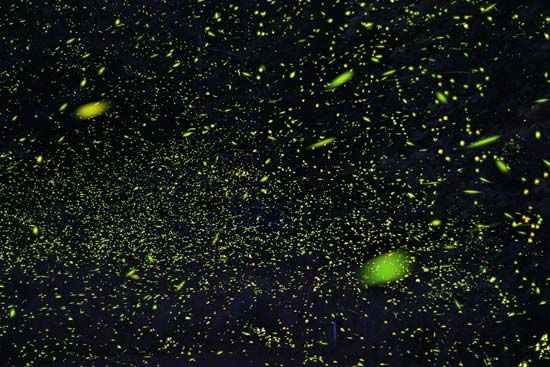
Some researchers suggest that the rhythmic flashing patterns of fireflies may function as a warning signal to potential predators, reminding them of the insect’s unpleasant taste.15
What is the life cycle of a firefly, from egg to adult?
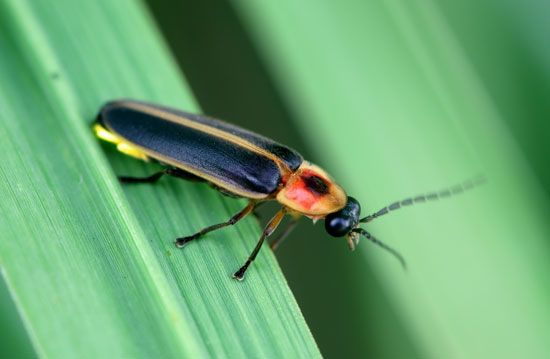
The life cycle of a firefly (family Lampyridae) follows a process of complete metamorphosis, consisting of four distinct stages: egg, larva, pupa, and adult.
- Egg: The cycle begins when eggs are laid, often in moist soil or on vegetation. In some species, the eggs themselves may exhibit bioluminescence before hatching.1
- Larva: Upon hatching, the larvae live on the ground. They are predatory, feeding on snails and slugs by injecting a fluid into their prey and consuming the partially digested remains through hollow mouthparts. These larvae are sometimes referred to as glowworms.16
- Pupa: After a period of growth, the larva enters the pupal stage, during which it undergoes a transformation into its adult form.
- Adult: The adult firefly emerges from the pupal stage. While the larva is the primary nutritive stage, the adult stage is focused on reproduction. Adult feeding habits vary; some species consume pollen and nectar, while others do not eat at all. Adults use rhythmic bioluminescence to signal and locate mates.1
How many species of fireflies exist, and where are they commonly found?
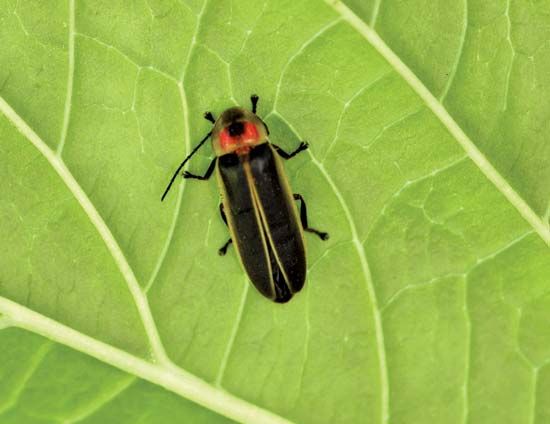
There are approximately 2,000 known species of fireflies (family Lampyridae), which are a type of beetle.
These insects are widely distributed and are commonly found in most tropical and temperate regions across the globe.1
Sources
- firefly — Encyclopædia Britannica
- lamprey — Encyclopædia Britannica
- agnathan - General features — Encyclopædia Britannica
- mimicry - Fireflies — Encyclopædia Britannica
- How do fireflies light up? — Encyclopædia Britannica
- Diptera - Pupa — Encyclopædia Britannica
- Lepidoptera - The adult — Encyclopædia Britannica
- glowworm — Encyclopædia Britannica
Published on · 2 min read