Cuckoo-shrike
A cuckoo-shrike is any of several Old World songbirds belonging to the family Campephagidae. Despite their name, they are not true shrikes; they are…
What is Cuckoo-shrike?
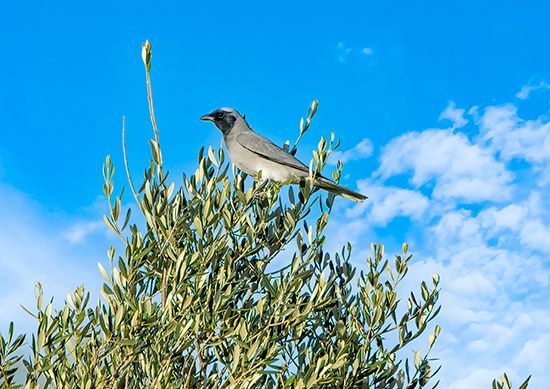
A cuckoo-shrike is any of several Old World songbirds belonging to the family Campephagidae. Despite their name, they are not true shrikes; they are distinguished from true shrikes by their undulating flight, which resembles that of a cuckoo.1
These birds are found from Africa to the Pacific Islands and typically inhabit forests and gardens. They generally possess slightly hooked bills, long tails, and fluffy plumage. While most species are arboreal, the ground cuckoo-shrike of Australia is a notable exception.23
Their diet consists largely of fruit and insects, particularly caterpillars, which—along with their often gray, barred plumage—contributes to their cuckoo-like appearance. They are known for their social behavior, often moving in noisy flocks and nesting high in trees.23
What makes the flight pattern of a cuckoo-shrike unique?
The flight pattern of a cuckoo-shrike is characterized by a distinct undulating motion. This style of movement is a primary feature used to distinguish these birds from true shrikes, as the pattern closely resembles the flight of a cuckoo.2
While true shrikes and cuckoo-shrikes were historically grouped together in the family Laniidae, their flight mechanics serve as a key taxonomic differentiator. The undulating flight—a series of rhythmic rises and dips—is a hallmark of the family Campephagidae, setting them apart from other songbirds with similar habits, such as flycatchers.21
How do cuckoo-shrikes differ from true shrikes?
While cuckoo-shrikes were historically classified within the family Laniidae alongside true shrikes, they are now placed in their own family, Campephagidae2.2
The primary differences between the two groups include:
- Flight Pattern: Cuckoo-shrikes are distinguished by their undulating flight, which involves a series of rhythmic rises and dips that closely resemble the flight of a cuckoo.1
- Taxonomy: True shrikes belong to the family Laniidae, whereas cuckoo-shrikes constitute the family Campephagidae.12
- Habits: Cuckoo-shrikes are often compared to flycatchers in their habits, whereas true shrikes are well-known for their predatory behavior, often impaling prey on thorns or barbed wire.1
While some cuckoo-shrikes may display a shrikelike mask in their plumage, they remain distinct from true shrikes in both their evolutionary lineage and their characteristic movement through the air.2
What are some other examples of birds in the Campephagidae family?
The family Campephagidae includes nearly 90 species of songbirds, primarily categorized as cuckoo-shrikes and minivets. These birds are found across regions ranging from Africa to the Pacific Islands.1
Examples of birds within this family include:
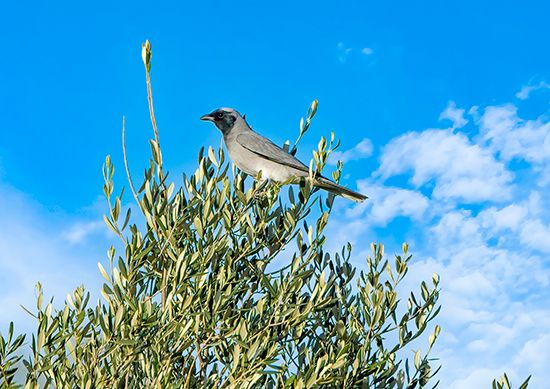
- Large (or black-faced) cuckoo-shrike (Coracina novaehollandiae): A species measuring about 30 cm in length, found from India and China to Australasia.4
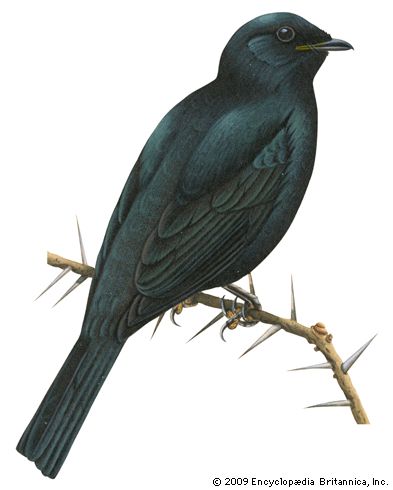
- Black cuckoo-shrike (Campephaga phoenicea): An African species where males are typically glossy black, while females are brownish and barred. Some races within this group feature red or yellow shoulders.4
- Ground cuckoo-shrike (Pteropodocys maxima): Native to Australia, this is the only member of the family that is not arboreal.4
- Trillers (genus Lalage): Found in Australia and the Pacific islands, these birds are often black and white and are known for their distinct trilling calls.5
Sources
- Cuckoo-shrike — Encyclopædia Britannica
- cuckoo shrike — Merriam-Webster
- Cuculiform - Food habits — Encyclopædia Britannica
- Campephagidae — Encyclopædia Britannica
- triller — Merriam-Webster
Published on · 2 min read