Munia
A munia is any of several small, finchlike birds belonging to the family Estrildidae and the order Passeriformes. These birds are closely related to the…
What is Munia?
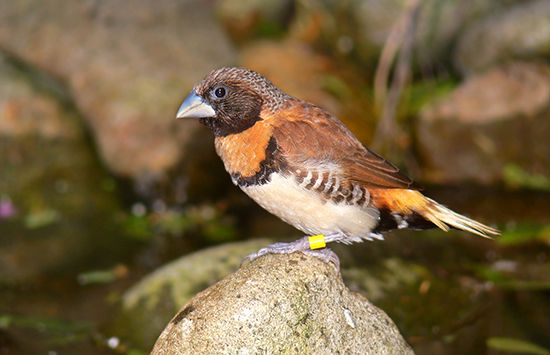
A munia is any of several small, finchlike birds belonging to the family Estrildidae and the order Passeriformes. These birds are closely related to the mannikin and waxbill groups1.
Munia species are found across Asia and are often kept as pets or recognized for their impact on agriculture. Notable examples include:
- Black-headed munia (Lonchura malacca): Often called the tricolour nun when kept as a cage bird, this species is considered a pest in rice fields throughout regions ranging from India to the Philippines.1
- White-headed munia (L. maja): A species native to areas from Thailand to Java that is frequently kept as a pet.1
- Green munia (Amandava formosa): Also known as the green tiger finch, this bird is native to India.1
- White-throated munia: Frequently referred to as a silverbill.1
For information regarding the red munia, you may wish to look into the avadavat.1
What are the main characteristics of the Estrildidae bird family?
The Estrildidae family, belonging to the songbird suborder Passeri, consists of approximately 140 species of small, finchlike birds native to the Old World. These birds are characterized by their short, stout bills, short legs, and a diverse array of vibrant colors and patterns.2
Key characteristics of the family include:
- Size: Members typically range from 7.5 to 15 cm (3 to 6 inches) in length.2
- Diet and Behavior: They are gregarious ground feeders that primarily consume seeds, berries, and insects.2
- Vocalization: While many are popular as cage birds due to their liveliness and adaptability, they are generally considered poor singers, with songs often consisting of chirps, buzzes, and chatters.2
- Diversity: The family includes various groups such as waxbills, mannikins, munias, fire finches, and parrot finches. Some classifications also include whydahs, which are notable for being brood parasites that lay their eggs in the nests of other species.23
- Regional Variations: Certain tribes, such as the grass finches of Australasia, exhibit specific traits like long, pointed tails and a preference for hot, open country near rivers.4
Why are some munia species considered pests in rice farming?
Some species of munia, such as the black-headed munia (Lonchura malacca), are considered agricultural pests because they frequently feed on rice crops. Their tendency to congregate in rice fields across regions spanning from India to the Philippines can lead to significant damage to harvests, as these small, finchlike birds consume the grain directly from the plants.1
What are the differences between mannikins and waxbills?
Both mannikins and waxbills belong to the Estrildidae family of songbirds, but they are distinguished by their specific physical traits and taxonomic groupings.52
Mannikins
- Classification: These birds belong to the tribe Amadini, specifically within the genus Lonchura.5
- Appearance: They are generally brownish in color, often featuring black throats and fine barring patterns.5
- Distribution: They are found in large flocks across open country ranging from Africa to Australia.5
- Common Examples: This group includes the bronze mannikin, the nutmeg mannikin (also known as the spice finch or spotted munia), and the striated mannikin (also known as the white-backed munia).5
Waxbills
- Classification: The name is used broadly for the entire family, but more specifically for the tribe Estrildini and the genus Estrilda.6
- Appearance: They are named for their prominent, conical bills, which are often red—resembling the color of sealing wax. Most species are brown or grayish with touches of red, yellow, or black, and they typically exhibit fine barring.6
- Distribution: Most species of the genus Estrilda are native to Africa.6
Sources
- Munia — Encyclopædia Britannica
- Estrildidae — Encyclopædia Britannica
- Grass finch — Encyclopædia Britannica
- Passeriform - Territoriality and courtship — Encyclopædia Britannica
- Mannikin — Encyclopædia Britannica
- Waxbill — Encyclopædia Britannica
Published on · 3 min read