Flycatcher
Flycatchers are highly migratory, insectivorous birds that typically travel at night to reach their wintering grounds. As nocturnal migrants, they rely on…
How do flycatchers migrate, and which species are known for long-distance migration?
Flycatchers are highly migratory, insectivorous birds that typically travel at night to reach their wintering grounds. As nocturnal migrants, they rely on celestial navigation, using the stars to determine their bearings and maintain a constant direction during their long-distance journeys.123
Many flycatcher species are known for their extensive migrations, often traveling from breeding grounds in northern regions to spend the winter in the tropics. For example, insectivorous species in Europe, including various flycatchers, migrate to tropical Africa, reaching as far south as the tip of the continent. Similarly, many American flycatchers (family Tyrannidae) exhibit long-distance migratory behavior similar to that of hummingbirds, moving between North America and wintering areas in Central and South America. These journeys are not continuous; they are characterized by intermittent flights interrupted by stops to rest and hunt for food.142
What are the unique feeding habits and adaptations of flycatchers?
Flycatchers, which include the Old World Muscicapidae family and the New World Tyrannidae family, are primarily insectivorous birds that have evolved specialized behaviors to secure their food.1
Feeding Habits and Adaptations
The defining feeding strategy of these birds is “hawking,” a method where they dart out from a perch to capture insects while in flight. This behavior requires high agility and keen vision to track and intercept prey on the wing. While the majority of flycatchers are insectivorous, their dietary habits can be diverse; some New World species are known to supplement their diet by consuming fish.16
These birds have developed structural specializations to support their feeding patterns, particularly in their bills and feet, which allow them to effectively exploit their environment. Because feeding patterns are the result of an evolutionary interplay between a species’ phylogenetic structure and its ecological niche, flycatchers have adapted to compete successfully for specific food sources. This specialization often allows closely related species to coexist in the same area by foraging in different ways or targeting different types of prey.67
What is the typical size range for flycatcher species?
Flycatchers are members of the order Passeriformes, a group of land birds that generally range from 7.5 to 117 cm (3 to 46 inches) in total length. Within this order, flycatchers are categorized as small to medium-sized birds.
Specific examples of flycatcher sizes include:
- Dusky flycatcher (Alseonax adustus): Approximately 10 cm (4 inches) in length.
- Spotted flycatcher (M. striata): Approximately 14 cm (5.5 inches) in length.
While many passerine species typically fall within the range of 12.5 to 20 cm (5 to 8 inches), some of the smallest members of the order are found among the New World flycatchers (family Tyrannidae).
How many species of flycatchers exist, and where are they typically found?
The term “flycatcher” refers to two distinct groups of birds, each with its own distribution and diversity:
- New World Flycatchers (Family Tyrannidae): This group, known as tyrant flycatchers, consists of about 400 species. They are primarily found in the Americas, with the highest diversity in Central and South America, though approximately 30 species breed in North America. This family includes specialized subgroups such as the tyrannulets, which comprise about 50 species.110
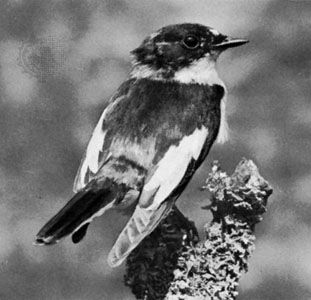
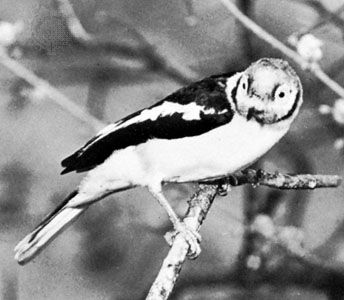
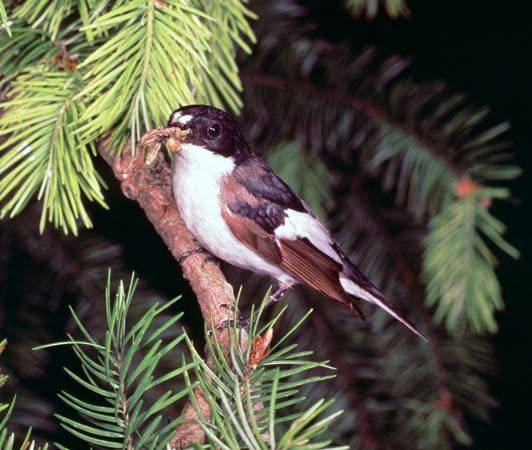
- Old World Flycatchers (Family Muscicapidae): These are the “typical” flycatchers. While the exact number of species varies depending on the classification system used—as some taxonomists include thrushes, warblers, and babblers within this family—the group is widespread across Europe, Africa, and Asia. For example, the spotted flycatcher is common in Europe and Asia, while the dusky flycatcher is widespread in Africa.12
Because these groups belong to different families and inhabit different geographic regions, their total species count is not represented by a single figure.
Sources
- Flycatcher — Encyclopædia Britannica
- Migration - In Europe — Encyclopædia Britannica
- Migration - In North America — Encyclopædia Britannica
- Migration - Modes of migration — Encyclopædia Britannica
- Migration - Birds — Encyclopædia Britannica
- Passeriform - Size range and structural diversity — Encyclopædia Britannica
- Bird - Feeding habits — Encyclopædia Britannica
- Feeding behaviour - Types of food procurement — Encyclopædia Britannica
- Falconiform - Feet and beak — Encyclopædia Britannica
- tyrannosaur - Classification — Encyclopædia Britannica
- tyrannosaur - Other skeletal features — Encyclopædia Britannica
- Tyrant flycatcher — Encyclopædia Britannica
- Tyrannulet — Encyclopædia Britannica
Published on · 3 min read