Cyclostome
The term cyclostome refers to two distinct groups of organisms depending on the biological context:
What is cyclostome?
The term cyclostome refers to two distinct groups of organisms depending on the biological context:
Vertebrates
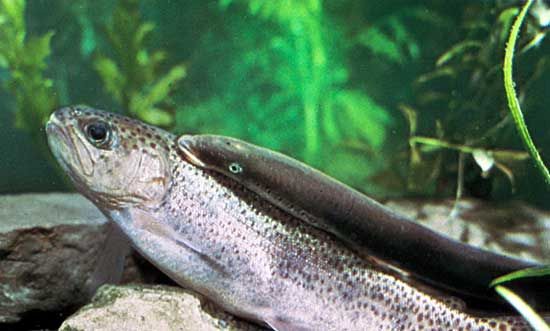
In zoology, cyclostome is a collective term for the living members of the superclass Agnatha, which includes lampreys and hagfishes. These jawless fish are characterized by:1
- A long, slender, scaleless body without fins.1
- A round, jawless mouth often equipped with horny teeth.12
- A cartilaginous skull and a persistent notochord.1
Unlike higher vertebrates, modern cyclostomes lack true bone, possessing only an endoskeleton made of noncalcified cartilage.3
Invertebrates
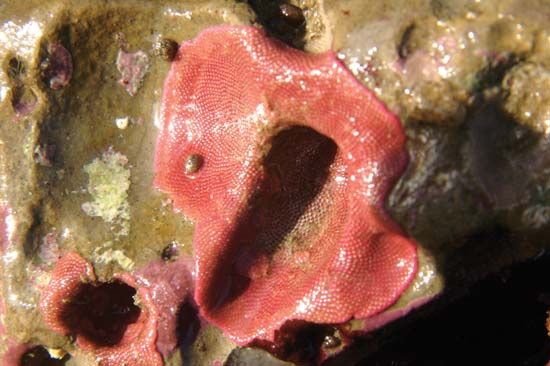
In the study of bryozoans (moss animals), Cyclostomata is an order within the class Stenolaemata. These are sedentary, aquatic invertebrates that form colonies of zooids. They are distinguished by having a circular orifice and a circular lophophore, and they have existed from the Ordovician period to the present.4
What are the main differences between lampreys and hagfish?
While both lampreys and hagfishes are jawless, eel-shaped vertebrates belonging to the class Agnatha, they exhibit significant differences in their anatomy, habitat, and life cycles.36
Key Differences
Feature
Lampreys
Hagfishes
Eyes
Well-developed.
Vestigial and skin-covered.
Habitat
Cool, fresh, and coastal waters.
Cold, deep marine waters.
Fins
Well-developed dorsal and caudal fins.
Only a low caudal fin.
Gills
Seven pairs of external gill openings.
Variable; gills open through pores or a common duct.
Development
Undergo radical metamorphosis from a larval stage.
Hatch as miniature adults.
Feeding
Often parasitic, using a suctorial disk to feed on blood/tissue.
Scavengers that feed on dead animals or invertebrates.
Lampreys are characterized by a complex life cycle that begins as a blind, filter-feeding larva called an ammocoete before transforming into an adult. In contrast, hagfishes are specialized bottom-dwellers that produce a unique gelatinous slime when disturbed and possess a single nostril positioned anteriorly above the mouth.36
What does it mean for an animal to be jawless?
To be “jawless” means an animal lacks the paired, bony or cartilaginous structures—specifically a movable lower jaw (mandible) and a fixed upper jaw (maxilla)—that most vertebrates use for biting, chewing, and handling food.7
In the context of Agnatha, the superclass of jawless fishes, this anatomical trait defines a group of primitive vertebrates that includes modern cyclostomes like lampreys and hagfishes, as well as various extinct forms. Because they lack true jaws, these animals cannot bite or chew in the traditional sense. Instead, they often rely on alternative feeding mechanisms, such as:89
- Filter feeding: Early agnathans likely strained tiny organisms from the water using their gill apparatus.10
- Suction and rasping: Modern cyclostomes have evolved specialized structures, such as suctorial mouths or rasping tongues, to feed on blood, tissue, or scavenged remains.10
Beyond the absence of jaws, agnathans are distinguished from jawed vertebrates (gnathostomes) by their lack of lateral fins supported by fin rays, true vertebrae, and certain complex sensory structures like the horizontal semicircular canal in the ear.11
How do lampreys undergo metamorphosis from larvae to adults?
Lampreys undergo a radical metamorphosis after spending approximately three years as a blind, wormlike ammocoete larva burrowed in stream silt. During this transformation, the animal undergoes several significant physiological and anatomical changes:36
- Sensory Development: The eyes, which are rudimentary in the larval stage, complete their development.36
- Oral Transformation: The hoodlike upper lip of the larva is restructured into a suctorial oral disk, which allows the adult to attach to hosts.36
- Glandular Changes: The endostyle—a mucus-secreting organ in the pharynx used for filter feeding—is transformed into a thyroid gland.36
- Physical Growth: The fins along the back increase in height, preparing the lamprey for a more active, free-swimming life.36
Once this process is complete, the lamprey typically migrates to the sea or remains in fresh water, depending on the species, to begin its adult life stage.311
Sources
- cyclostome — Encyclopædia Britannica
- cyclostome — Merriam-Webster
- agnathan - General features — Encyclopædia Britannica
- moss animal - Annotated classification — Encyclopædia Britannica
- bone - Evolutionary origin and significance — Encyclopædia Britannica
- lamprey — Encyclopædia Britannica
- jawless fish — Merriam-Webster
- muscle - Jawless fishes — Encyclopædia Britannica
- fish - Agnatha: early jawless fishes — Encyclopædia Britannica
- jaw — Encyclopædia Britannica
- agnathan: Top Questions — Encyclopædia Britannica
- tetraodontiform - Feeding habits — Encyclopædia Britannica
- Vertebrate - The cyclostomes — Encyclopædia Britannica
Published on · 3 min read