Goby
Gobies communicate primarily through visual displays, particularly when defending their territories. These behaviors are often used to signal dominance or…
How do goby fish communicate with each other?
Gobies communicate primarily through visual displays, particularly when defending their territories. These behaviors are often used to signal dominance or ward off intruders, especially during the breeding season.1
Common visual threat displays used by gobies include:
- Flaring their gill covers1
- Gaping their jaws1
- Puffing out their throats1
- Raising their heads1
- Shaking their bodies1
When these visual signals are insufficient to resolve a territorial dispute, male gobies may escalate their interaction to physical conflict, which involves biting and chasing. While many fish species utilize sound, chemical signals, or electrical discharges for communication, the provided information highlights these specific physical and behavioral postures as the primary means of interaction for gobies.1234
What are some interesting symbiotic relationships that goby fish have with other marine organisms?
Goby fish participate in several fascinating symbiotic relationships, ranging from mutualistic cleaning services to commensal burrow-sharing.
Cleaning Symbiosis
Some gobies, such as the neon goby, act as “cleaners.” In this mutualistic relationship, the goby removes and consumes parasites from the bodies of larger fish. The host fish benefit by being rid of harmful pests, while the goby gains a reliable food source.1
Burrow-Sharing
Many gobies rely on other marine organisms for shelter, often living in burrows created by other species:
- Ghost Shrimp: The blind goby is entirely dependent on the burrows dug by the ghost shrimp (Callianassa). The goby cannot survive without the shelter provided by the shrimp’s excavation efforts.15
- Other Associates: Various other goby species share their homes with burrowing worms, pea crabs, and snapping shrimps.5
These associations demonstrate the diverse ways gobies have adapted to their environments by forming close ties with other marine life.
How many species of goby fish exist, and what are some of the most common or interesting ones?
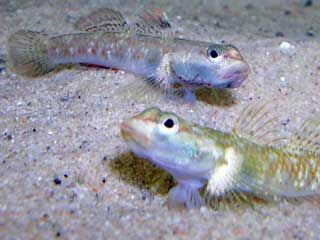
There are more than 2,200 species of fish within the suborder Gobioidei, with the majority belonging to the family Gobiidae. These carnivorous, typically small fish are found globally, particularly in tropical marine environments.1
Several notable species demonstrate the diversity within this group:
- Pygmy Goby (Pandaka pygmaea): Native to the Philippines, this is one of the smallest living vertebrates, reaching a maximum length of only about 13 millimetres (3/8 inch).1
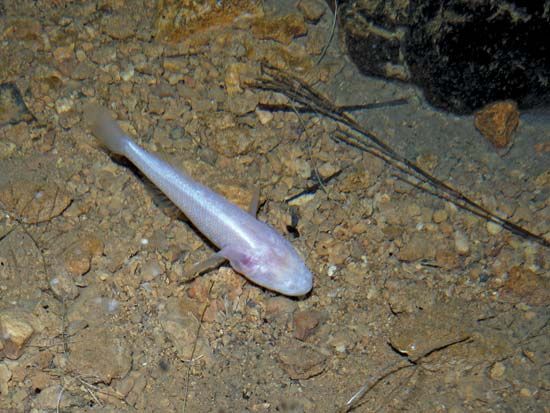
- Blind Goby (Typhlogobius californiensis): A small, pink fish found in California that lives in an obligate symbiotic relationship within burrows excavated by ghost shrimp.1
- Neon Goby (Elacatinus oceanops): A brilliantly blue-banded Caribbean species known for acting as a “cleaner,” removing and consuming parasites from larger fish.1
- Mudskippers (Periophthalmus): Unique amphibious gobies that inhabit mudflats across the Indo-Pacific and eastern Atlantic regions.1
- Crystal Goby (Crystallogobius nilssoni): A European species notable for its transparent body.1
What is the typical size range of goby fish?
Goby fish are generally small in size, with the majority of adult members of the family Gobiidae measuring 10 centimetres (4 inches) or less in length.1
The size range within this group includes some of the smallest known vertebrates. For instance, the Philippine pygmy goby (Pandaka pygmaea) is fully grown at approximately 12 to 13 millimetres (about 0.5 inches) in length. While the vast majority of these fish remain quite small, they represent a significant portion of the diverse order Perciformes, which includes much larger species like the bluefin tuna and black marlin.18
Sources
- goby — Encyclopædia Britannica
- ostariophysan - Sound — Encyclopædia Britannica
- Animal communication - Signal production — Encyclopædia Britannica
- perciform - Territorial activity — Encyclopædia Britannica
- perciform - Interspecific relationships — Encyclopædia Britannica
- commensalism — Encyclopædia Britannica
- goby — Merriam-Webster
- perciform - Size range — Encyclopædia Britannica
Published on · 3 min read