Damselfly
There are approximately 2,600 species of damselflies (suborder Zygoptera) found worldwide, primarily inhabiting shallow, freshwater environments. While the…
What are some common species of damselflies found around the world?
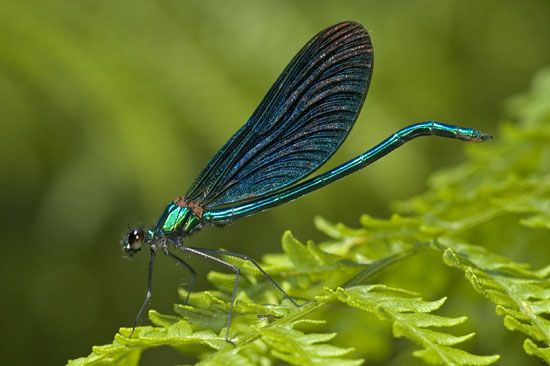
There are approximately 2,600 species of damselflies (suborder Zygoptera) found worldwide, primarily inhabiting shallow, freshwater environments. While the provided knowledge base identifies the group as a whole, it highlights one notable example: Megaloprepus caerulatus, a giant damselfly native to the tropical regions of Central and South America, which can reach a wingspan of up to 19 cm (7.5 inches).
Damselflies are distinct from dragonflies due to their slender, needlelike abdomens and their habit of holding their wings vertically together at rest. Unfortunately, these insects are facing significant environmental challenges; a 2021 assessment by the International Union for Conservation of Nature (IUCN) indicated that 16 percent of damselfly and dragonfly species are currently at risk of extinction due to widespread habitat loss in wetlands and along rivers.
How do damselflies breathe underwater during their nymph stage?
During their nymph stage, damselflies (suborder Zygoptera) are aquatic predators that rely on specialized structures to extract oxygen directly from the water. Unlike adult damselflies, which breathe air through a system of tracheae and spiracles, the larvae possess external tracheal gills to facilitate underwater gas exchange](https://www.britannica.com/science/gill-respiratory-system) to facilitate underwater gas exchange.41
These gills are typically found as three prominent, leaflike plates located at the tip of the abdomen. These structures contain networks of fine tubes that bring water into close contact with the insect’s internal respiratory system, allowing oxygen to diffuse into the body. In addition to their primary respiratory function, these leaflike plates serve a secondary purpose: many damselfly nymphs use them to swim, moving the plates in a manner similar to how a fish uses its tail.456
This respiratory adaptation is a key feature used to distinguish damselfly nymphs from dragonfly nymphs, as the latter possess internal gills located within the rectum rather than external appendages.415
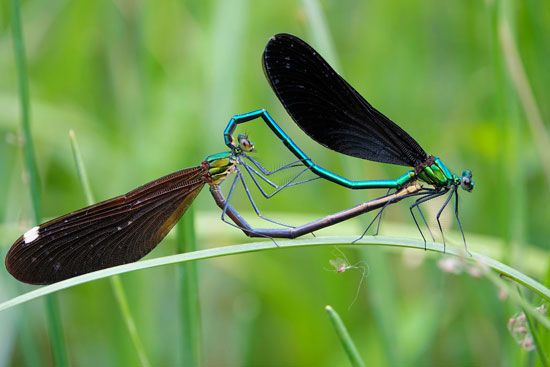
What are the key characteristics that distinguish damselflies from dragonflies?
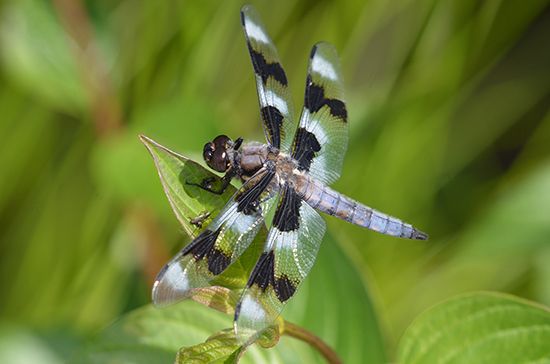
Although damselflies and dragonflies are both members of the order Odonata, they possess distinct physical and behavioral characteristics that allow them to be easily distinguished from one another.13
Key Distinctions
- Resting Wing Position: The most reliable way to identify a damselfly is by its wings at rest; they typically hold them vertically and together over their backs. In contrast, most dragonflies rest with their wings spread out horizontally.13
- Body Shape: Damselflies are generally more delicate, with slender, needlelike abdomens. Dragonflies have a more robust, powerful build.13
- Eye Structure: The eyes of a damselfly are always widely separated on the head. Dragonfly eyes are much larger and typically touch or are very close together, providing a wider field of vision.13
- Wing Morphology: Damselflies have two pairs of wings that are nearly identical in size, shape, and vein pattern. Dragonflies have front and rear wing pairs that differ in shape.13
- Flight Ability: Dragonflies are generally stronger, faster, and more agile fliers compared to the more graceful, weaker flight of damselflies.13
How do damselflies’ wings differ from those of other insects?
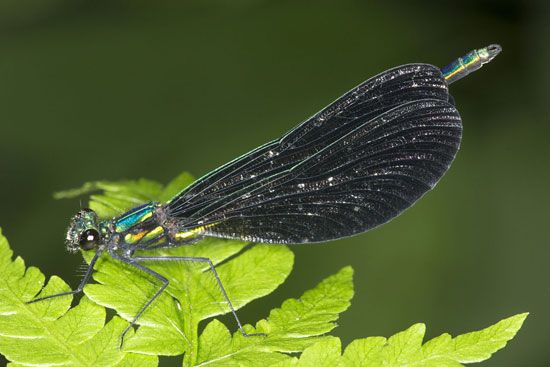
Damselfly wings are characterized by their long, filmy, and net-veined structure. When compared to other insects, particularly their close relatives the dragonflies, damselfly wings exhibit several distinct features:1
- Uniformity: Unlike dragonflies, which have front and rear wing pairs that differ in shape, damselflies possess two pairs of wings that are almost identical in size, shape, and vein pattern.1
- Resting Position: A primary behavioral distinction is that damselflies typically hold their wings vertically and together over their backs when at rest. Most other similar insects, such as dragonflies, hold their wings horizontally and spread apart.1
- Flight Characteristics: Damselflies are generally considered weaker, more graceful fliers compared to the more agile and powerful flight seen in many other winged insects.1
These wings are essential for the damselfly’s life as a predatory, aerial insect, and in some species, males use their brightly colored wings during elaborate courtship displays to attract mates.1
Sources
- damselfly — Encyclopædia Britannica
- List of insects - dragonflies and damselflies (order Odonata ) — Encyclopædia Britannica
- dragonfly — Encyclopædia Britannica
- Respiratory system - Trachea — Encyclopædia Britannica
- heteropteran - Respiratory system — Encyclopædia Britannica
- insect - Aquatic insects — Encyclopædia Britannica
- Odonata - Basic structure — Encyclopædia Britannica
- Odonata - Basic structure — Encyclopædia Britannica
- Odonata - Taxonomy and classification — Encyclopædia Britannica
Published on · 3 min read