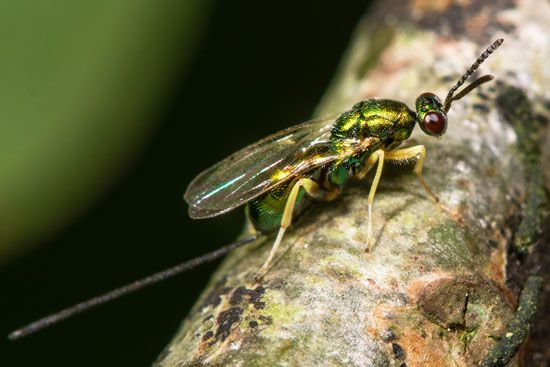
Fig Wasp
Sorry, the Britannica knowledge base does not contain information regarding the specific navigational mechanisms or sensory cues that fig wasps use to locate…
How do fig wasps navigate and locate fig trees?
Sorry, the Britannica knowledge base does not contain information regarding the specific navigational mechanisms or sensory cues that fig wasps use to locate fig trees.
While the provided text details the coevolution between these insects and their host plants, as well as their life cycle within the syconium, it does not explain the biological processes behind their flight or host-finding behavior.
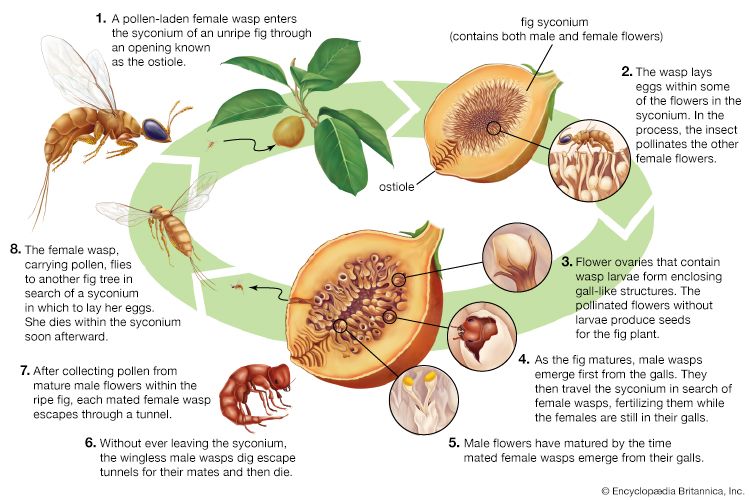
What is the life cycle of a fig wasp?
The life cycle of the fig wasp is a specialized process of coevolution occurring entirely within the syconium, the flowering structure of a fig tree.1
- Development: Eggs are deposited into the female flowers inside the syconium. Each occupied flower develops into a gall rather than a seed.1
- Mating: Blind, wingless males emerge first. They locate galls containing females, chew holes into them, and mate with the females before they have even hatched.1
- Emergence: Males often dig escape tunnels for the females before dying inside the fig. The impregnated females then emerge from their galls.1
- Pollination and Dispersal: As the female exits the syconium, she brushes against male flowers and becomes covered in pollen. During her short adult life—often lasting only two days—she flies to another fig to deposit her eggs and fertilize the plant.1
This cycle is essential for the survival of both the wasp and the Ficus tree, as neither can exist without the other.1
How do male and female fig wasps differ in their roles and characteristics?
Male and female fig wasps exhibit significant differences in their physical characteristics and life roles, reflecting their specialized existence within the syconium of a fig tree.1
Male Characteristics and Roles
- Physical Traits: Males are blind and wingless.1
- Life Cycle Role: They spend their entire lives inside the syconium. Upon emerging from their galls, they locate galls containing females, chew holes into them, and mate with the females before the females have even hatched.1
- Contribution: They often dig escape tunnels to facilitate the departure of the females before dying inside the fig.1
Female Characteristics and Roles
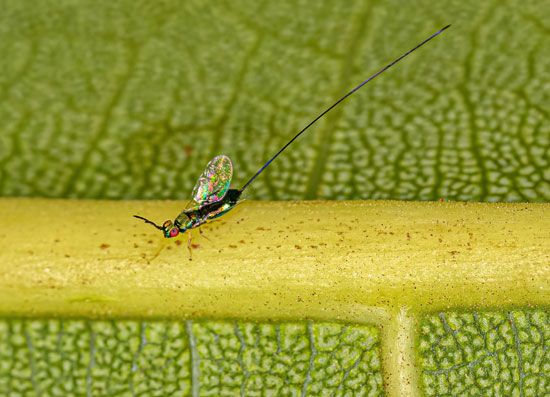
- Physical Traits: Females are winged and capable of flight, which is necessary for their dispersal. They possess an ovipositor used for depositing eggs.1
- Life Cycle Role: After mating, they emerge from the syconium and fly to another fig tree to deposit their eggs.1
- Pollination: As they exit the syconium, they become covered in pollen, which they carry to the next fig. This process is vital for the fertilization and ripening of many fig species, including commercially important varieties like the Smyrna fig.1
What is a fig wasp and how does it differ from other wasp species?
A fig wasp is a member of the family Agaonidae, consisting of about 900 species that share a highly specialized, obligate coevolutionary relationship with figs. Unlike most other wasps, which are often incidental pollinators or predators, fig wasps are essential, species-specific pollinators; each fig species relies on exactly one corresponding wasp species for its survival, and the wasp cannot exist without its host fig.12
The primary differences between fig wasps and other wasp species include:
- Life Cycle: Fig wasps spend their entire development cycle inside the syconium, a closed flowering structure. While other wasps may hunt prey or visit flowers for nectar, fig wasps use the fig’s internal flowers as incubators for their young.14
- Pollination Mechanism: In many wasp species, pollination is an incidental byproduct of visiting flowers for nectar. In contrast, the fig wasp’s pollination is driven by its instinct to reproduce, as the female must enter the fig to deposit her eggs, inadvertently transferring pollen in the process.142
- Specialization: Most wasps are not the primary drivers of pollen movement for plants. Fig wasps, however, are the sole pollinators for their respective fig species, making them critical to the ecology of tropical forests.12
Sources
- fig wasp — Encyclopædia Britannica
- pollination - Wasps — Encyclopædia Britannica
- Hymenoptera - External structure — Encyclopædia Britannica
- major types of pollinators - Wasps — Encyclopædia Britannica
Published on · 3 min read