Dandie Dinmont Terrier
The Dandie Dinmont terrier is a distinct breed of terrier that originated in the border country of England and Scotland around 1700. The breed was later…
What is Dandie Dinmont terrier?
The Dandie Dinmont terrier is a distinct breed of terrier that originated in the border country of England and Scotland around 1700. The breed was later named after a character who owned six such dogs in Sir Walter Scott’s 1815 novel, Guy Mannering.12
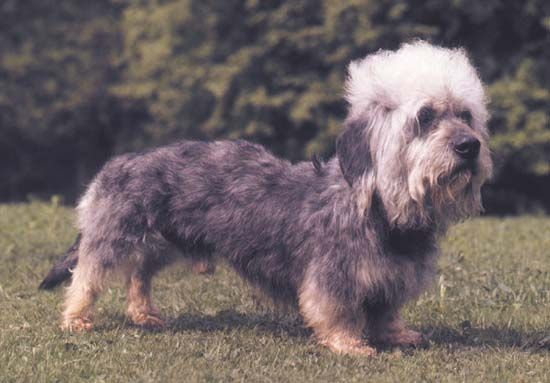
Unlike many other terriers, the Dandie Dinmont features a softly curved body rather than an angular one. Its physical characteristics include:1
- Build: A long body with short legs and a large, domed head.13
- Features: Large eyes and pendulous ears, topped with a silky, full topknot.123
- Coat: A crisp-textured coat consisting of hard and soft hairs, appearing in “pepper” (silver-gray to blue-black) or “mustard” (light fawn to reddish brown) colors.1
- Size: Typically stands 8 to 11 inches (20 to 28 cm) tall and weighs 18 to 24 pounds (8 to 11 kg).1
Like other terriers, these dogs were historically used for hunting vermin.24
What does the term terrier mean in relation to hunting?
The term terrier is derived from the Old French chien terrier, meaning “earth dog,” which reflects the breed’s historical purpose of hunting underground. These dogs were specifically developed to dig for small game, confront prey within burrows, or drive animals out of their dens.54
In the context of hunting, terriers are distinguished by several key traits:
- Function: Unlike many other hunting dogs that merely track or chase quarry, terriers were often required to engage and kill vermin or small game themselves. They were frequently used for ratting and as companions in foxhunting, where smaller individuals were sometimes carried on horseback to be “put to the ground” when needed.56
- Physical Adaptations: To navigate underground environments, many terriers were bred with short legs, tough wiry coats for protection, and strong tails that allowed hunters to pull them out of burrows.56
- Temperament: Because they were bred to confront prey that often fought back, terriers are characterized by a tenacious, fearless, and sometimes pugnacious nature.56
Who was Sir Walter Scott and why did he feature this breed in his novel?
Sir Walter Scott (1771–1832) was a prolific Scottish novelist, poet, historian, and biographer. He is widely celebrated as the inventor and greatest practitioner of the historical novel, a genre he popularized through his famous series known as The Waverley Novels.71
Scott featured the breed now known as the Dandie Dinmont terrier in his 1815 novel, Guy Mannering, by creating a character named Dandie Dinmont who owned six of these dogs. Scott did not invent the breed itself; rather, the dogs were already well-known in the border country of England and Scotland as distinct working terriers. By incorporating these specific dogs into his popular fiction, Scott inadvertently provided the breed with its modern name, as the public began to identify the dogs with his fictional character.328
What are the differences between pepper and mustard coat colors?
The Dandie Dinmont terrier is unique for its specific coat color classifications, which are defined as either “pepper” or “mustard.” These colors are a hallmark of the breed’s appearance and are described as follows:
- Pepper: This color range spans from a silver-gray to a deep blue-black.
- Mustard: This color range varies from a light fawn to a reddish brown.
Both color variations are found within the breed’s crisp-textured coat, which is composed of a distinct combination of hard and soft hairs.1
Sources
- Dandie Dinmont terrier — Encyclopædia Britannica
- 17 Words for Dog Breeds | Dandie Dinmont Terrier — Merriam-Webster
- Dandie Dinmont terrier — Merriam-Webster
- terrier — Encyclopædia Britannica
- terrier — Merriam-Webster
- dog - Terriers — Encyclopædia Britannica
- What did Sir Walter Scott write? — Encyclopædia Britannica
- The Waverley Novels — Encyclopædia Britannica
- Sir Walter Scott — Encyclopædia Britannica
Published on · 3 min read