DeBrazza’s Monkey
DeBrazza’s monkey (Cercopithecus neglectus) is a large, brightly colored guenon found throughout central Africa, extending into Ethiopia and western Kenya.…
What is DeBrazza’s monkey?
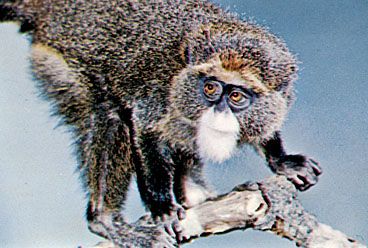
DeBrazza’s monkey (Cercopithecus neglectus) is a large, brightly colored guenon found throughout central Africa, extending into Ethiopia and western Kenya. These primates typically inhabit forests located near swamps and rivers.1
Physically, the species is characterized by its white beard, speckled yellow-gray fur, and a distinctive white stripe running along each thigh. Their hands, feet, and tails are black, and they feature a unique forehead marking consisting of a white-tipped red browband topped with a black band.1
DeBrazza’s monkeys are heavy-set, with males weighing approximately 7.5 kg (16.5 pounds) and females weighing about 4 kg (9 pounds). Compared to other guenons, they are noted for having a less lively temperament and are more terrestrial, spending more time on the forest floor than in the trees.1
What are guenons and how do they differ from other monkeys?
Guenons are a group of 26 species of African monkeys belonging to the genus Cercopithecus. They are characterized by their slim, graceful bodies, long limbs, and bold, colorful markings, often featuring speckled fur and distinctive patches of contrasting color on their noses.2
As members of the Old World monkey family (Cercopithecidae), guenons differ from New World monkeys in several key ways:
- Nose Structure: Guenons are catarrhines, meaning they have narrow noses with downward-facing nostrils, whereas New World monkeys have broad, flat noses with outwardly directed nostrils.3
- Sitting Pads: Unlike New World monkeys, guenons possess hard, bare “sitting pads” (ischial callosities) on their buttocks.3
- Tail Function: Guenons have long, nonprehensile tails that cannot support their body weight, while some New World species have prehensile tails capable of grasping objects.23
- Manual Dexterity: Many Old World monkeys, including guenons, have opposable thumbs that allow for precise handling of objects, a trait not found in New World monkeys.3
- Cheek Pouches: As members of the subfamily Cercopithecinae, guenons possess cheek pouches for storing food, a feature absent in the other Old World subfamily, the Colobinae.3
How does living on the forest floor affect a monkey’s survival?
Living on the forest floor presents distinct survival challenges and opportunities for monkeys, primarily influencing their locomotion, social structure, and predator-avoidance strategies.
Locomotion and Adaptation
While most monkeys are arboreal, ground-dwelling species—such as vervets, baboons, and patas monkeys—have adapted to terrestrial life through quadrupedalism. Unlike the complex, three-dimensional navigation required in the canopy, ground-living locomotion is more limited, often favoring digitigrade movement where the animal walks on the flats of its fingers.56
Predator Defense
Survival on the ground necessitates sophisticated defensive behaviors. Because they are vulnerable to large predators like leopards, pythons, and birds of prey, many ground-dwelling monkeys have developed complex vocalizations to alert their troop to specific threats. These calls trigger coordinated responses, such as fleeing to trees for feline threats or hiding in dense vegetation to avoid aerial predators.7
Social Structure
Terrestrial monkeys often live in large, highly social troops. This sociality provides collective protection and support, which is essential for survival in open environments where cover is limited.78
What are some other primate species found in central Africa?
Central Africa is home to a diverse array of primates beyond the guenons. These include several species of apes, which are distinguished from monkeys by their lack of a tail, more complex brains, and presence of an appendix.8
Notable primate species in the region include:
- Great Apes: The gorilla, chimpanzee, and bonobo are all found in the tropical forests of central Africa. These species are highly social and are known for their intelligence and tool-use capabilities.8
- Ground-living Monkeys: In addition to arboreal species, the region hosts terrestrial primates such as baboons, vervets, and patas monkeys, which are primarily found in savanna or montane-savanna regions.12
- Specialized Guenons: The owl-faced monkey (Cercopithecus hamlyni) is a specific type of guenon found in the tropical forests east of the Congo Basin.13
- High-Altitude Primates: In the montane regions of equatorial Africa, one can find geladas and hamadryas baboons, which have adapted to rugged, mountainous terrain.1214
Many of these species face significant conservation challenges, with several listed as endangered due to habitat loss and human predation.14
Sources
- DeBrazza’s monkey — Encyclopædia Britannica
- guenon — Encyclopædia Britannica
- monkey - Old World monkeys versus New World monkeys — Encyclopædia Britannica
- guenon — Merriam-Webster
- vervet — Encyclopædia Britannica
- monkey — Encyclopædia Britannica
- primate - Diet — Encyclopædia Britannica
- primate - Forest and savanna — Encyclopædia Britannica
- primate - Four types of locomotion — Encyclopædia Britannica
- primate - Size range and adaptive diversity — Encyclopædia Britannica
- primate — Encyclopædia Britannica
- ape — Encyclopædia Britannica
- primate - Distribution and abundance — Encyclopædia Britannica
- owl-faced monkey — Encyclopædia Britannica
Published on · 3 min read