Pakicetus
Pakicetus is an extinct genus of early cetacean mammals that lived approximately 48.5 million years ago. Discovered in present-day Pakistan, it is recognized…
What is Pakicetus?
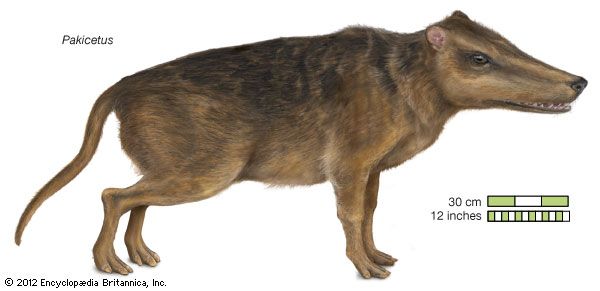
Pakicetus is an extinct genus of early cetacean mammals that lived approximately 48.5 million years ago. Discovered in present-day Pakistan, it is recognized as one of the earliest known whales and the first to be identified with functional legs.1
Roughly the size of a wolf or large dog, Pakicetus possessed a skeleton and skull adapted for significant time on land. Unlike its fully aquatic descendants, it featured an auditory system optimized for hearing in air and feet capable of terrestrial locomotion. Although it primarily consumed fish, its anatomy bridges the evolutionary gap between terrestrial ancestors and the marine-dwelling archaeocetes that emerged later in the Eocene Epoch.1
How did whales transition from land to water?
The transition of cetaceans from land to water was a gradual evolutionary process that began during the Eocene Epoch in the warm, shallow Tethys Sea.1
Early ancestors, such as the Pakicetus, were terrestrial mammals roughly the size of a wolf. While they possessed a diet of fish, their skeletons and skulls indicate they spent significant time on land, and they retained functional legs and an auditory system optimized for hearing in air.1
As these animals adapted to a more aquatic existence, they underwent significant physiological changes:
- Locomotion and Feeding: As cetaceans became more aquatic, they lost the ability to manipulate food with their forelimbs, shifting toward grabbing prey and swallowing it whole. This led to changes in dentition; toothed whales transitioned from complex, differentiated teeth to simple, conical ones, while baleen whales eventually replaced teeth entirely with baleen plates.23
- Auditory Adaptation: Whales converted their ears to a specialized aquatic form. The external ear opening was reduced to a pinhole, and the middle-ear ossicles became massive to facilitate sound conduction through the tissues of the head, allowing them to hear effectively underwater.4
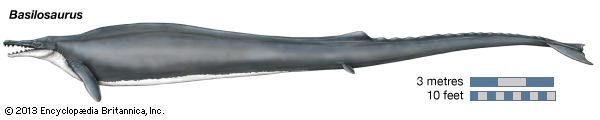
- Diversification: By the Oligocene Epoch, groups like the basilosaurids had become fully aquatic, eventually giving rise to modern suborders.13
What was the Tethys Sea like during the Eocene?
During the Eocene Epoch (approximately 56 to 40 million years ago), the Tethys Sea was a warm, shallow tropical body of water situated between the northern landmasses of Asia and Europe and the southern landmasses of Africa, Arabia, Madagascar, and the Indian subcontinent.5
The climate during this period was the warmest of the Cenozoic Era, with global temperatures nearly 10 °C (18 °F) higher than modern averages. This warmth was further punctuated by the Paleocene-Eocene Thermal Maximum, a period of intense heat that saw significant ecological shifts in both marine and terrestrial environments.51
The Tethys Sea served as a critical habitat for early cetaceans, such as the Pakicetus, which lived along its margins. The environment was characterized by abundant tropical marine life, and the sea played a vital role in global heat transport and climate regulation before its eventual closure—caused by the collision of continental fragments with Eurasia—led to the formation of the Alpine-Himalayan mountain ranges.56
What are some other examples of transitional fossils?
Transitional fossils provide essential evidence for evolution by exhibiting characteristics of both ancestral and derived forms. Beyond the well-documented transition of whales, several other significant examples illustrate major evolutionary shifts:8
- Emergence of Vertebrates onto Land: Tiktaalik roseae, dating to approximately 380–385 million years ago, serves as a key example of the transition from aquatic fish to land-dwelling tetrapods. It possessed a flat, crocodile-like body and limbs intermediate between fins and legs, allowing it to clamber in shallow water.9
- Evolution of Birds: Archaeopteryx is a classic example of a transitional form between nonavian dinosaurs and birds. While it possessed feathers and wings capable of flight, it retained primitive features such as teeth, a long bony tail, and claws on its fingers.10
- Evolution of the Horse: The lineage of the Equidae family is one of the best-documented in paleontology. It tracks the transition from the small, multi-toed, browsing Eohippus to the large, one-toed, grazing modern horse (Equus).1112
- Mammalian Ear Evolution: Paleontologists have identified therapsid fossils that display a double jaw joint. This transition shows how bones originally part of the reptile jaw evolved into the hammer and anvil bones of the mammalian ear.12
Sources
- Pakicetus — Encyclopædia Britannica
- sound reception - Marine mammals — Encyclopædia Britannica
- cetacean - Feeding adaptations — Encyclopædia Britannica
- cetacean - Paleontology — Encyclopædia Britannica
- Tethys Sea — Encyclopædia Britannica
- Cretaceous Period - Marine life — Encyclopædia Britannica
- Paleocene-Eocene Thermal Maximum — Encyclopædia Britannica
- Tiktaalik roseae — Encyclopædia Britannica
- transitional fossil — Merriam-Webster
- Archaeopteryx — Encyclopædia Britannica
- horse - Evolution of the horse — Encyclopædia Britannica
- evolution - The fossil record — Encyclopædia Britannica
Published on · 3 min read