Deer Mouse
The deer mouse (genus Peromyscus) is an omnivore, meaning it consumes a diverse range of food sources in the wild. Its diet is flexible and includes:
What is the diet of a deer mouse in the wild?
The deer mouse (genus Peromyscus) is an omnivore, meaning it consumes a diverse range of food sources in the wild. Its diet is flexible and includes:
- Plant products: Various seeds, fruits, and berries.12
- Fungi: Different types of mushrooms and fungal matter.1
- Invertebrates: A variety of insects.2
- Carrion: The remains of dead animals.1
Because they are omnivorous, their specific intake can shift depending on availability, with some populations consuming a higher proportion of insects or berries at different times of the year.2
What are the physical characteristics of a deer mouse?
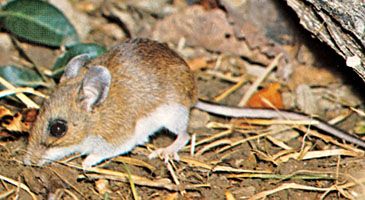
The deer mouse (genus Peromyscus) is characterized by several distinct physical features:
- Size and Weight: They weigh between 15 and 110 grams (0.5 to 3.9 ounces) and measure 8 to 17 cm (3.1 to 6.7 inches) in length.1
- Facial Features: They possess large ears and bulging eyes.1
- Fur and Coloration: They have soft fur that varies significantly in color, ranging from gray, buff, and brown to reddish brown and blackish. While coloration often depends on the environment—with darker coats in forest-dwelling species and paler coats in desert-adapted ones—nearly all deer mice have white feet.1
- Tail: The length of the tail varies by species, sometimes being shorter than the head and body and other times being strikingly longer.1
These rodents are agile climbers, and their physical adaptations, such as coat color, are often linked to natural selection to provide camouflage in their specific habitats.1
How have deer mice been used in scientific research?
Deer mice, particularly the species Peromyscus maniculatus, are valuable subjects in scientific research because they breed readily in laboratory settings. They are frequently utilized across the United States for studies in several key fields:1
- Genetics and Evolution: Researchers use deer mice to study natural selection in action. For example, the evolution of lighter-colored fur in populations inhabiting sand dunes is considered a prime example of how gene mutations can provide a survival advantage through camouflage.1
- Physiology and Medicine: Their biological characteristics make them useful models for understanding various physiological processes and medical conditions.1
- Disease Transmission: Because they are primary hosts for hantavirus and can transmit plague and Lyme disease, they are critical subjects for research into zoonotic diseases and public health.13
What diseases can deer mice carry and potentially transmit to humans?
Deer mice (Peromyscus maniculatus) are known to carry several pathogens that can be transmitted to humans, primarily through contact with the animals or their waste.
- Hantavirus: The deer mouse is the primary host for the virus responsible for hantavirus pulmonary syndrome (HPS) in North America. Humans typically become infected by inhaling airborne particles from dried rodent urine, droppings, or saliva, particularly in enclosed or poorly ventilated spaces.153
- Plague: Deer mice are recognized as one of the mammalian hosts capable of carrying the bacteria that cause plague.1
- Lyme Disease: While ticks are the primary vectors for Lyme disease, deer mice and related species like the white-footed mouse serve as important reservoirs. Ticks, such as Ixodes scapularis, often acquire the causative Borrelia bacteria by feeding on these infected rodents.16
Transmission generally occurs through direct contact with contaminated materials, rodent bites, or the inhalation of contaminated dust. To reduce risk, health experts recommend controlling rodent infestations around homes and limiting exposure to environments where these rodents are active.53
Sources
- deer mouse — Encyclopædia Britannica
- omnivore — Encyclopædia Britannica
- hantavirus: Top Questions — Encyclopædia Britannica
- deer mouse — Merriam-Webster
- hantavirus — Encyclopædia Britannica
- Lyme disease — Encyclopædia Britannica
Published on · 3 min read