Delagoa Bay
Delagoa Bay is situated on the southeast coast of Mozambique in East Africa, positioned near the border with South Africa.
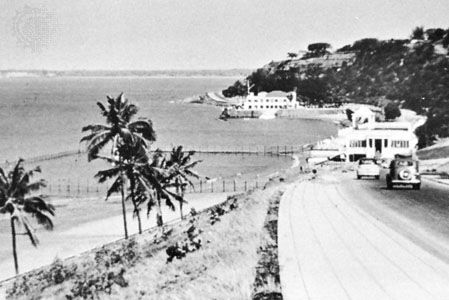
What is the geographical location of Delagoa Bay in Mozambique?
Delagoa Bay is situated on the southeast coast of Mozambique in East Africa, positioned near the border with South Africa.1
The bay measures approximately 19 miles (31 km) in length and 16 miles in width. It features Inhaca Island at its mouth, while the port of Maputo—the capital of Mozambique—is located near the head of the bay. The inner bay serves as the confluence for the Matola, Tembe, and Umbelúzi rivers, which meet in the Espírito Santo estuary, while the larger Maputo and Komati rivers flow into the outer bay.1
What is the historical significance of Delagoa Bay in the context of Portuguese colonization?
Delagoa Bay played a pivotal role in Portuguese colonial history, serving as a vital economic and strategic hub in southeastern Africa. Discovered by António do Campo in 1502 and explored by Lourenço Marques in 1544, the bay became a crucial outlet for the trade of ivory and enslaved people.1
During the 19th century, while Portuguese authority in the region remained largely confined to coastal enclaves, the bay emerged as a rare point of prosperity. It functioned as a significant way station for Indian Ocean trade and a major center for the slave trade, which peaked in the 1840s to supply plantations in Brazil and the Mascarene Islands. This trade caused severe regional instability, forcing local populations to migrate or participate in raiding.314
Ownership was long contested by the Dutch, English, and Boers until international arbitration awarded the bay to Portugal in 1875. Following the discovery of gold in the South African Republic, the bay’s importance surged as the closest maritime outlet for the interior, leading to the establishment of Lourenço Marques as the capital of Mozambique in 1888.13
How does Delagoa Bay compare to other major bays along the Mozambican coast in terms of size and importance?
Delagoa Bay is a significant geographical feature on the southeast coast of Mozambique, measuring approximately 19 miles (31 km) in length and 16 miles in width. While the provided search results highlight its importance as a major maritime outlet, they do not offer a comprehensive comparative analysis of its size relative to other bays along the Mozambican coast.1
In terms of importance, however, Delagoa Bay is distinguished by its role as the site of Maputo, the capital of Mozambique. The bay serves as a vital port, historically functioning as a primary transit point for trade from the mines and industries of South Africa and Eswatini. Its strategic location near the South African border and its capacity to receive major rivers, such as the Maputo and Komati, have historically made it a focal point for international commerce and colonial competition in East Africa.15
What role did Delagoa Bay play during the colonial conflicts between European powers in Africa?
Delagoa Bay served as a critical focal point for colonial competition in southeastern Africa due to its strategic value as a maritime gateway to the interior. Throughout the 18th century, the Portuguese struggled to maintain a permanent presence, facing intense rivalry from Dutch, British, and Austrian interests, as well as North American whalers, all of whom sought to control the local trade in ivory and other goods.13
The bay’s significance intensified during the 19th century as it became a major hub for the slave trade, supplying labor to plantations in Brazil and the Mascarene Islands. This commerce contributed to widespread regional instability, as local chiefdoms and European mercenaries engaged in raiding and forced migrations.8
Following decades of contested claims, international arbitration in 1875 formally awarded the bay to Portugal. Its strategic importance reached a zenith with the discovery of gold in the South African Republic; as the closest maritime outlet for the interior, the bay became essential to the region’s economic development, leading to the establishment of Lourenço Marques as the capital of Mozambique in 1888.14
Sources
- Delagoa Bay — Encyclopædia Britannica
- Moçambique — Encyclopædia Britannica
- Southern Africa - Colonists in Angola and Mozambique — Encyclopædia Britannica
- South Africa - The Delagoa Bay slave trade — Encyclopædia Britannica
- Mozambique Channel — Encyclopædia Britannica
- Madagascar - Relief — Encyclopædia Britannica
- Maputo — Encyclopædia Britannica
- Southern Africa - The declining power of the Portuguese — Encyclopædia Britannica
Published on · 3 min read