Denmark Strait
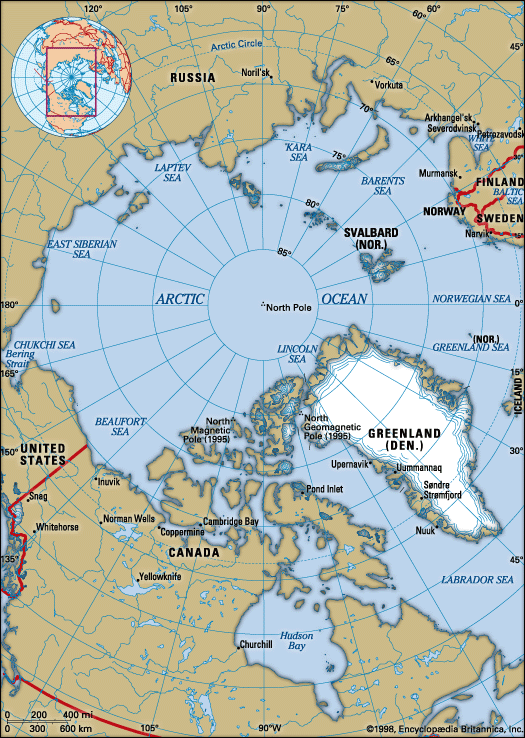
The Denmark Strait is a significant oceanic channel situated between Greenland to the west and Iceland to the east. Partially located within the Arctic…
What is Denmark Strait?
The Denmark Strait is a significant oceanic channel situated between Greenland to the west and Iceland to the east. Partially located within the Arctic Circle, it serves as a vital connection between the Greenland Sea and the North Atlantic Ocean.1
The strait is characterized by distinct hydrographic features. The cold East Greenland Current moves southward along the Greenland coast, transporting icebergs originating from the Arctic Ocean and the Greenland ice cap. Conversely, a branch of the warmer Irminger Current flows northward near the Icelandic coast. While sources vary slightly on its precise width, it is generally recognized as a major maritime passage that has been known by its current name since at least the late 19th century.12
How does the Denmark Strait cataract work?
The “Denmark Strait cataract” is not a waterfall in the traditional sense, but rather a massive underwater density current. It occurs because cold, dense water from the Arctic Ocean flows southward through the Denmark Strait and plunges over a steep drop-off in the ocean floor.
This phenomenon functions as a giant submarine waterfall. As the cold, dense water spills over the sill of the continental shelf, it descends toward the deep ocean floor. During this descent, the current experiences entrainment, where the high velocity of the falling water generates eddies that mix in surrounding, less-dense ambient water. This process increases the current’s total volume flux while diluting its density and temperature. This overflow is a critical component in the formation of North Atlantic Deep Water (NADW), which helps regulate global ocean circulation.1
What role do ocean currents play in the Earth’s climate?
Ocean currents play a fundamental role in regulating Earth’s climate by acting as a global conveyor system that redistributes heat and moisture.45
Heat Redistribution
The most significant climate impact of ocean currents is the transport of heat from the tropics toward the poles. Warm currents, such as the Gulf Stream, carry heat into higher latitudes, where it is transferred to the atmosphere. This process moderates the climate of coastal regions; for instance, the North Atlantic Current helps keep northwestern Europe significantly warmer and more temperate than it would otherwise be at those latitudes. Conversely, cold currents, like the Peru Current, transport cooler water toward the equator, influencing regional temperature and precipitation patterns.467
Ocean-Atmosphere Interaction
The ocean serves as a massive reservoir of heat, and its surface temperature directly influences atmospheric circulation.56
- Moisture Supply: Warm ocean surfaces promote evaporation, supplying moisture to the atmosphere that eventually releases latent heat when it condenses into clouds and precipitation.56
- Weather Steering: Strong thermal gradients at the boundaries of warm and cold currents can influence the position of the jet stream, thereby steering weather systems across the globe.6
- Climate Patterns: Complex interactions, such as the El Niño/Southern Oscillation, demonstrate how anomalies in sea-surface temperatures can trigger major climatic shifts, affecting precipitation and temperature patterns across multiple continents.56
Deep Ocean Circulation
Beyond surface currents, the thermohaline circulation—driven by differences in temperature and salinity—moves vast volumes of water to the deep ocean. This “global conveyor” helps regulate the climate by ventilating the deep ocean and balancing heat distribution on a millennial scale.87
Why is the East Greenland Current important for marine life?
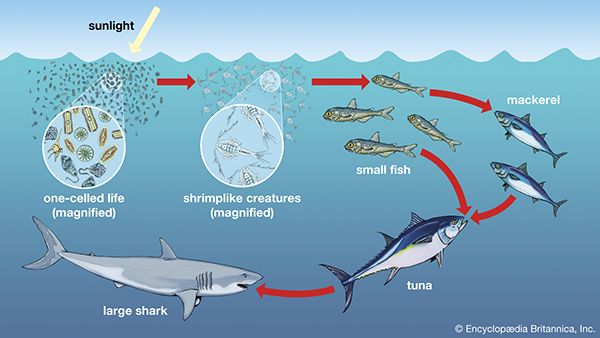
The East Greenland Current is vital to marine life primarily because of the thermal mixing that occurs when it encounters warmer currents. As the cold, southward-flowing East Greenland Current meets the warmer Irminger Current and Norwegian Current, the resulting mixing of water layers creates highly productive fishing grounds near Iceland, the Norwegian Sea, and the Faroe and Shetland islands.910
This environment supports a dense population of lower life forms, which serve as the essential base of the food chain. These organisms sustain a diverse array of marine species, including:
Sources
- Denmark Strait — Encyclopædia Britannica
- Denmark Strait — Merriam-Webster
- density current - Entrainment of surrounding water — Encyclopædia Britannica
- How Do Ocean Currents Affect the Biosphere? — Encyclopædia Britannica
- ocean current - Thermohaline circulation — Encyclopædia Britannica
- thermohaline circulation — Encyclopædia Britannica
- Climate - Climate and the oceans — Encyclopædia Britannica
- Climate - Circulation, currents, and ocean-atmosphere interaction — Encyclopædia Britannica
- Greenland Current — Encyclopædia Britannica
- East Greenland Current — Encyclopædia Britannica
- Greenland Sea — Encyclopædia Britannica
- Norway Current — Encyclopædia Britannica
Published on · 3 min read