Delos
Sorry, the Britannica knowledge base does not contain information regarding the specific impact of UNESCO World Heritage status on the preservation and…
How has UNESCO World Heritage status impacted the preservation and tourism of Delos?
Sorry, the Britannica knowledge base does not contain information regarding the specific impact of UNESCO World Heritage status on the preservation and tourism of Delos.
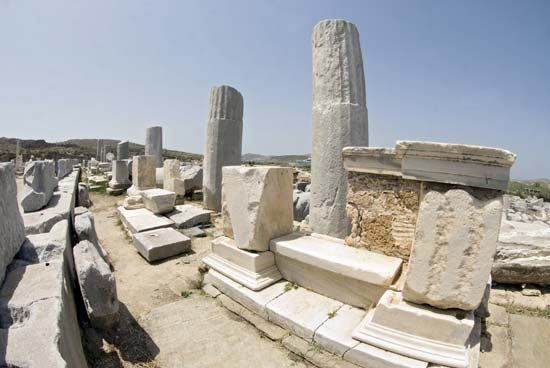
While it is established that Delos is a significant archaeological site and that UNESCO designates sites of “outstanding universal value” to foster international cooperation in their protection, the provided search results do not detail the specific consequences of this status for the island. Today, visitors are permitted on the island exclusively to view its extensive ruins, which include sanctuaries, a theatre, and private houses dating back to the 3rd and 2nd centuries BCE.123
What major archaeological discoveries have been made on the island of Delos?
Since 1873, the French School of Athens has conducted extensive excavations on Delos, revealing a complex of buildings comparable to those at Delphi and Olympia. Major archaeological findings include:
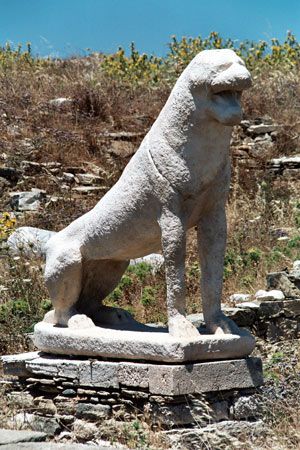
- Sculptural Artifacts: Notable discoveries include fragments of a colossal statue of Apollo and a famous row of nine marble lions.
- Religious Structures: The site features the hieron (sanctuary) of Apollo, which includes the Doric temple of Apollo, the Athenian temple, and the Porinos Naos. Other religious finds include the precinct of Artemis, the temple of Dionysus, and sanctuaries dedicated to Egyptian and Syrian deities.
- Residential and Commercial Areas: Excavations have uncovered private houses from the 3rd and 2nd centuries BCE, many featuring columned courts and intricate mosaics. Additionally, archaeologists have identified docks, warehouses, and large commercial exchanges, such as the Agora of Italians.
- Public and Athletic Facilities: Significant structures include a 3rd-century BCE theatre, a stadium, and a palaestra (gymnasium).
- Early Settlements: Remains of ancient Cycladic dwellings dating back to the 3rd millennium BCE have been found on the summit of Mount Cynthus.
How did the Romans impact Delos after they gained control of the island?
After Rome gained control of Delos in 166 BCE, the island underwent a significant transformation, becoming a free port that served as a major commercial hub in the Aegean Sea. This status facilitated extensive trade, evidenced by the construction of large commercial exchanges, such as the Agora of Italians, and the use of imported materials like Egyptian granite for local docks.14
However, the island’s relationship with Rome also led to its eventual decline:
- Conflict and Destruction: In 88 BCE, Delos was sacked by Menophaneses, a general of Mithradates VI of Pontus, because the island remained faithful to Rome. This attack resulted in the slaughter of thousands of people.1
- Piracy and Abandonment: A pirate attack followed in 69 BCE. Although Rome restored Athenian control in 42 BCE, the island remained largely uninhabited.1
- Commercial Demise: By the end of the 1st century CE, shifts in regional trade routes rendered Delos commercially obsolete, leading to the abandonment of its cults and religious centers.1
What is the mythological significance of Delos in ancient Greek culture?
In ancient Greek culture, Delos holds profound mythological significance as the sacred birthplace of the twin deities Apollo and Artemis.16
According to legend, their mother, the Titan Leto, was pregnant by Zeus and sought a place of refuge to give birth while fleeing the jealousy of Zeus’s wife, Hera. Delos was said to have been a wandering rock, tossed about by the waves, until it was finally fixed to the bottom of the sea to provide a stable sanctuary for the birth of the twins.7
Because of this divine association, the island became a major center of religious life in the Aegean Sea, housing a significant hieron (sanctuary) dedicated to Apollo. The island’s status as a holy site was so established that it was famously referenced in the Odyssey and eventually served as the religious and political heart of the Delian Confederacy.1
Sources
- Delos — Encyclopædia Britannica
- World Heritage site — Encyclopædia Britannica
- UNESCO: Top Questions — Encyclopædia Britannica
- Delphi — Encyclopædia Britannica
- Hellenistic age - Economic developments — Encyclopædia Britannica
- Leto — Encyclopædia Britannica
- Apollo — Encyclopædia Britannica
Published on · 3 min read