Desert Pavement
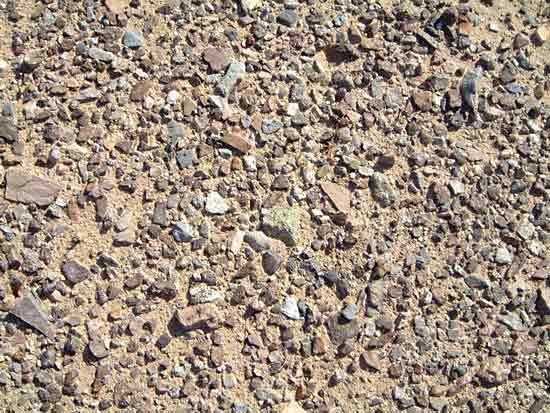
Desert pavements are natural surfaces composed of angular, interlocking fragments of pebbles, gravel, cobblestones, and boulders. These fragments are often…
What types of rocks are commonly found in desert pavements?
Desert pavements are natural surfaces composed of angular, interlocking fragments of pebbles, gravel, cobblestones, and boulders. These fragments are often concentrated through the combined effects of wind, which removes finer surface sediments, and water, which facilitates the movement of silt beneath the ground.12
While these pavements consist of various rock types, they are frequently characterized by their surface appearance. Over time, many of these rocks develop a desert varnish—a thin, dark red to black coating composed of iron and manganese oxides and silica. In some instances, evaporation and capillarity draw soil moisture to the surface, precipitating calcium carbonate, gypsum, and other salts that cement the fragments together into a desert conglomerate. In areas known as hammadas, the wind may remove most finer material, leaving behind bare rock surfaces scattered with larger boulders.341
How does desert varnish relate to desert pavement?
Desert varnish and desert pavement are closely linked features of arid environments, as the varnish frequently coats the individual rock fragments that constitute the pavement surface.
Desert pavement is a surface layer of interlocking pebbles, gravel, and boulders formed by the wind-driven removal of fine sediments and the settling of larger materials. Once these fragments are exposed on the surface for long periods, they become prime substrates for desert varnish. This varnish is a thin, dark, glossy coating composed of iron and manganese oxides and silica.
The formation of both features relies on the unique conditions of desert regions:
- Exposure: The stability of the desert pavement surface allows rocks to remain exposed for thousands of years, providing the necessary time for the varnish to accumulate.
- Moisture and Evaporation: Both processes involve the movement of moisture. While desert pavement is partially shaped by the percolation of water, desert varnish forms as soil moisture and dew are drawn to the surface by capillarity and subsequently evaporate, leaving behind mineral deposits.
What are the characteristics of desert pavement surfaces?
Desert pavement surfaces are characterized by a natural mosaic of angular, interlocking fragments, including pebbles, gravel, cobblestones, and boulders. These surfaces typically form on level or gently sloping desert flats, fans, and river terraces.13
Key characteristics of these surfaces include:
- Composition and Structure: The fragments are often so tightly packed and smooth that they create a stable, armored surface that resists further wind deflation.1
- Formation Process: They are produced by the combined effects of wind, which removes finer surface sediments, and water, which facilitates the movement of silt particles beneath the ground.1
- Surface Features: The rocks are frequently coated with a dark, glossy patina known as desert varnish, which consists of iron and manganese oxides.2
- Cementation: In some cases, evaporation and capillarity draw soil moisture to the surface, precipitating calcium carbonate, gypsum, and other salts that cement the fragments into a desert conglomerate.1
How does desert pavement affect the surrounding ecosystem?
Desert pavement significantly influences the surrounding ecosystem by altering the physical and chemical properties of the land surface. By creating a stable, armored layer of interlocking pebbles and gravel, these surfaces effectively halt further wind deflation, which helps preserve the underlying soil structure.12
The ecological impact of this process includes:
- Soil Nutrient Retention: Because wind erosion removes fine, chemically reactive particles like silt and clay, the remaining surface becomes coarser and less capable of retaining essential plant nutrients or trapping pollutants.6
- Moisture Dynamics: The pavement acts as a barrier that influences how water interacts with the ground. While it protects the surface, the evaporation and capillary action that help form the pavement can also lead to the precipitation of salts, such as calcium carbonate and gypsum, which cement the fragments together.1
- Habitat Stability: By creating a durable, smooth surface, desert pavement provides a consistent environment that has historically been stable enough to support human transit, such as caravan routes in the Sahara.1
Sources
- desert pavement — Encyclopædia Britannica
- desert pavement — Merriam-Webster
- desert varnish — Encyclopædia Britannica
- desert varnish — Merriam-Webster
- Desert - Environment — Encyclopædia Britannica
- soil - Erosive processes — Encyclopædia Britannica
Published on · 3 min read