Desert
Desert regions are often rich in valuable natural resources, particularly those formed through geological processes over millions of years. Key resources…
What valuable natural resources are often found in desert regions?
Desert regions are often rich in valuable natural resources, particularly those formed through geological processes over millions of years. Key resources found in these environments include:
- Fuel Resources: Deserts are major sources of petroleum, natural gas, and coal. Significant oil fields, such as the Al-Ghawār field in the Arabian Desert, have made these regions central to global energy markets.123
- Metallic and Industrial Minerals: Many deserts contain substantial deposits of iron ore, copper, manganese, and uranium. Additionally, regions like the Sahara hold rich phosphate deposits, while salt and gypsum are frequently extracted from saline flats.12
- Water: Underground water supplies—often ancient, non-replenishing aquifers—are critical resources. While essential for agriculture and industry, their extraction is costly and carries the risk of depletion.12
While these resources drive economic investment, it is important to acknowledge that their extraction often disrupts traditional nomadic lifestyles and can lead to environmental degradation and social challenges for local populations.23
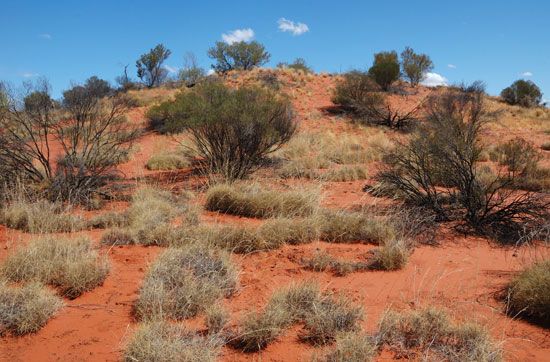
What defines a desert, and what are the main types of deserts?
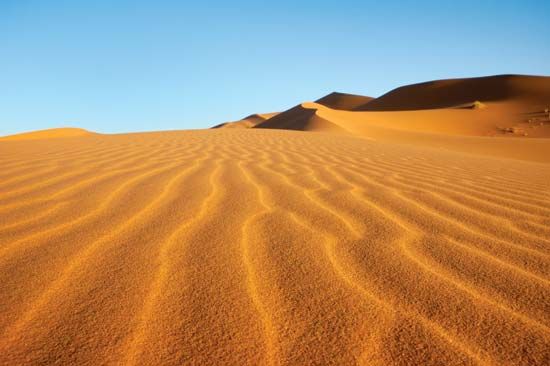
A desert is defined as any large, extremely dry area of land with sparse vegetation. While there is no single, universally accepted definition, the most fundamental characteristic is a significant shortage of available moisture for plants, resulting from an imbalance between precipitation and evapotranspiration. Many authorities use an upper limit of 250 millimetres (about 10 inches) of mean annual precipitation to classify a true desert, though some include regions receiving up to 400 millimetres.367
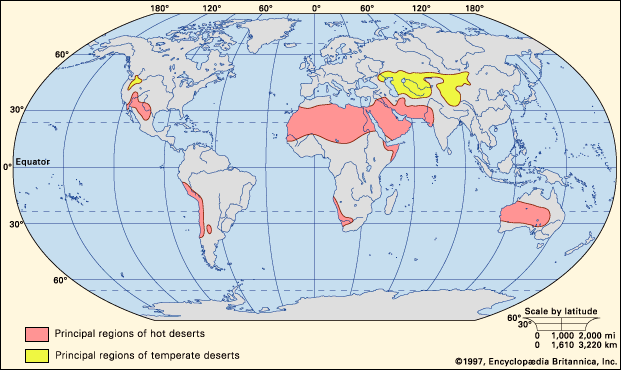
Deserts are generally categorized into two main types based on their climatic conditions:
- Hot Deserts: Located in subtropical regions, these areas experience high daytime temperatures and are influenced by descending, dry air masses associated with Hadley cell circulation.6
- Cold Deserts: These occur at higher latitudes or elevations where temperatures are significantly lower. They are often found in continental interiors, far from moisture-bearing winds, or in rain shadows created by mountain ranges. A subset of these are polar deserts, which are found at very high latitudes in the Arctic and Antarctica and are characterized by extreme cold and frozen water.687
What role do deserts play in Earth’s climate system?
Deserts play a significant role in Earth’s climate system by influencing global atmospheric circulation, surface reflectivity, and the transport of particulate matter.
- Atmospheric Circulation: Major hot deserts are integral to the Hadley cell circulation pattern. As air rises near the Equator and loses its moisture, it descends over the subtropics as dry, compressed air. This process creates the stable, high-pressure conditions that maintain arid climates and dictate regional weather patterns.310
- Surface Albedo: Deserts have a high albedo, or reflectivity, which affects how much solar energy is absorbed by the surface versus reflected back into the atmosphere. Changes in land cover—such as those caused by desertification—can increase regional albedo, which has been linked to significant declines in rainfall and alterations in the timing and frequency of thunderstorms.11
- Particulate Transport: Deserts act as major sources of atmospheric dust. This dust can travel vast distances, reflecting incoming solar radiation and cooling the air and ocean surfaces beneath it. These dust plumes also influence hurricane development by increasing wind shear and altering thermal conditions.12
How do oases form in deserts, and why are they important?
An oasis is a fertile area within a desert that exists wherever there is a perennial supply of fresh water. These features vary significantly in size, ranging from small springs covering about one hectare to vast, irrigated regions.15
Formation
Most oases are sustained by underground water sources. These are often supplied by sandstone aquifers, which can have intake areas located hundreds of miles away. Water reaches the surface through natural springs or human-made wells, some of which are artesian. In certain regions, traditional methods such as foggaras—inclined underground tunnels designed to tap into dispersed groundwater—are used to access water, alongside modern motorized pumps.1516
Importance
Oases are vital hubs of life in harsh environments. They provide the necessary conditions for rapid vegetative growth, supporting sedentary populations who rely on irrigation for survival. The date palm is typically the primary food source, providing shade for the cultivation of citrus fruits, figs, vegetables, and cereals like wheat, barley, and millet.1516
Sources
- Arabian Desert - Resources — Encyclopædia Britannica
- Sahara - Resources — Encyclopædia Britannica
- Desert - Environment — Encyclopædia Britannica
- Arabian Desert - Soils — Encyclopædia Britannica
- Sahara: Top Questions — Encyclopædia Britannica
- Desert — Encyclopædia Britannica
- Cold desert — Encyclopædia Britannica
- North American Desert - Physiography — Encyclopædia Britannica
- How Do Deserts Form? — Encyclopædia Britannica
- desertification - Causes and consequences of desertification — Encyclopædia Britannica
- Factors Affecting Hurricane Development in the Atlantic Ocean: Top Questions — Encyclopædia Britannica
- Climate - Climate and changes in the albedo of the surface — Encyclopædia Britannica
- desertification - Four areas affected by desertification — Encyclopædia Britannica
- Sahara - Climate of the Sahara — Encyclopædia Britannica
- oasis — Encyclopædia Britannica
- Sahara - People of the Sahara — Encyclopædia Britannica
Published on · 3 min read