Badland
A badland is a type of terrain characterized by deep, winding gullies and sharp, saw-toothed ridges created by intense erosion. These landscapes typically…
What is badland?
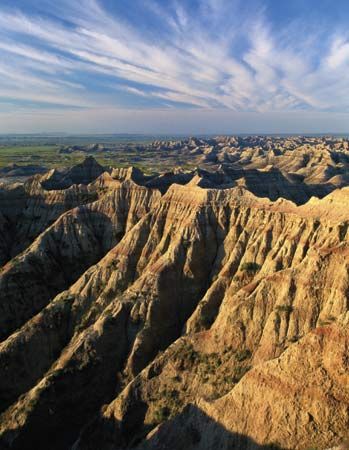
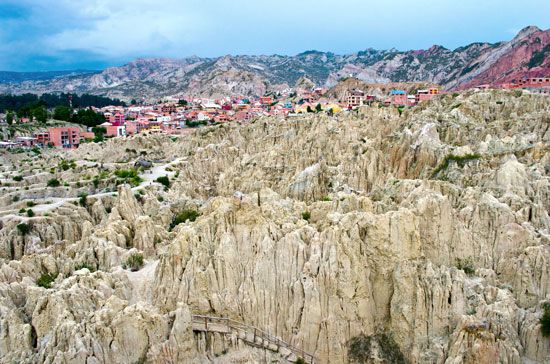
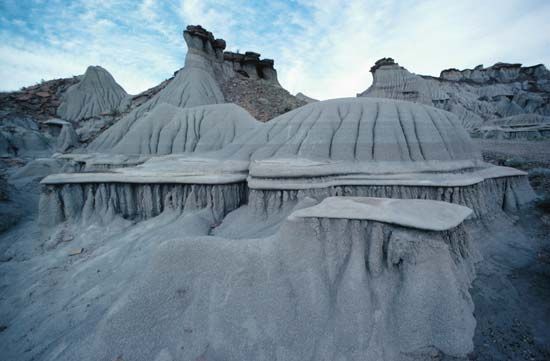
A badland is a type of terrain characterized by deep, winding gullies and sharp, saw-toothed ridges created by intense erosion. These landscapes typically form in arid or semiarid regions where poorly cemented bedrock is subjected to infrequent but heavy rainfall, such as cloudbursts.12
The resulting topography is often jagged and difficult to traverse, featuring isolated spires, mesas, and buttes. Because the surface material is dry and granular with little vegetation, the landscape remains largely bare.12
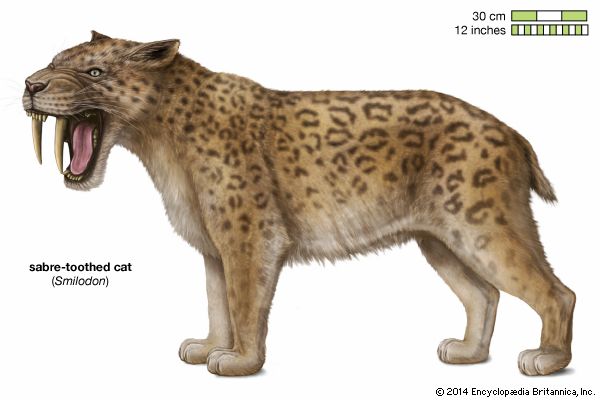
The term originated from the French-Canadian phrase mauvaises terres pour traverser (“bad lands to cross”), used to describe a rugged region in southwestern South Dakota1. This specific area, now protected as Badlands National Park, is well-known for its extensive fossil deposits, which have preserved the remains of prehistoric animals like the saber-toothed tiger, camels, and early horses.23
What types of fossils are commonly found in badlands?
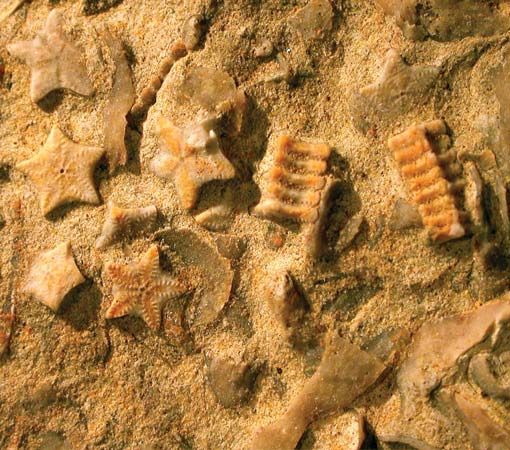
Badlands are renowned for their extensive fossil beds, which provide a significant record of prehistoric life. The types of fossils found depend on the specific geological formation and the era in which the sediments were deposited.
Oligocene Epoch Fossils
In areas like Badlands National Park, the sedimentary rock layers from the Oligocene Epoch (33.7 to 23.8 million years ago) have yielded a diverse array of mammal fossils, including:
- Three-toed horses45
- Camels45
- Saber-toothed cats45
- Ancestors of the rhinoceros45
Cretaceous Period Fossils
Formations such as the Hell Creek Formation contain fossils from the end of the Cretaceous Period, approximately 65.5 million years ago. These include:
- A rich variety of dinosaurs, such as theropods (Tyrannosaurus), ceratopsians (Triceratops), ankylosaurs, and pachycephalosaurs2
- Early primates and other small mammals2
- Plant remains2
Eocene Epoch Fossils
Other badland-like regions, such as those found in Fossil Butte National Monument, preserve life from the Eocene Epoch. These sites are famous for:
- Extensive records of freshwater fish3
- Insects, turtles, lizards, and plants3
- Primitive horses and early primates3
How does sparse vegetation contribute to soil erosion?
Sparse vegetation significantly accelerates soil erosion by removing the natural barriers that protect the land from the forces of water and wind.
Impact on Water Erosion
When land lacks vegetation, the soil surface is exposed to the direct impact of rainfall. Without plants to intercept these drops, the force of the impact breaks the bonds holding soil aggregates together, catapulting particles into the air and making them easily transportable by surface runoff. Vegetation typically acts as a buffer that slows water flow and stabilizes the ground; in its absence, processes like sheet erosion, rill erosion, and gully erosion occur much more rapidly.78
Impact on Wind Erosion
In arid regions, vegetation serves as an anchor that reduces the wind’s ability to dislodge and transport soil particles. Where plant cover is sparse, wind can easily lift and carry loose particles through a process called saltation. This constant movement of soil not only strips away topsoil but can also lead to the formation of desert pavement, leaving behind only larger, less fertile particles.78
Essentially, root systems are vital for stabilizing the soil profile; their removal—whether through natural conditions or human activities like deforestation—leaves the earth vulnerable to rapid degradation.89
What is the difference between a mesa and a butte?
The primary difference between a mesa and a butte is size. Both are flat-topped landforms with steep sides created by the erosion of a plateau, where layers of harder rock act as protective caps for the softer underlying material.1011
- Mesa: Derived from the Spanish word for “table,” a mesa is a broad, flat-topped tableland.1012
- Butte: A butte is similar in structure to a mesa but is smaller in surface area. It is often described as a flat-topped hill surrounded by a steep escarpment.1011
Both features are characteristic of the arid regions of the western United States, where the process of denudation—downcutting and stripping—has left these isolated remnants of once-larger plateaus standing above the surrounding plains.1011
Sources
- badland — Encyclopædia Britannica
- Badlands — Encyclopædia Britannica
- Badlands National Park — Merriam-Webster
- Badlands National Park — Encyclopædia Britannica
- Hell Creek Formation — Encyclopædia Britannica
- Fossil Butte National Monument — Encyclopædia Britannica
- soil - Erosive processes — Encyclopædia Britannica
- What causes soil erosion? — Encyclopædia Britannica
- Tree - Tree roots — Encyclopædia Britannica
- mesa — Encyclopædia Britannica
- butte — Merriam-Webster
- mesa — Merriam-Webster
- butte — Encyclopædia Britannica
Published on · 3 min read