Erg
The term "erg" refers to two distinct concepts depending on the context:
What is erg?
The term “erg” refers to two distinct concepts depending on the context:
Physics
In physics, an erg is a unit of energy or work within the centimeter-gram-second (cgs) system. It is defined as the work performed by a force of one dyne acting over a distance of one centimeter. One erg is equivalent to 10−710^{-7} joules, which is the standard SI unit for energy.123
Geography
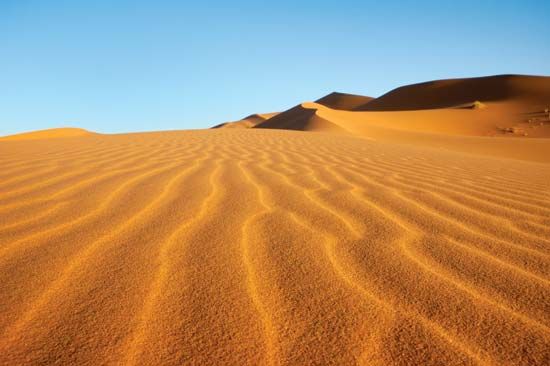
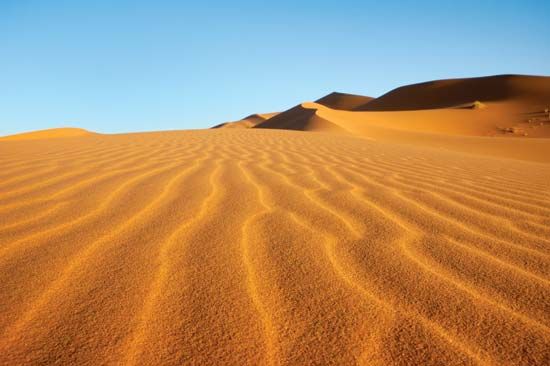
In a desert environment, an erg is a vast region characterized by a significant accumulation of sand. These areas are typically located in the bottom of large basins where ancient rivers deposited alluvium. Ergs consist of actively shifting dunes, “fossilized” dunes, or extensive sand sheets, making them challenging to traverse. Notable examples include the Great Western and Great Eastern ergs found in the Sahara.4
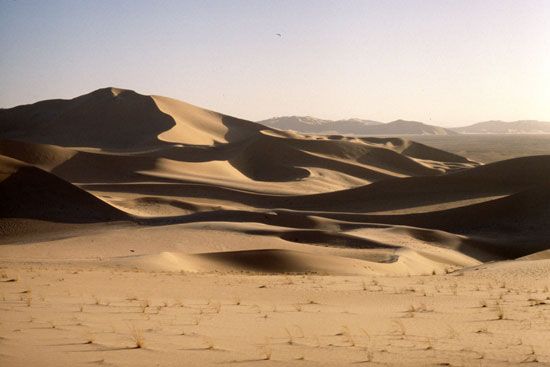
How do sand dunes form in an erg?
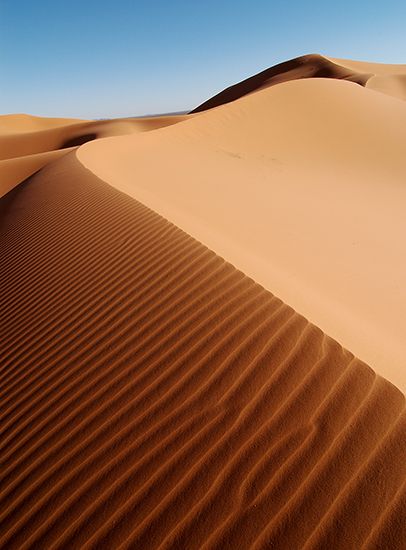
In an erg, sand dunes form through the complex interaction of wind, gravity, and loose sand grains. The process typically begins on a hard desert surface where slight hollows or smooth patches cause the wind to decrease its near-surface velocity, leading to the deposition of sand. Once a small patch of sand is initiated, it acts as a trap, attracting more grains and eventually building into a dune.6
The Mechanics of Growth and Movement
- Saltation: Most sand is transported as “saltating” grains—particles that bounce along the surface. These grains also trigger the movement of coarser particles through a process called creep.6
- Equilibrium: As a dune grows, its windward slope adjusts to the wind, increasing near-surface velocity to compensate for surface drag. Once this balance is reached, the dune stops growing in size.6
- Migration: On the leeward side, the wind separates from the surface, creating a “dead zone” where sand falls. When this slope reaches the angle of repose (approximately 32°), the sand slips down the face. This allows the dune to migrate forward as a whole, with sand being eroded from the windward side and deposited on the lee.6
Patterns in the Erg
In vast sand seas, dunes often form complex, hierarchical patterns. Regional wind variations, velocity gradients, and turbulence create diverse shapes, such as crescent-shaped barchan dunes or large compound dunes (also known as draa). These features can reach heights of nearly 200 meters and are often covered by smaller, secondary dune patterns and ripples.7
What is the difference between the CGS and SI systems of measurement?
The CGS (centimeter-gram-second) and SI (International System of Units) are both metric-based systems of measurement, but they differ in their base units and their application in modern science.
CGS System
The CGS system is an older, specialized system of units based on the centimeter for length, the gram for mass, and the second for time. It was historically used in scientific disciplines to simplify certain calculations, though it has largely been superseded by the SI system in general practice.11
SI System
The International System of Units (SI) is the modern, globally recognized decimal system of weights and measures. Adopted in 1960, it evolved from the earlier metre-kilogram-second (MKS) system to provide a standardized, highly accurate framework for science and technology.1213
The SI system is defined by seven base units:
- Length: Metre (m)
- Mass: Kilogram (kg)
- Time: Second (s)
- Electric current: Ampere (A)
- Thermodynamic temperature: Kelvin (K)
- Luminous intensity: Candela (cd)
- Amount of substance: Mole (mol)12
Unlike the CGS system, the SI system is defined by fundamental physical constants, such as Planck’s constant and the speed of light, ensuring consistency across all scientific fields.12
What are some other types of desert landforms besides ergs?
Besides ergs, which are characterized by vast accumulations of shifting sand, deserts feature a variety of other distinct landforms shaped by wind, water, and temperature fluctuations:
- Playas: These are flat-bottomed depressions found in interior desert basins. They are periodically covered by water that eventually evaporates or infiltrates the ground, leaving behind deposits of salt, sand, and mud. They are among the flattest landforms on Earth.17
- Yardangs: These are large areas of soft, poorly consolidated rock that have been extensively grooved, fluted, and pitted by wind erosion. They consist of alternating ridges and furrows that run parallel to the dominant wind direction.18
- Hammadas (or Hamadas): These are elevated, rock-floored, or rock-strewn desert regions. Unlike sandy ergs, hammadas are characterized by extensive rocky surfaces, often featuring isolated mountain remnants like buttes and mesas.1920
- Regs (or Gibber Plains): These are stony plains covered by desert pavement—a surface layer of coarse gravel and stones often coated with a dark, glossy patina known as “desert varnish”.21
- Arroyos (or Wadis): These are dry channels or steep-sided valleys that are subject to flash flooding during irregular rainstorms. They are significant agents of erosion and sediment transport in arid environments.211
Sources
- erg — Encyclopædia Britannica
- erg — Encyclopædia Britannica
- erg — Merriam-Webster
- centimeter-gram-second — Merriam-Webster
- joule — Encyclopædia Britannica
- sand dune - Dune and sheet patterns — Encyclopædia Britannica
- sand dune - Formation and growth of dunes — Encyclopædia Britannica
- sand dune — Encyclopædia Britannica
- sand dune - Winds — Encyclopædia Britannica
- aeolianite — Merriam-Webster
- measurement system - The International System of Units — Encyclopædia Britannica
- International System of Units — Encyclopædia Britannica
- SI — Merriam-Webster
- cgs — Merriam-Webster
- International System of Units — Merriam-Webster
- cg — Merriam-Webster
- yardang — Encyclopædia Britannica
- playa — Encyclopædia Britannica
- North American Desert - Geology — Encyclopædia Britannica
- Desert - Environment — Encyclopædia Britannica
- hamada — Merriam-Webster
- arroyo — Encyclopædia Britannica
- hammada — Merriam-Webster
Published on · 4 min read