The Sahara Was Once Green
The Sahara, currently the world’s largest hot desert, experienced a period known as the African Humid Period, during which it was a lush, verdant landscape…
What is The Sahara Was Once Green?
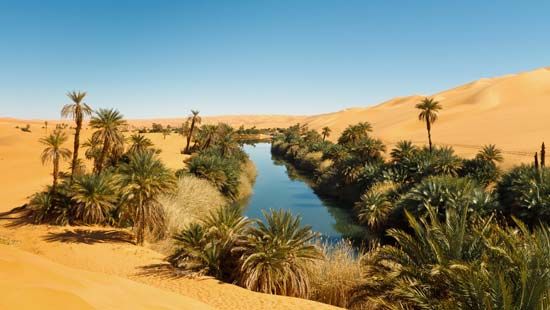
The Sahara, currently the world’s largest hot desert, experienced a period known as the African Humid Period, during which it was a lush, verdant landscape of grasslands, woodlands, and rivers. This green phase lasted from approximately 11,700 to 5,000 years ago.1
This climatic shift was driven by precession—the wobble of Earth’s axis—which altered the timing of the planet’s perihelion relative to the seasons. This change increased solar radiation in the Northern Hemisphere, strengthening the West African monsoon and drawing humid tropical air across the region. Evidence for these cycles, which have occurred repeatedly over the last 800,000 years, is found in ancient lake basins, marine sedimentary rock, and fossilized plant leaves.1
What are Milankovitch cycles and how do they influence Earth’s climate?
Milankovitch cycles refer to the long-term, cyclical variations in Earth’s orbital geometry that influence the amount and distribution of solar radiation reaching the planet’s surface. Named after the Serbian geophysicist Milutin Milankovitch, these cycles are fundamental to understanding historical climate change, particularly the pacing of glacial and interglacial periods.34
The cycles are driven by three primary astronomical parameters:
- Eccentricity: The shape of Earth’s orbit around the Sun fluctuates between nearly circular and elliptical over periods of approximately 100,000 and 413,000 years.34
- Obliquity (Tilt): The angle of Earth’s axis relative to its orbital plane varies between 22.1° and 24.5° on a 41,000-year cycle. A greater tilt increases the intensity of seasonal solar radiation in both hemispheres.34
- Precession: A 26,000-year “wobble” of Earth’s axis that changes the timing of the seasons relative to the planet’s position in its orbit (perihelion).31
By interacting on different timescales, these factors alter the seasonal and latitudinal distribution of solar energy, which can trigger significant climatic shifts, such as the expansion or retreat of ice sheets and the strengthening of monsoonal patterns.341
How do scientists use fossils and sediment to study ancient environments?
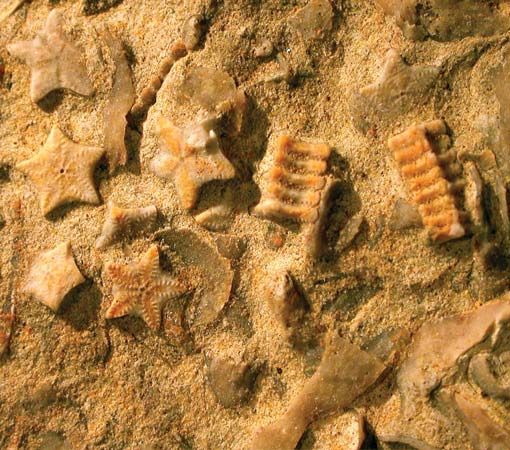
Scientists use fossil records and sedimentary deposits as natural archives to reconstruct ancient environments and climates. Because these materials record biological and geological processes over time, they serve as essential “proxy evidence” for conditions that predate modern instrumental records.5
Methods of Investigation
- Coring: Researchers collect cylindrical samples of sediment from lakes, bogs, and ocean basins. These cores provide a chronological sequence of materials, including clastic debris, organic matter, and chemical precipitates, which reveal past climate and environmental shifts.567
- Palynology: By analyzing pollen and spores preserved in sedimentary rock, scientists can determine regional changes in vegetation and forest composition, which are direct indicators of past climatic conditions.8
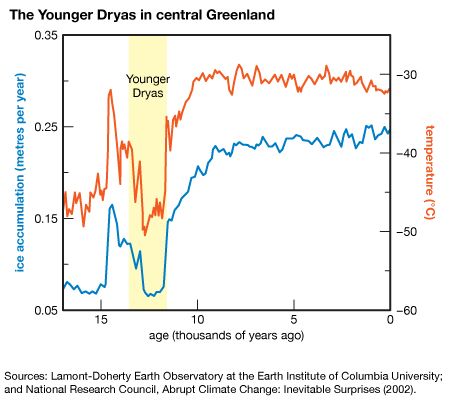
- Geochemical Analysis: Scientists study oxygen isotopes and chemical ratios (such as calcium-to-magnesium) within fossil shells or ice cores to estimate historical temperatures and ice volumes.910
- Fossil Assemblages: The presence of specific plant or animal fossils acts as an environmental indicator. For example, certain corals require specific water temperatures, allowing researchers to infer the climate of the site where they were deposited.11
By cross-referencing these multiple lines of evidence, paleoclimatologists can build a detailed history of Earth’s complex environmental changes.5
What is the West African monsoon and how does it affect the region today?
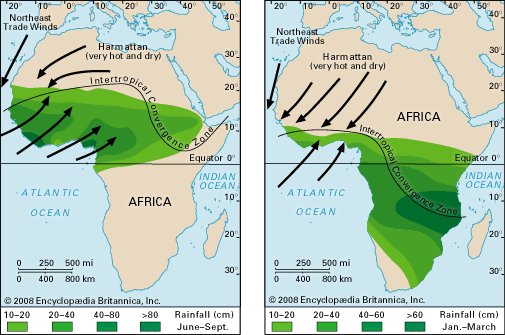
The West African monsoon is a major wind system that dictates the seasonal climate of West Africa between latitudes 9° and 20° N. It is characterized by the alternation of two distinct air streams: a moist, southwesterly flow during warmer months and a dry, northeasterly flow known as the harmattan during cooler months.12
Seasonal Dynamics
- The Wet Season: Driven by the southwesterly monsoon, this period brings humid air and significant rainfall. The intensity and duration of the rainy season vary by latitude, lasting longer in the south and becoming shorter toward the north.12
- The Dry Season: The harmattan, a deep stream of dry, dusty air originating from the Sahara and Sahel, dominates during the cooler months. It is characterized by extreme daily temperature ranges and low humidity.12
Regional Impact
The monsoon is the primary driver of West African weather, determining the availability of water for agriculture and ecosystems. Historically, the strength of this system has fluctuated; during the early Holocene, increased solar radiation amplified the monsoon, delivering enough moisture to transform the Sahara into a lush landscape of rivers and forests. Today, the monsoon remains a critical, though variable, influence on the region’s climate and environmental stability.121314
Sources
- The Sahara Was Once Green — Encyclopædia Britannica
- Sahel — Encyclopædia Britannica
- Climate change - Orbital ( Milankovich ) variations — Encyclopædia Britannica
- Milutin Milankovitch — Encyclopædia Britannica
- Climate change - Evidence for climate change — Encyclopædia Britannica
- palynology — Encyclopædia Britannica
- fossil record — Encyclopædia Britannica
- lake - Sediments and sedimentation — Encyclopædia Britannica
- ocean basin - Deep-sea sediments — Encyclopædia Britannica
- Quaternary - Paleoclimate — Encyclopædia Britannica
- Permian extinction - Temperature crises — Encyclopædia Britannica
- West African monsoon — Encyclopædia Britannica
- Monsoon — Encyclopædia Britannica
- The Sahara Was Once Green: Top Questions — Encyclopædia Britannica
- Climate change - Amplification of the Indian Ocean monsoon — Encyclopædia Britannica
Published on · 3 min read