Devils Tower National Monument
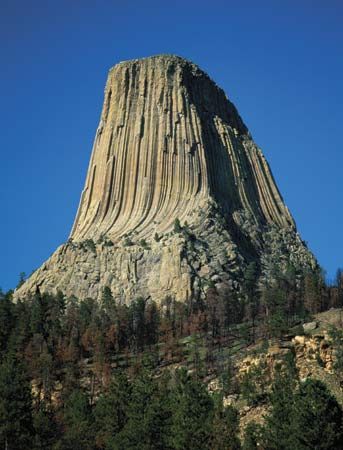
Devils Tower, located in northeastern Wyoming, rises 867 feet (264 meters) from its base, reaching an elevation of 5,112 feet (1,558 meters) above sea level.
How tall is Devils Tower, and what are its distinctive physical features?
Devils Tower, located in northeastern Wyoming, rises 867 feet (264 meters) from its base, reaching an elevation of 5,112 feet (1,558 meters) above sea level.12
The tower is defined by several distinctive physical features:
- Shape: It is a prominent, flat-topped rock formation covering approximately 1.5 acres (0.6 hectare).2
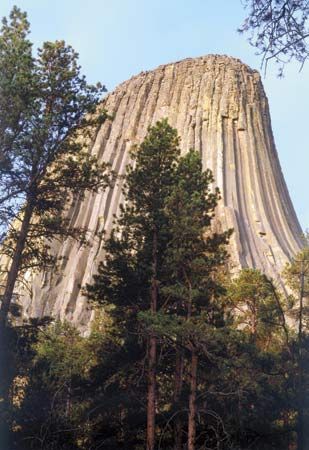
- Structure: The tower features characteristic fluted sides, which are the result of volcanic activity and subsequent erosion that exposed the harder igneous rock over millions of years.32
- Appearance: The rock is primarily light gray and buff in color, with patches of lichen covering parts of the surface.2
- Summit: The top supports a small ecosystem, including moss, grass, sage, chipmunks, and birds.2
Beyond its geology, the site is a sacred location for many Plains Indians, and it is essential to respect the cultural significance of this land alongside its recreational use.2
What is the cultural importance of Devils Tower to Native American tribes?
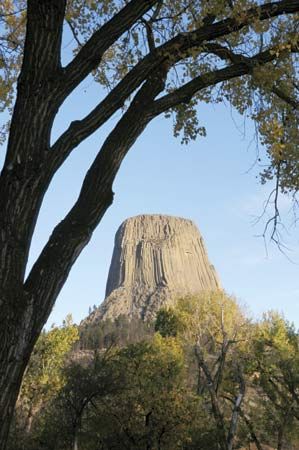
Devils Tower is a deeply sacred site for many Plains Indians, serving as a significant location for religious practices and ceremonies.31
The month of June holds particular importance in the Plains religious calendar, as it is a time when many individuals visit the site to conduct traditional services. This cultural significance has led to complex discussions regarding the use of the monument. Because June is also a popular time for rock climbing, conflicts have arisen between those who wish to climb the tower and those who believe the activity is disrespectful to the site’s spiritual nature.3
In recognition of these concerns, the National Park Service implemented a voluntary climbing hiatus program in 1995. While some individuals continue to climb during this period, many others choose to refrain out of respect for the religious traditions of Indigenous peoples. It is essential to honor the cultural heritage of this land and the spiritual practices of the tribes for whom it remains a sacred place.3
What unique wildlife can be found in and around Devils Tower National Monument?
The area surrounding Devils Tower National Monument supports a variety of wildlife adapted to the local environment, which includes a mix of pine forests and open terrain.
Notable wildlife found at the monument includes:
- Summit Dwellers: The flat top of the tower provides a unique, isolated habitat where chipmunks and various bird species reside.3
- Base Residents: A sizable prairie dog town is located near the base of the tower, serving as a prominent feature of the local ecosystem.3
- Surrounding Habitat: The surrounding country is characterized by pine forests, which provide cover and resources for diverse animal populations.3
While the monument is a small protected area, its diverse landscape allows for these species to thrive in the shadow of the geological formation.
How was Devils Tower formed and what is its geological significance?
Scientists generally agree that Devils Tower was formed through volcanic activity and subsequent erosion over 50 million years ago, though the exact mechanism remains a subject of scientific debate.2
The most widely accepted theory suggests that magma pushed upward from the mantle but was blocked by a layer of sedimentary rock near the surface. This forced the magma to spread horizontally, cooling underground into a pluton—possibly a laccolith—before the surrounding softer rock eroded away to reveal the tower. Other theories propose it is the “throat” of an ancient volcano or the result of a steam-driven explosion (a maar-diatreme volcano) that filled with lava.2
Geologically, the tower is significant for its distinct columnar jointing. As the igneous rock cooled, it contracted and fractured into polygonal columns, typically intersecting at 120-degree angles. The size of these columns is determined by the cooling rate, providing a visible record of the thermal history of the intrusion.4
Sources
- Devils Tower — Merriam-Webster
- How was Devils Tower formed? — Encyclopædia Britannica
- Devils Tower National Monument — Encyclopædia Britannica
- Black Hills — Encyclopædia Britannica
- joint — Encyclopædia Britannica
Published on · 3 min read