Dimorphodon
Dimorphodon was a primitive flying reptile that lived during the Early Jurassic Period, approximately 200 million to 176 million years ago. Fossil evidence…
When and where did Dimorphodon live?
Dimorphodon was a primitive flying reptile that lived during the Early Jurassic Period, approximately 200 million to 176 million years ago. Fossil evidence for this genus has been discovered in deposits located in England.12
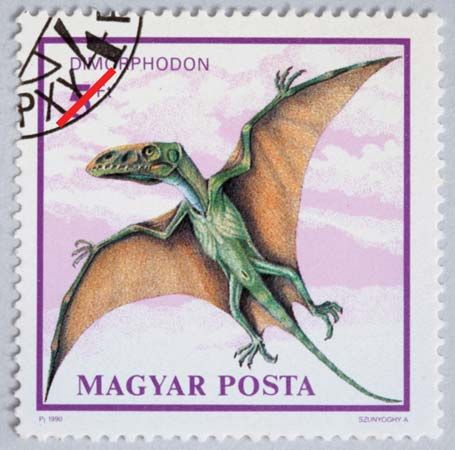
As one of the earliest known pterosaurs, Dimorphodon was well adapted for flapping flight, featuring a wingspan of about 1.5 to 1.7 meters. It possessed a distinctively large, lightly built skull and a long tail that likely provided stability while in the air. On the ground, it was capable of walking on its hind limbs, likely folding its wings similarly to modern birds or bats.12
How does Dimorphodon fit into the evolutionary history of pterosaurs?
Dimorphodon represents a significant stage in the evolutionary history of pterosaurs, the first vertebrates to achieve flight. As an Early Jurassic genus, it is classified among the basal forms traditionally grouped as “rhamphorhynchoids,” which were the earliest pterosaurs to appear in the fossil record.12
Its anatomy provides key insights into early pterosaur development:
- Flight Adaptations: Like other basal pterosaurs, Dimorphodon possessed a long tail that served as a stabilizer during flight, and it featured a large breastbone and a prominent crest on the humerus for the attachment of powerful flight muscles.1
- Locomotion: Its skeletal structure suggests it was well-suited for flapping flight, while its well-developed limbs indicate it likely walked on two legs on the ground, similar to its archosaur ancestors.12
- Morphology: It exhibited primitive traits such as sharply pointed teeth and a long tail, distinguishing it from the later, more advanced pterodactyloids that emerged in the Middle Jurassic.2
What are some unique adaptations that Dimorphodon had for flight?
Dimorphodon possessed several specialized anatomical features that made it well-suited for flapping flight during the Early Jurassic Period:
- Wing Structure: Its wings were formed by thin membranes of skin that stretched from an enormously elongated fourth finger on each hand to the hind limbs. This design allowed for the necessary surface area to generate lift.1
- Musculature and Support: To power its flight, Dimorphodon featured a large breastbone and a prominent crest on the humerus, which served as robust attachment points for its powerful flight muscles.1
- Stability: Like other early pterosaurs, it possessed a long tail that acted as a stabilizer, helping the animal maintain balance and control while in the air.1
- Lightweight Build: The skull was notably large but very lightly built with several wide openings, which helped keep the animal’s overall weight low—a critical requirement for efficient flight.1
What are the key physical characteristics of Dimorphodon?
Dimorphodon was a primitive pterosaur from the Early Jurassic Period with a body length of approximately 1 meter (3.3 feet) and a wingspan of about 1.7 meters. Its physical characteristics include:
- Skull and Teeth: The head was large, deep, and lightly built with several wide openings. It featured large, pointed teeth in the front of the jaws and smaller teeth toward the back. The eyes were notably large.1
- Wings and Flight Anatomy: The wings consisted of skin membranes stretching from an elongated fourth finger to the hind limbs. It possessed a large breastbone and a prominent crest on the humerus for the attachment of powerful flight muscles, as well as a long tail that provided stability during flight.1
- Limbs and Stance: The limbs were well-developed, with the first three fingers of each hand featuring large, grasping claws. It likely walked on two legs while on the ground, potentially folding its wings similarly to modern birds or bats.1
Sources
- Dimorphodon — Encyclopædia Britannica
- pterosaur — Encyclopædia Britannica
Published on · 3 min read